
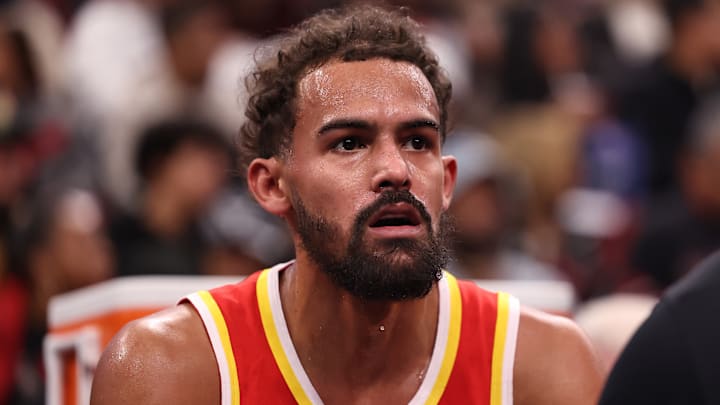
Just a few years ago, Trae Young was on top of the basketball world, having conquered Madison Square Garden and taken the upstart Atlanta Hawks all the way to the Eastern Conference Finals. Sure, his team had fallen short in six games against the eventual champion Milwaukee Bucks, but still: Young was one of the most explosive and singular offensive players in the sport, and he was just 22 years old. His, and Atlanta's, arrow was pointing squarely up, ready to challenge for the East for a decade to come.
Flash forward to 2026, and the Hawks, mired in 10th place in a weak East at 17-20, have signaled their willingness to dump Young on whichever team will take on the rest of his contract (which includes a whopping $49 million player option for next season). ESPN's Shams Charania reports that Atlanta and Young's reps are currently in the process of trying to find a trade, and the suitor with the most momentum at the moment is seemingly the Washington Wizards — with CJ McCollum's expiring contract heading back to the Hawks.
Atlanta is set on salary-dumping a player it once oriented itself around, a former No. 3 pick who signed a max extension that seemed to tie him to the Hawks for the long haul. It's among the more precipitous falls we've seen in recent memory. Which begs the question: Just how the heck did it happen? And is there anything Young can do to revive his career?
The fall of Trae Young: How it got this bad, and what comes next
Diminishing returns — especially on defense

Little did we know, it would be downhill from there both for Young and the Hawks. Young was never the most efficient scorer from the field, relying instead on the threat of his range and his tremendous passing and his ability to get to the free-throw line. But his shooting, both from 2 and from 3, got slowly but steadily worse after that 2021-22 campaign. And even more concerningly, the cracks in his profile started to show.
The Hawks swung big in the 2022 offseason, acquiring Dejounte Murray from the San Antonio Spurs (and forfeiting a trove of draft picks in the process). The idea was that Murray would put an elite perimeter defender next to Young while helping ease his offensive burden. Instead, all it did was bog Atlanta's offense down: Young showed very little interest in playing off the ball, leading to a your-turn, my-turn effect that was less than the sum of its parts.
That's been the conundrum of Young, at least since he burst onto the scene in 2021. He's a one-man offensive engine; guys who can shoot like he can and pass like he can and dribble like he can will always put stress on a defense. But Atlanta has been consistently awful on the defensive end since drafting him, as modern NBA offenses offer fewer and fewer places to hide an undersized liability — especially one who isn't always particularly engaged on that end of the floor. And in the end, what does all that really add up to?
The Hawks suffered two straight first-round exits after their ECF run and haven't been back to the playoffs since. It's fair to question how far you can go with Young as your best player, and the Murray experiment cast doubt on how willing he was to accept any other role.
Injuries have taken their toll
And that's when Young is able to stay on the court. He cleared the 65-game threshold four times across his first seven seasons in the league, and that's going to be four out of his first eight after a knee sprain cost him 22 games earlier this year. Young needs to maintain the threat of breaking down defenses and reaching the paint in order for his value proposition to work, but that's a hard life to live for someone of his diminutive stature.
And during his most recent stint on the sideline, a funny thing happened: The Hawks started looking better. Atlanta went 13-9 during Young's absence, then immediately lost their next seven games in a row upon his return. When Young doesn't have the ball in his hands, he doesn't have the movement skills or the werewithal to add value on the offensive end, and lord knows he's not adding value on defense. As he's come back from injury, he hasn't been able to shoulder his usual load, making him more a liability than anything — while a teammate proves far more capable of being the team's primary playmaker.
The Hawks might just be Jalen Johnson's team now

Young really might not be the Hawks' best offensive engine at this point, which is a damning thing to say about a player whose whole thing is generating offense. But what can I say: Johnson has just been that good so far this season.
This is a breakout years in the making; a former first-round pick in 2021, Johnson began his NBA career as a freakishly athletic ball of clay, his ultimate ceiling still unclear. But he's just kept adding more to his game, bit by bit, until all of a sudden he exploded: Despite a spike in usage rate this season, from 22.6% all the way to 26.9%, Johnson has actually gotten more efficient, shooting 52.6% from the floor and a career-best 37.7% from 3. He's averaging 24 points, 10 boards and 8.5 assists per game, all while providing excellent on-ball and help defense at 6-foot-8.
In short, he — not Young — is exactly the sort of player a team like the Hawks should want to build around. And it's increasingly looking like Johnson, not Young, is built to thrive in today's NBA.
The rise of a new kind of point guard

Not all that long ago, Young would have been considered something of a prototypical primary ball-handler: short, sure, and a weak defender, but an ace shooter and distributor whose flaws could be papered over. Increasingly, though, that's just not how the league works. More and more, teams are able to find those guys in all sorts of body types. Heck, they can even find role players who are still able to make plays with the ball in their hands, whether generating offense from a standstill or driving past closeouts.
There used to be an implicit understanding that teams had to sacrifice size for scoring and playmaking chops. These days, though, size is at a premium, and even bigger players are threats to put the ball on the floor, shoot or score. That leaves nowhere for someone like Young to hide on the defensive end: Even if you want to stick him on the opposition's least threatening offensive player, the odds are better than ever before that said player can still hurt him.
Just look at Young's long-time foil, the guy who the Hawks passed on in the 2018 draft: Luka Doncic. Doncic is also not the most gifted or motivated defender (to put it kindly), but he's at the very least big enough and strong enough to offer a little bit of resistance — and even more than that when he decides he wants to be engaged. That might sound like a minor difference, but it's not. The bar for short guards (really, anyone under 6-foot-3) is just so high now. And unless you can clear it — unless you can be such a relentless force offensively that it can dwarf your shortcomings — you simply can't be the best player on a title contender.
The looming specter of a new mega-contract
All of which brings us back to Monday's report, and goes a long way toward explaining why the Hawks are now willing to salary-dump a four-time All-Star and one-time max contract guy. Young is still a very good offensive player, but he's also an inflexible one, and he's not so good that he warrants the accommodations necessary. He's also not so good that he can get away with compromising his defense on just about every possession, as teams get better and better (and more and more capable) of hunting him.
Just a few years ago, a player of Young's pedigree would've been handed another max almost reflexively; that's just what teams did with their stars. Given the draconian nature of the new CBA, however, sacrificing that much of your cap space to one player can't be done lightly. And it definitely can't be done if said player hasn't proven that he's capable of getting you where you want to go.
Give Atlanta's front office credit. They didn't hem and haw, they didn't allow their hope for who Young could become or the wattage of his star power to cloud their vision. They know who Young is, and they know that it doesn't fit with the team they want to become, and so they're moving on — even if they don't get much of anything in return, as the rest of the league shifts its priorities.
Where will Trae Young play in 2026-27 and beyond?

At this point, it seems clear that Young can be had for pennies on the dollar. It's virtually impossible to construct a trade for him to a contender that would actually help a playoff push, and no one wants to be on the hook for the contract he's going to be demanding in the offseason. That does present an interesting buy-low proposition, at least for cellar-dwellers who don't have much else to do with their cap space for the present moment.
Maybe it'll be a team like the Wizards, or even the Sacramento Kings, in desperate need of some sort of identity no matter what it costs. Maybe Atlanta will be able to coax a would-be contender like the Bucks or Hawks to throw caution to the wind and see what happens. (I still think the Hawks are the most likely Giannis Antetkounmpo team, for what it's worth.) When a Young deal comes, though, it's going to be shockingly cheap, especially if he can't prove that he can be the sort of complementary star that an established core would actually like to play with.
And from there ... your guess is as good as mine. Young is still a walking top-10 (heck, maybe even top-five) offense, but the demands that come with that are pretty much disqualifying at this point. Will he take a bag from an also-ran just to keep getting his numbers up? Will he look inward, make a change and sign a shorter-term deal with a contender that will allow him to hit the market again once he's proved the doubters wrong? Whatever the case, it's been a stunning fall.
 Add us as a preferred source on Google