
It's a complicated time for point guards in the NBA. The league has evolved so much in recent years, putting an increased emphasis on the intersection between size and skill. The classic, "true" point guard, as we know it, is on its last legs.
Becky Hammon laid out this point in bluntly, but accurately, with a simple observation: small guards don't win championships. Not as the best player on their team.
In all of (semi-recent) NBA history, the exceptions are few and far between. Isiah Thomas? Stephen Curry? That's about it. There are great teams led by small guards, from Jalen Brunson and the Knicks today, to Allen Iverson and the Sixers in the early 2000s. But at the end of the day, almost without fail — save for perhaps the greatest shooter and off-ball manipulator ever — small guards simply cannot lead their team to the mountaintop.
That doesn't mean, of course, that small guards can't contribute to a championship team. Cason Wallace made his impact felt for OKC in June. Kyle Lowry was an elite third wheel on the Raptors in 2019. Fred VanVleet fit into a similar box. Point guards who can create and extend advantages from scratch — but who can also defend at the point of attack and scale down to fit various roles offensively — still have value. They just need to be thought of in a different light.
Welcome to Upside and Motor, a weekly NBA Draft column dedicated to analyzing the next wave of basketball stars, from blue blood sensations to those flying under the radar.
The 2026 draft could define the next era of NBA point guards

As Trae Young, Ja Morant and other "small" or "traditional" NBA point guards face early questions about their basketball mortality, the 2026 NBA Draft class features an exciting collection of, well, "small guards."
Mikel Brown Jr. (6-foot-4, 172 lbs.), Kingston Flemings (6-foot-3, 190 lbs.), Labaron Philon Jr. (6-foot-4, 177 lbs.), Bennett Stirtz (6-foot-4, 180 lbs.) and Darius Acuff Jr. (6-foot-2, 180 lbs.) all land in the top 15 of FanSided's most recent big board.
Potential second round picks and late risers include Anthony Robinson II (6-foot-2, 175 lbs.), Christian Anderson (6-foot-2, 165 lbs.), Ebuka Okorie (6-foot-2, 185 lbs.) and Tahaad Pettiford (6-foot-1, 175 lbs.), just to name a few.
All these guards are different in terms of role, skill set and approach, but the general consensus on so-called traditional point guards is that they need to A) elevate teammates and B) defend their positions well enough to stick in today's up-tempo, uber-athletic NBA. And all these guards, to varying degrees, have what it takes to carve out successful careers despite a fading archetype.
Setting expectations for the loaded 2026 point guard class
It's important to set expectations with the top point guards in the 2026 draft. Mikel Brown, Kingston Flemings, Labaron Philon and Bennett Stirtz are all potential top-10 picks in my book. And yet, history tells us that none of them are "best player on a champion" material. And that's okay.
There's a reason Flemings, despite his incredible efficiency and multilayered impact on one of the best teams in college hoops, won't be a top-3 pick, on par with the likes of Cam Boozer, Darryn Peterson and AJ Dybantsa. You can be a top-10 pick, even the best player on a young and rebuilding roster, and still be viewed long-term as a complementary star. A secondary building block. That nuance — and the understanding that true, 1A superstars are rare — is critical.
Bennett Stirtz

Bennett Stirtz transferred from Drake to Iowa, taking on his greatest challenge yet as a senior. So far, he has done exactly what he has always done: systematically dismantle lesser opponents. The only issue? Stirtz has struggled against better competition, including a 3-of-11 shooting performance against Iowa State.
iowa state frosh killyan toure made life hell for bennett stirtz, loaded with length, flexibility, fluid hips and tight footwork.
— Ben Pfeifer (@bjpf_) December 12, 2025
i tagged toure with 8 net def. impact plays/40 vs iowa, the third highest mark of any guard this cycle in a single game (DP vs miz, fland vs zona)! pic.twitter.com/GmCyq0vtlo
Stirtz has participated in an NCAA-leading 95 percent of Iowa's possessions this season. He's almost always on the floor. Head coach Ben McCollum, whom Stirtz followed from Drake to Iowa (after following him from Northwest Missouri State to Drake), has full faith in Stirtz as an offensive orchestrator. And for good reason.
You won't find a more visionary passer in the 2026 draft. That is Stirtz's superpower. He diagnoses defensive breakdowns and locates open teammates before his opponents have time to react, always several steps ahead mentally. Stirtz gets the ball up the floor quickly in transition, but he can also slow the Hawkeyes' offensive tempo to a crawl — on purpose. Iowa is happy to let Stirtz set up at the top of the key, dribble off a screen, and methodically worm his way into the teeth of a defense. He will eat up the clock, patiently create an advantage, and then pounce. His basketball spirit animal is a cobra. Wait, wait, wait — and then bam, a knockout punch.
Stirtz is a proficient pull-up shooter. He has an effective floater and the touch to finish among the trees at the rim. But NBA teams will question if Stirtz's skill set, as it exists, can translate.
My gut says yes, it can. But Stirtz needs to evolve. He won't be so ball-dominant at the next level. He won't be the single generative source for an NBA offense. Stirtz will need to apply his shot-making and passing in a more connective role, spotting up on the perimeter, delivering quick-hitting passes in motion, and learning to be a cog in the machine, not the whole machine.
He's smart enough to do it, and Stirtz is a much better defender than he gets credit for. But Stirtz is probably the best example of a "pure" or "traditional" point guard in the 2026 draft, and it's telling just how much NBA teams will want him to change.
Labaron Philon Jr.

Labaron Philon has blossomed into one of the best guards in college basketball as a sopohomore. He has seen a significant spike in both usage and efficiency, taking full advantage of the freedom afforded to him in lieu of Mark Sears. Philon is averaging 21.4 points and 5.3 assists on stellar .552/.415/.714 splits.
There's every reason to believe Philon can end the season as PG1 at his current rate of improvement. He's a slippery downhill guard, able to shift gears and create driving angles despite lacking an explosive first step. He's dexterous, damn near elastic, changing speed and direction as fluidly as a mountain goat scales a cliff. The footwork and touch around the rim is sublime. He's a real basketball poet.
So what does the next level hold for Philon, exactly? Last season was proof that he can operate — even thrive — in a secondary role. Philon's shooting leap should only aid him as he reliquishes control at the next level. He's great at attacking seams off the catch and extending advantages that way. He's comfortable operating out of pick-and-rolls and functioning as the head of the snake, but Philon is a combo guard at heart. That's not a derogatory statement.
The main concerns center on his frame, especially as it pertains to defense. Philon has bulked up his lower body as a sophomore, but he's still slender by NBA standards. For all his instincts and off-ball activity, can Philon actually handle the rigors of defending NBA guards? The answer to that question could determine his fate.
Philon will also need to prove that this shooting leap isn't a fluke (he's still inconsistent from the charity stripe and he shot 31.5 percent on 3s as a freshman). If Philon can hit 3s, slide on- or off-ball, and create havoc as a roamer defensively (to compensate for potential matchup issues), the future is bright.
Kingston Flemings

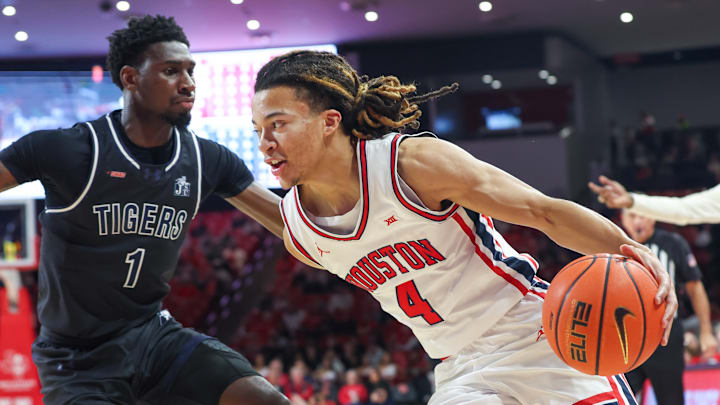
Kingston Flemings, a four-star recruit thought of by many as a 2027 or 2028 prospect coming into the season, has rapidly climbed draft boards as the starting point guard for a competitive Houston squad. The Cougars are as polished and fundamentally-sound a basketball team as there is in college basketball. Flemings has fit right in.
It's difficult to overstate just how impressive Flemings has been out of the gate. There remains a long season ahead, but Flemings is averaging 14.8 points on .606/.517/.759 splits through 11 games, averaging 29.0 minutes. Some shooting regression is inevitable, but what Flemings has thus far accomplished feels sustainable.
He's a spritely three-level scorer, mixing electric first-step explosiveness and downhill speed with shifty handles and a potent pull-up jumper. Flemings consistently pressures the rim (where he's a great finisher) and looks comfortable stoping on a dime in the mid-range. The free throw volume, or lack thereof, is a mild concern, but Flemings exhibits the sort of body control, vertical pop and touch that bodes well for his interior scoring profile long term.
What makes Flemings so easy to project toward the next level, however, is his versatility. He's not just an on-ball engine. Flemings can splash spot-up 3s, attack off the catch, and deliver slick passes in the flow of the offense. He operates with his head on a swivel and there's no fat on the bone. Every move, every decision, is executed with purpose. Flemings shares the backcourt with Milos Uzan and other talented guards at Houston. He can fit within a healthy team context.
So, Flemings is not the next Jalen Brunson or Trae Young-style, heliocentric offensive star. He's more adapatable, his contributions flexible based on a team's need. Pair that with efficient, three-level scoring, low turnover propensity and an active defensive profile — Flemings puts his bubbly athleticism to excellent use as a pickpocket and even as a help-side rim deterrent — and the Houston freshman has what it takes to survive and thrive in the NBA.
Mikel Brown Jr.

Mikel Brown Jr. is probably my favorite point guard in the 2026 draft, but he's also the riskiest of this bunch. The least "evolved," so to speak — not in terms of skill or IQ, both of which Brown has in droves, but in terms of approach and "fit" in the modern game. Brown is a slender guard who will face all the related defensive challenges at the next level. He also maps onto the Trae Young/Ja Morant archetype more than any other on this list, for better or for worse.
That is to say, Brown is very much the engine behind Louisville's offense. He will demand significant touches at the next level and attempt to impact winning by volume. He has countless star traits, but has also struggled immensely with efficiency. He's averaging 16.6 points and 5.1 assists on .381/.268/.838 splits through 10 games.
If your reaction to those numbers is angst or flat-out dismissal, fair enough. But Brown puts incredible pressure on the rim with his speed and physicality. He gets to the line a ton, despite a thin frame, and hits free throws at a high clip — a strong indicator of touch. The 3s aren't falling right now, but he's attempting 7.1 per game (over 14 per 100 possessions), often with a high degree of difficulty.
Brown's touch and volume suggests that he is a good shooter — and that he can warp defenses not only in college, but at the next level. He pairs deep range with the handles and quickness to beat closeouts, explode downhill out of pick-and-rolls, and force a defense into compromised positions. From there, Brown's passing vision and creativity pops. Taking age into consideration, Brown's playmaking profile challenges the very best in college basketball.
Typically the best point guards are those with elite pull-up jumpers, a high free throw rate and proficient distribution skills. Brown has a lower turnover rate (16.1 percent) than both Flemings (19.2 percent) and Philon (17.3 percent), on comparable usage. His shot-making variety compromises the defense at all times. The shooting splits will positive regress soon enough, as Brown gets more comfortable, and even the most ardent skeptics will be won over.
More NBA news and analysis:
 Add us as a preferred source on Google