
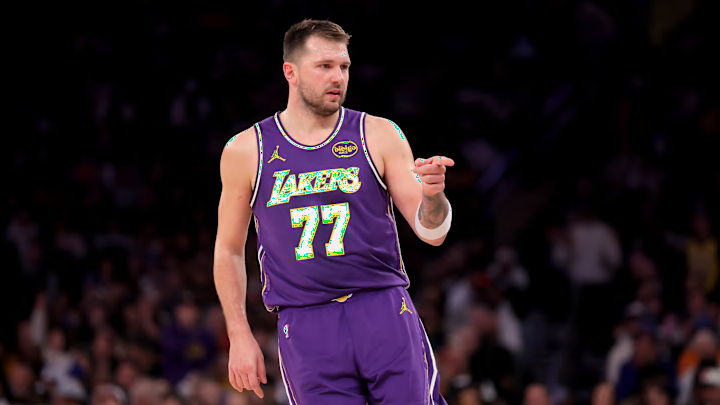
One year ago, the Dallas Mavericks pulled the trigger on one of the most controversial transactions in the modern history of professional sports. Then-GM Nico Harrison, seemingly under the cover of darkness, negotiated with old friend and Los Angeles Lakers executive Rob Pelinka on a deal that sent superstar player Luka Dončić to Los Angeles in exchange for a relatively uninspiring package of Anthony Davis, Max Christie, and a single first-round draft pick.
From there, the reactions were swiftly and decisively against what Dallas did, both in the choice to trade Dončić at all and also in the manner in which the Mavericks made the trade without gauging the rest of the NBA to further assess Dončić's value. Now, a year later, many retrospectives are in the works on what happened, and, in this space, we will look at the four major entities involved, assessing how things have gone since then.
Luka Dončić
The majority of the focus around the trade was on the Mavericks organization and Lakers organization, both of which are covered below. However, Dončić was also forced to uproot his (very) deep ties in Dallas, making the move to what is arguably the league's flagship franchise. Beyond that, Doncic is now playing alongside one of the best players of all time in LeBron James and under a completely different microscope.
To his credit, Dončić has responded well. The remainder of the 2024-25 season was something of a reset for Dončić who was not fully healthy for the majority of the campaign. Then, it was well-chronicled that he improved his physical conditioning over the summer, and as of Feb. 2, Doncic is leading the NBA in scoring while averaging 33.6 points per game. He is also averaging 8.8 assists per game, second-most in his career, and he is, full stop, one of the best offensive players in the world at age 26.
It is clearly true that the Lakers have more work to do to reorient their roster around Dončić in the way that Dallas did, but Dončić has a 61.6 percent true shooting for the season with the Lakers operating at an elite level on offense when he plays. Overall, things have worked out well for Dončić to this point, even if none of this was his choice.
The Los Angeles Lakers
The Lakers were afforded a tremendous opportunity in this situation. Pelinka deserves some credit for keeping things so quiet that the entire NBA world was shocked by the deal, but other than that, Dončić basically fell into the laps of Los Angeles.
So far, the Lakers probably draw an "incomplete" for how they've maximized Dončić. Last season, it was merely an evaluation period, and while the Lakers are overachieving their peripherals in 2025-26, they are winning at an encouraging level. Still, LeBron is still around, and the Lakers haven't been able to build the defensive infrastructure around Dončić that maximized him in Dallas on the way to the NBA Finals.
The Lakers are in a much better overall place organizationally than they were a year ago, both due to the trade and an ownership change. The question is how the front office will be able to build around Dončić to really drive home how fortunate the transaction was for the Lakers.
Nico Harrison
For many in Dallas, "Nico Harrison" is a two-word phrase that elicits quite a negative reaction. No matter the evaluation of Dončić as a player or franchise pillar, Harrison clearly made a grave error in not maximizing the trade return for Dončić. Then, he made things far worse with multiple sets of public comments that bordered on nonsensical.
The lead statement from Harrison seemed to be that "defense wins championships," seemingly pointing at a weakness of Dončić and a strength of Davis. Unfortunately for Harrison, Davis has not been durable, Kyrie Irving suffered a long-term injury, and, crucially, the plan never made any sense. For one thing, it narrowed the competitive window for Dallas and limited the overall ceiling of the team, all in one fell swoop.
After a slow start to the 2025-26 season, Harrison was relieved of his duties by the Mavericks. It is hard to blame leadership for taking that action, even if it should be said that ownership could have stopped the Dončić trade and simply did not. It will be interesting to see if Harrison works as an executive again, but the former Nike vice president is not exactly viewed in the best regard around the league after the Doncic maneuver.
The Dallas Mavericks
Since the trade, the Dallas Mavericks have a record of 33-50. Context is needed when assessing the team's performance on the floor but, as noted above, a big part of Harrison's move was to win now, and that clearly has not happened.
Yes, the Mavericks got some bad luck with Irving's injury, though the same can't really be said for Davis given his previous durability problems. To be clear, the Dončić trade would have been a (very) bad idea even if the Mavericks had on-court success in the short term, simply because of the long-term ramifications. But Dallas also flopping on the court paved the way for Harrison to be fired quickly and for a franchise reckoning.
For all of the bad luck around Irving's injury, the Mavericks got a massive bounce of good fortune when they won the 2025 NBA Draft Lottery despite having only 1.8 percent odds to do so. That allowed Dallas to draft Cooper Flagg, who looks to be a star in the making, and the Mavericks could land on their feet better than imagined as a result. Harrison made a few public comments pointing to that as part of the "plan" in Dallas, which made no sense with the long-shot nature of the lottery win, but the lottery gods did smile upon the Mavericks.
Still, they are just 19-30 this season and, even with the pending return of players like Davis and Dereck Lively from injury, there are real questions about the future in Dallas. Flagg certainly helps, but it is hard to go back to Feb. 2, 2025 and not wonder how things would look and feel for the Mavericks if Harrison simply didn't pick up the phone and call Pelinka.
More NBA news and analysis:
 Add us as a preferred source on Google