
Key Points
Bullet point summary by AI
- The 2026 Final Four features four top-nine teams in net rating, promising a slew of intense matchups.
- High-profile stars like Keaton Wagler, Jalen Bradley and Tarris Reed Jr. will need to win their individual matchups to give their teams a chance.
- These interplays of size and skill will determine who advances and gives their team a chance to compete for a National Championship.

The 2026 Final Four is nearly upon us, and this year's edition is set to be a wonderful one. While there aren't any traditional Cinderella stories, we do have four heavyweights ready to give us two prize fights. According to KenPom, all four of these teams sit in the top nine in net rating.
To celebrate this joyous occasion, we are here to bring you the four matchups that will ultimately decide the outcome of these two games.
Sign-up for Sling TV for the best of what NCAA College Basketball has to offer. Watch every upset, buzzer-beater, or nail-biting victory on TBS, TNT and TruTV.
Michigan vs. Arizona: Jaden Bradley Vs. Elliot Cadeau
Few sporting events have received this much hype since Muhammad Ali and Joe Frazier III squared off for a rubber match in the Philippines. Not only are these two teams the best in the sport, but because we have a clash of stylistical equals.
Both of these groups play a conservative style that involves a heavy-dose of drop coverage. They seek to omit all shots in the paint with their premier rim protectors (more on those gentlemen in a moment). They don't leave shooters, and they force teams into the most inefficient shot in basketball (midrange jumpers). Clearly, this approach has yielded each of these units some great results, as Michigan and Arizona are the No. 1 and No. 2 ranked defenses in the nation, respectively.
These are two nearly impenetrable defenses, with only one real weaknesses to poke at: guards who can take and make the shots they are willing to surrender at a high level.
This brings us to each team's lead pick-and-roll initiator: Jaden Bradley and Elliot Cadeau. When you have two teams who are so good at taking away the best shots in the game, it becomes a battle of shot-making.
The season-long numbers favor Bradley in this regard. According to Bart Torvik, Bradley has hit 45.1 percent of his 173 midrange jumpers. Meanwhile, Cadeau is shooting far worse (37.5 percent) on much lower volume (48 attempts). Still Cadeau has proven capable of some big scoring games in the past (eight games with 17 points or more this season), and in a single game sample, anyone is capable of getting hot. This particular game may just end up depending on which of these two lead guards hits more of these shots.
Michigan vs. Arizona: Aday Mara vs. Motiejus Krivas

As we alluded to earlier, both of these teams are quarterbacked by elite paint protectors. Between Aday Mara and Motiejus Krivas, we have two of the top 18 players in Defensive Box Plus-Minus and two of the top 51 players in block rate (per Bart Torvik).
Each of these teams has done a great job of keeping actions flat (meaning everyone stays on their man and no automatic advantages are conceded) and funneling the ball to their giants in the paint. However, just because both of these groups have turned the interior into a No Fly Zone, doesn't mean that these offenses are just going to roll over and forfeit that region of the floor altogether.
Arizona specifically has the third-lowest 3-point rate in the entire nation. But they are seventh in free throw rate, meaning that they live off attacks at the rim. Michigan's offensive shot diet is a little more balanced, but again, they are going to want to stampede the rim as much as possible.
This puts a lot of pressure on both of these starting centers to execute. Their positioning in drop coverage needs to be perfect, and they have to play strong defense without getting into foul trouble.
Here, Michigan has the clear edge. Mara's block rate is nearly five percentage points higher, and he is second in the entire nation in DBPM. He also commits 0.3 less fouls per 40 minutes (per KenPom). This may not seem like much, but in a game where the two teams are as evenly-matched as this one, a single possession could make all the difference.
Fortunately, Arizona has a little more insurance at the five spot, as they can also lean on senior bench big Tobe Awaka to come in and give them a different punch.
Connecticut vs. Illinois: Tarris Reed Jr. vs. Tomislav Ivisic

Few players have been as dominant this March as Tarris Reed Jr. In four tournament games, Reed is averaging 21.8 points, 13.5 rebounds, 3 assists, and 2.3 blocks on 64.2 pertcent true shooting. Reed has been one of the most dominant low post scorers in basketball (converting on 73 percent of his close twos/dunks), giving UConn a reliable safety valve when their motion offense isn't firing at all cylinders (more on this in a moment).
Reed has been an absolute force. However, Illinois has a 7-foot-1 center in Tomislav Ivisic that can match Reed's blend of size and strength. In general, Illinois touts a ton of size on the front line, and they foul less than every team in the country (19.4 percent opponent free throw rate -- over three percentage points lower than the second-best team), making them the perfect foil to Reed and the Huskies on paper.
On the flip side, Connecticut's only other big bodies in their main rotation are Eric Reibe (7-foot-1) and Alex Karaban (6-foot-8). This means they rely a ton on Reed to anchor their ninth-ranked defense. To his credit, he has done a tremendous job in this role (eighth in DBPM).
Still, Illinois may be his toughest test yet. They are absolutely relentless on the offensive glass Ivisic and David Mirkovic were in the top 25 in the Big Ten this season in individual offensive rebounding rate. As a team, they are third in the nation in this statistic. UConn's defense has tended to be vulnerable against strong crashing units, forfeiting second chance opportunities on more than 40 percent of misses in games against Florida, Duke, and Arizona this season (three of the other top five offensive rebounding teams in the league).
Can Reed overcome Illinois' bigs to continue his stellar stretch? And can he manage this while also keeping this tenacious Big Ten team off the offensive glass? The answers to these questions could ultimately decide how this game goes.
Connecticut vs. Illinois: Keaton Wagler vs. Silas Demary

If Michigan and Arizona are two peas in the same pod, Connecticut and Illinois are basically fire and water. In Connecticut, you have the manifestation of the perfect non-professional offense. Their offense is predicated on off-ball actions and side-to-side ball movement. On the flip side, you have Illinois, who has turned college basketball into the NBA with their isolation and pick-and-roll heavy attack.
The numbers are clearly in favor of Illinois here. UConn's offense has been good, but not great (28th). Meanwhile, Illinois has been the best offense in college basketball this season. However, more context is needed here. UConn's movement offense is something Big Ten teams don't have much familiarity with, as evidence by their ability to jump out to a 25-6 lead against Michigan State in the Sweet Sixteen. So, Illinois' edge in this category may not be as significant as raw offensive rating will lead us to believe.
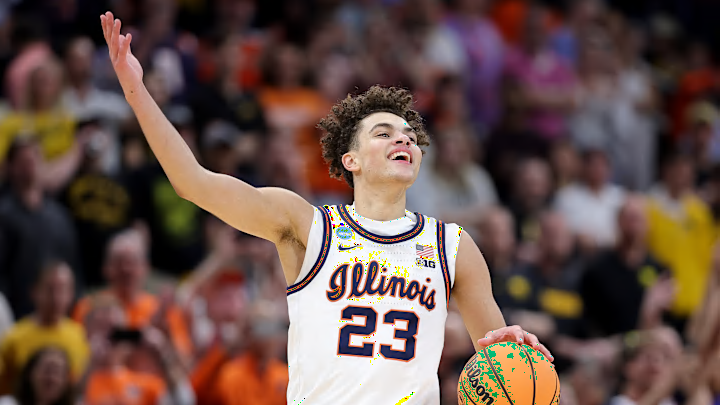
We are highlighting each team's lead creator for this matchup because, at the end of the day, March games are often decided by guard play. Keaton Wagler has been one of the best freshman in the country this year, averaging 17.9 points and 4.3 assists on a 59.7 true shooting percentage. Silas Demary isn't nearly the scorer he is (10.9 points on a 58.1 true shooting percentage), but he has been the better assist man (5.9 per game), and he does have experience on his side (this is his junior season).
Which offensive philosophy will win out? Egalitarianism or skill-ball? This very well may come down to which one of these guards does a better job of leading their troops.
More college basketball news and analysis:
 Add us as a preferred source on Google