
The Heisman Trophy is synonymous with college football greatness: the stiff-arm pose, the 45-pound bronze statue, the instant elevation into sports royalty. But while some winners become legends, others fade quickly from memory.
Ten winners have made the Pro Football Hall of Fame, but dozens more barely left a mark after their trophy moment. That’s especially surprising given how heavily the award now skews toward quarterbacks, even though only one Heisman-winning QB has reached Canton.
As this year’s finalists (Jeremiyah Love, Fernando Mendoza, Diego Pavia and Julian Sayin) compete for college football's biggest honor, it’s worth remembering the winners who didn’t stand the test of time. Before we focus on the future, let’s take a look at the past.
1. Dick Kazmaier
1951 Heisman Trophy winner
Princeton Tigers
This one is a little different than the others, but it deserves mentioning. Dick Kazmaier was really good during his senior season for Princeton University. The Ivy Leaguer was playing at a time when Blue Bloods were actually really good at football, but things were changing
Kazmaier is actually the last player who started at an Ivy League school to win the Heisman. He definitely deserved it, playing an incredible dual-threat offense. He often broke 100 yards rushing in the game while adding some decent passing stats. Kazmaier was a tactician on the field, and it showed in his work.
What’s bizarre about Kazmaier is he refused to give his football career a shot. He was drafted by the Chicago Bears in 1952, but he decided to go to Harvard Business School and join the Navy. Kazmaier never went back to his football career, and his name would slowly fade to history.
Right now, Kazmaier’s Heisman Trophy is sitting in a case at Maumee High School in Ohio. But what's cool: His legacy is actually in women’s sports. He helped create the Patty Kazmaier Award, named after his daughter, which is given to the top women’s ice hockey player at the Frozen Four.
2. Pat Sullivan
1971 Heisman Trophy winner
Auburn Tigers
Pat Sullivan was much more famous as a football coach than he ever was as a player, despite winning the Heisman Trophy. Sullivan has been the head football coach for TCU and Samford, but he played his football at Auburn.
On the field, he was a three-sport athlete who could have gone pro in both baseball and basketball if he focused his efforts there, but he chose football with the Tigers. He would take over the starting QB job in 1969. Despite being undersized, Sullivan was breaking NCAA records during his time with Auburn. He won the Heisman in 1971 after putting up 2,012 yards and 20 touchdowns. He finished his college career with 54 passing touchdowns and 18 rushing touchdowns, tying the NCAA record for most total touchdowns in a career (72, which has since been broken).
He was drafted in the second round of the NFL Draft by the Atlanta Falcons, and he had a fine career. He never made a Pro Bowl or even held a full-time starting job. He finished his NFL career with just five touchdowns against 12 interceptions. Not the type of career that gets remembered, but hey, I'd take it any day.
3. Andre Ware
1989 Heisman Trophy winner
Houston Cougars
Andre Ware broke the glass ceiling, becoming the first black quarterback to win the Heisman Trophy in 1989. He was an electric player for the Houston Cougars, leading all of Division 1 college football with 4,699 yards, 46 touchdowns and a ridiculous 427 yards per game. Houston's coaching staff asked Ware to carry this team, and he did just that with 578 pass attempts.
Ware's season is incredibly important to the history of college football. This was a kid who grew up in Houston, leading his hometown university to new heights despite facing NCAA sanctions. Ware didn't play in a bowl game during his Heisman season because of transgressions from a previous regime. Many don't talk about how important Ware is to changing how we see the quarterback position as one that is the ultimate athletic impact. Who knows if we get Heisman winners like Lamar Jackson and Jayden Daniels without Ware setting the standard for them.
Ware was the seventh overall pick in the 1990 NFL Draft. Unfortunately, he went to the completely mismanaged Detroit Lions, and his development was disastrous. He wasn't given any chance to play despite his draft stock, was forced to watch Rodney Peate and Erik Kramer play to losing seasons, and his stints with the Vikings, Raiders and Jaguars didn't even lead to one regular-season game played.
4. Gino Torretta
1992 Heisman Trophy winner
Miami Hurricanes
If anyone in the city of Miami is reading this, they are calling us insane. Gino Torretta is a legend in the Sunshine State, bringing two National Championships to the U (one as the starter). Torretta had these flashes for years on those insane Miami teams, but he finally got his full-time chance to start in 1991. In his two seasons under center, Torretta went 26-1. That's an insane record, and one we'd expected to live on in infamy.
But that's not exactly how Torretta is looked at in today's college football landscape. There are plenty of players who flame out in the NFL but are still considered some of the best college quarterbacks of all time. Guys like Matt Leinart, Johnny Manziel, Tim Tebow and Tommie Frazier are still given their due despite failing at the next level.
During his Heisman season, Torretta put up 3,060 yards and 19 touchdowns. He had some big games in big moments, but in the biggest moment, he faltered. Torretta was terrible in the Sugar Bowl against Alabama. The Crimson Tide showed him an 11-man front before sending guys into the secondary, severely confusing the senior. He threw three interceptions in the 34-13 drubbing. Still, the prior season, he beat Miami's rival Florida State to win the championship, and Miami remembers that a lot more than the Alabama game.
5. Rashaan Salaan
1994 Heisman Trophy winner
Colorado Buffaloes
Last season, Colorado Buffaloes superstar Travis Hunter won the Heisman Trophy as one of the best two-way stars we've ever seen. . His athleticism and impact were unlike anything most college football fans today have ever watched. The game is too hard to cover to understand two playbooks at all, let alone dominate both sides of the ball. It also came at Colorado, which isn't known as a "Heisman" school.
They do have a previous winner. In 1994, running back Rashaan Salaam had one of the best seasons in modern college football history. He rushed for 2,055 yards. At the time, he was just the fourth player to ever break the 2,000 yards rushing milestone. He added 24 touchdowns on top of it.
Colorado was starting to get a good handle on the Big Eight conference at the time. They hadn't had more than three losses in seven seasons, and they were getting to major bowls. They won a National Championship in 1990, winning the Orange Bowl to end the year. In 1994, they went 11-1 and finished the season third in the nation. However, an initial 1,000-yard season with the Bears was quickly followed by injuries and ineffectiveness. It got so bad that he was in the XFL in 2001.
6. Eric Crouch
2001 Heisman Trophy winner
Nebraska Cornhuskers
Oftentimes, video game covers allow players to gain a little bit of long-term notoriety that might not last without it. We still talk about Vince Young being on the cover of Madden. Joey Harrington is discussed from time to time after being on the cover of EA Sports' college football title. Heck, even Peyton Hillis has gained a little extra juice because of his Madden cover spot. However, it didn't work out that way for Eric Crouch, who had one of the strangest pro careers after a stellar college campaign.
Crouch joined the Nebraska Cornhuskers out of college, sticking to the home state. Crouch took over as starter in 1999 after sitting behind Bobby Newcombe to start the season. He went off and led Nebraska to the Big 12 title. He would be good his junior season, but the senior season should be considered legendary.
Crouch had 1,500 yards passing and 1,115 yards rushing in his senior year. He rushed for 18 touchdowns and three for seven more. He even completed 55% of his passes, showing he could be a quarterback at the next level in the right offense. That right offense never came, and a serious injury caused him to retire during his rookie season. He tried to come back with the Packers as a kick returner, but he retired before playing a game. Then he tried free safety, but the Packers cut him before the season. He tried one more time with the Chiefs, trying to play his way on the roster through NFL Europe, but he was released that June. Now, he's in sales in Omaha.
7. Jason White
2003 Heisman Trophy winner
Oklahoma Sooners
Jason White should be up there with the very best quarterbacks of the 21st century, but something was off there. White was amazing for the Oklahoma Sooners. He wasn’t flashy or anything. He was a typical pocket passer. It did help that he had Adrian Peterson next to him, but White did his part to make the Sooners a yearly contender.
Yet today, we don’t really think about him at all. White was the 2003 Heisman Trophy winner, putting up 3,846 yards and 40 (!!!) touchdowns. He was basically a given to throw a minimum of three touchdowns in a game. During the Red River Rivalry against Texas in his senior year, he put up one of the biggest butt-kickings we’ve ever seen in the rivalry. Despite being ranked No. 14 going into the game, Texas lost 65-13, with White throwing for four touchdowns.
White’s knee injuries defined him, however. It clearly hampered him at the end of the season, and it ended any thoughts of a professional career. He was not very effective in either National Championship Game, losing to LSU and USC, scoring just 14 and 19 points in each game. White is now more known for these lists, where people ask “what happened to Jason White,” than he is for his dominance on the football field. It’s a shame, really (and he’s a retail store owner in Oklahoma today, for those asking).
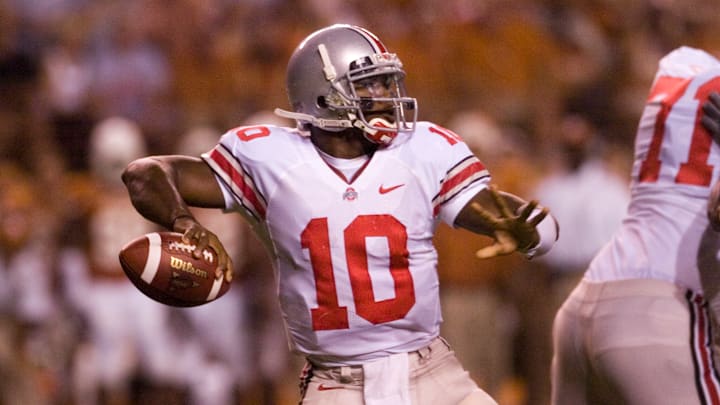
8. Troy Smith
2006 Heisman Trophy winner
Ohio State Buckeyes
Troy Smith had huge competition during his Heisman Trophy year, but he dominated the votes. Despite facing off against a record-setting Darren McFadden year at Arkansas and a superstar performance from Brady Quinn at Notre Dame, Smith got more than 91% of the first-place votes for the Heisman. That was a record at the time for most first-place votes.
Smith made a statement early, beating then-No. 2 Texas 24-7 in Week 2. He threw for 269 yards and two touchdowns in that game. Smith got better and better as the year progressed, showing the chops of a true No. 1 quarterback. He finished the season with 2,507 yards and 30 touchdowns against just five interceptions. Smith even finished the rivalry with Michigan with one of the most important performances in Ohio State history. He threw for 319 yards and four touchdowns in a 42-39 victory.
In the BCS Championship Game, Smith put up one of the worst performances we’ve ever seen. He threw for 35 yards. No, we’re not missing a digit there. Then, he rushed for -29 yards. Again, that’s not a typo. The quarterback of the Buckeyes contributed a total of six yards of offense, and there wasn’t even an injury to blame it on. In the NFL, he didn’t do much, either. And now, unfortunately, we're marking him a footnote to college football history.
9. Mark Ingram II
2009 Heisman Trophy winner
Alabama Crimson Tide
There are a lot of Heisman winners who fall by the wayside because of something they did wrong or a factor that impacts how we see them. Mark Ingram II just falls in the category of “not as good as his peers.” Ingram had a great college run and a good enough NFL career. He didn’t do anything nonsensical to impact his brand, and he walked away from the NFL on his own power. We love that for him.
We’d say the real issue is that he played for Alabama at a time when they had a new superstar running back on a yearly basis. Since Ingram’s insane 1,600-yard season in 2009, the Crimson Tide have had Trent Richardson, Derrick Henry, Eddie Lacy, T.J. Yeldon, Najee Harris, and Jahmyr Gibbs in the backfield. Some of them had memorable college seasons, while others have done very well in the NFL.
If you gave that list to most fairweather college football fans, which one do you think they would say won the Heisman Trophy? Where would Ingram land on that list? In the NFL, Ingram was mainly a quality backup, although he had a few 1,000-yard seasons. He was a bruiser and a beast, but it was inconsistent. Today, his legacy is kind of muted for someone who was so successful at a school like Alabama.
10. Kyler Murray
2018 Heisman Trophy winner
Oklahoma Sooners
There’s really no other way to explain Kyler Murray’s life in football than bizarre. He doesn’t have this terrible persona that shocks people or gets him in trouble with the law. The biggest issue people seem to have with him is he plays video games. He was an incredible athlete, even getting taken fifth-overall in the MLB Draft by the Athletics. Yet, we tend to forget how good he was at Oklahoma to get himself picked first overall in the first place.
Murray only played one season as a starting quarterback in college, but it was an incredible year. After watching Baker Mayfield win the Heisman Trophy, Murray repeated his performance. He completed 69% of his passes for more than 4,300 yards and 42 touchdowns. Those are cuckoo numbers from a guy who is considerably smaller than his offensive linemen.
This one might sound crazy to some reading this. Murray is technically a starting quarterback in the NFL. He might continue to be after this season. He does play in Arizona, which might be the most irrelevant NFL team as far as brand is concerned. He also can’t stay healthy, which has significantly impacted his career to date. Yet, when was the last time you thought about Murray’s career, let alone him being a Heisman Trophy winner?
 Add us as a preferred source on Google