
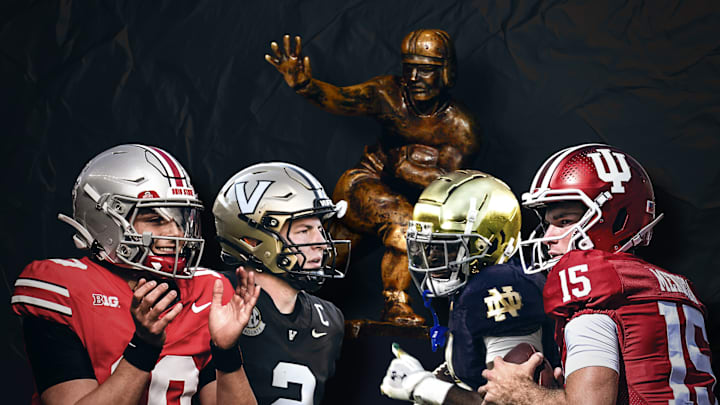
The 2025 Heisman Trophy winner will be revealed on Saturday night, ending the long debates over who is most worthy of college football's most prestigious award. Notre Dame running back Jeremiyah Love, Indiana quarterback Fernando Mendoza, Vanderbilt quarterback Diego Pavia and Ohio State quarterback Julian Sayin will be in New York hoping to take the bronze statue home with them. How exactly do we fairly determine which one it should be?
Heisman voters can use whatever criteria they want, from the eye test to a statistical deep dive. This is the latter. Let's breakdown every aspect of these football stars, from raw stats to advanced metrics to figure out the rightful winner of this year's Heisman.
- BOLD indicates leader among finalists
- *Indicates FBS leader
- ^Indicates conference leader
Total Offensive Production
FINALIST | PASSING YDS | RUSHING YDS | RECEIVING YDS | TOTAL YDS | TEAM YDS % |
|---|---|---|---|---|---|
Love | 0 | 1372 | 280 | 1652 | 0.300 |
Mendoza | 2980 | 240 | 0 | 3220 | 0.523 |
Pavia | 3192 | 826 | 0 | 4018 | 0.714 |
Sayin | 3323 | -2 | 0 | 3321 | 0.594 |
P4 Leaders | 3681 | 1560 | 426 | 4018 / 1821 | N/A |
There are a ton of advanced stats to take into account — and trust me we will — but sometimes simple counting stats say enough. Yardage matters. The more you rack up, the more you're helping your team.
All four of these players have totalled impressive yardage. Love was second only to Nebraska's Emmett Johnson in total yards from scrimmage. Sayin and Pavia each rank in the top 15 in passing yardage. Mendoza isn't far behind. Pavia trails only Georgia Tech's Haynes King in rushing yards for a quarterback in P4. Love is one of the most productive running backs in the country, not just on the ground but through the air. He ranks fifth in receiving yardage for a RB.
The Heisman is meant to go to the player with the most outstanding performance. Part of that is how much raw impact you had on your team. So we have to note that Pavia blows the rest out of the water in terms of how many of Vanderbilt's total yards he played a role in.
Counting stats can be deceiving, but in the case of the Heisman finalists, they're 100 percent legitimate.
Total Touchdowns Responsible For
FINALIST | PASSING | RUSHING | RECEIVING | TOTAL PTS | TEAM % |
|---|---|---|---|---|---|
Love | 0 | 18 | 3 | 126* | 0.326 |
Mendoza | 33* | 6 | 0 | 234* | 0.561 |
Pavia | 27^ | 9 | 0 | 216 | 0.577 |
Sayin | 31 | 0 | 0 | 186 | 0.553 |
P4 Leaders | 33 | 20 | 4 | QB: 234 | N/A |
If yardage matters, then touchdowns really, really matter. After all, points win football games. Driving down the field only matters if you can cap it all with a touchdown. True to form, the Heisman finalists have all contributed heavily to the scoreboard.
Mendoza leads all of college football with 33 passing touchdowns, a tally he added to with a score to beat Ohio State in the Big Ten title game. Adding six more on the ground makes him responsible for more total points than any other quarterback in the country. Measured against other running backs, Love also holds that title. The Notre Dame running back also ranks third nationally in rushing touchdowns.
When it comes to percentage of their team's scoring, Pavia takes the cake with his nine rushing touchdowns bolstering his lower passing total. He accounts for 57 percent of the Commodores points offensive points.
While Sayin matches up to Mendoza's passing numbers, his lack of run production holds him back in the counting stats. Lucky for him, he makes up for it in efficiency.
QB Efficiency Index
FINALIST | EPA/TOUCH | ADJ YPA | TD/INT RATE | RATING | PRESSURE RATE |
|---|---|---|---|---|---|
Mendoza | 0.273 | 10.66* | 10.4/1.9 | 181.4 | 0.294 |
Pavia | 0.276 | 9.92^ | 7.9/2.4 | 171.5^ | 0.354 |
Sayin | 0.351 | 10.32 | 8.7/1.7 | 182.1* | 0.288 |
P4 Leaders | 0.360 | 10.66 | 10.4/0.9 | 182.1 | 0.473 |
Counting stats don't always tell the whole story. Volume can be exaggerated by offensive philosophy or circumstances. That's where efficiency stats come in to help. What a player does on a play-by-play basis says much more about their quality than counting stats can dream of. Even better, efficiency stats give us an even better look at the context behind production.
Expected Points Added
EPA, or Expected Points Added, is a particularly useful measure. Based on historical data, EPA calculates the average points a team is expected to score from a given game situation. For example, a seven-yard gain on third-and-10 has a lower EPA than a two-yard gain on third-and-one.
Sayin leads the pack in EPA per touch, suggesting the scoring impact of his raw yardage. He's second nationally in that measure, but Pavia (7th) and Mendoza (8th) aren't far behind.
Adjusted Yards Per Attempt
It's a similarly tight race for the quarterbacks in adjusted yards per attempt. AY/A tells us more about the actual impact of each attempt by adding touchdowns, interceptions and sacks into the equation. Because a 10-yard completion at the 50-yard line is not more valuable than a two-yard completion into the end zone.
Mendoza leads the country in that value, which shouldn't be a surprise when you consider his touchdown-to-interception rate is one of the best in the country. It's also not shocking he's up with the best in passer rating, because it's a similar value to AY/A. However, it's Sayin who leads the nation in that measure.
Of course, nothing impacts efficiency quite like pressure. Mendoza and Sayin benefit from relatively average pressure rates while Pavia has dealt with more pressure in his face on a per play basis.
True Rushing Value
FINALIST | EPA/ATT | YAC/ATT | MISSED TACKLES | EXPLOSIVE RUN RATE |
|---|---|---|---|---|
Jeremiyah Love | 0.228 | 4.50 | 56 | 0.199 |
P4 Leaders | 0.304 | 4.59 | 86 | 0.212 |
We can't leave Love and the running backs out of the efficiency measures. Notre Dame's star back is up their with the best in just about every statistical category, including the advanced or specialized ones.
Love is that rare kind of back who is equal parts efficient and explosive. He ranks second among Power Four backs in EPA per attempt and explosive run rate. And he's a bear to bring down, ranking in seventh in missed tackles.
Level of Difficulty
FINALIST | SOS | DFEI | PFF PASS BLK | PFF RUN BLK | TIME TO THROW |
|---|---|---|---|---|---|
Love | 44th | 5th | 61st | 41st | N/A |
Mendoza | 29th | 3rd | 18th | 3rd | 2.68s |
Pavia | 25th | 50th | 130th | 86th | 2.85s |
Sayin | 28th | 2nd | 30th | 8th | 2.92s |
Heisman Trophy voters can get caught up in individual stats, but it's also important to take a look at the larger picture. A quarterback's life is easier if they're supported by an elite defense, rarely having to chase games or be put in situations where a single error means the difference between winning and losing. Running backs can only power the ground game so far if their offensive line doesn't block for them. And for all players, the strength of the opposition will impact counting and efficiency stats alike.
If the efficiency stats were a showcase for Love, Mendoza and Sayin, then measures of difficulty are Pavia's domain. The Vanderbilt quarterback faced off with six defensives rated in the top 20 of FEI, that's as many as Love, Mendoza and Sayin took on combined. He also had the least help from his offensive line and defense.
In fact, if there is one major difference between the four finalists, it's this: Love, Mendoza and Sayin have played alongside defenses equally as strong as their offenses, if not better. Pavia is the only Heisman finalist with a middling supporting cast.
Performance vs. Ranked Opposition
YPG | YPA | Rating | TD/G | INT/G | |
|---|---|---|---|---|---|
Love | 112.5 | 6.41 | N/A | 1.0 | N/A |
Mendoza | 218.5 | 8.1 | 137.61 | 1.0 | 1.0 |
Pavia | 230.7 | 7.5 | 136.22 | 2.0 | 0.66 |
Sayin | 205.7 | 8.2 | 156.45 | 2.0 | 0.66 |
P4 Leader | Pass: 332.9 | Pass: 9.9 | 162.46 | N/A | N/A |
It's one thing to play good teams. It's another to perform at the top of your game against them. So we've got to consider the performance of each finalist when facing ranked opponents. It's too easy to stack up statistical wins against cupcakes. Production against top teams reveals true quality.
All four finalists can hold their head up high for their performance in those games. Love still averaged more than 100 yards per game and six yards per carry. Pavia's yardage barely dipped. Sayin's yards per attempt and passer rating remained impressive. They each pass the quality opponent test in their own way. That's important as Mendoza and Sayin will be playing the best of the best in the playoff.
All-In Offensive Impact Scorecard
Love | Mendoza | Pavia | Sayin |
|---|---|---|---|
National Leader in Points for RBs | National Leader in Points for QBs | National Leader in Yards | Most Passing Yards |
No. 2 RB in P4 EPA Per Attempt and Explosiveness | Best TD/INT Rate | Highest Percent of Team Yardage | Highest EPA Per Touch |
No. 2 RB in P4 YPG vs. Ranked | Highest Adjusted Yards Per Attempt | Highest Yards Per Game vs. Ranked | Highest Yards Per Attempt vs. Ranked |
Shortest Time To Throw | Most Pressure Faced | Highest Passer Rating vs. Ranked | |
Worst Pass/Run Blocking | |||
Worst Defense | |||
Toughest SOS |
The truth is, it's exceedingly difficult to separate these players from one another. They're all exceptional. Declaring one better than the other is a Rorschach test, revealing more about what you value than anything. So here's what I value: Finding one single reason to pick one of them of the rest. Fortunately, the numbers have pointed me towards one.
Jeremiyah Love, Fernando Mendoza and Julian Sayin are great players, but none of them faced the kind of uphill climb that Diego Pavia did this year. Pavia kept up in nearly every statistic despite playing behind the shakiest offensive line and having to carry the worst defense while playing the hardest schedule.
All four of these players have run a marathon this year. They all crossed the finish line at more or less the same time. But one of them did it while wearing a weighted vest.
More CFB news and analysis:
 Add us as a preferred source on Google