
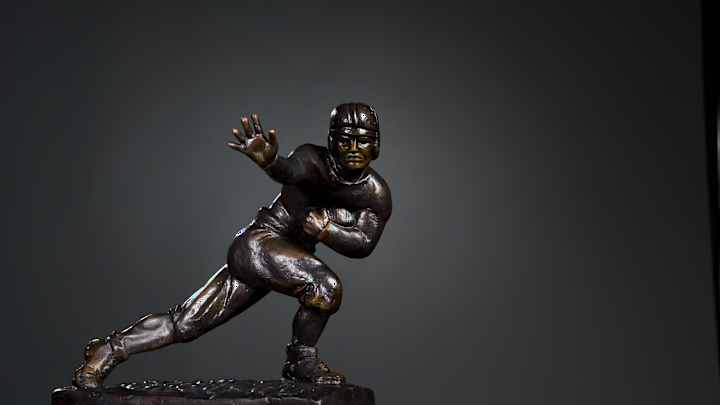
The system is rigged against Jeremiyah Love. No, the system isn’t targeting the Notre Dame star running back, but it is a system that’s not built to highlight the best player in college football. The system in question? The Heisman Trophy.
Love has been one of the best players in college football this year, yet quarterbacks have dominated the Heisman conversation. And that’s hardly new. In the past 25 years, only five non-quarterbacks have won the award; since 2016, only Travis Hunter (2024) and DeVonta Smith (2020) have broken through. It’s a dramatic shift from the Heisman’s earlier eras, when running backs and two-way stars routinely defined it.
The numbers make it undeniable: This is a quarterback award
YEAR | PLAYER | POSITION |
|---|---|---|
2024 | Travis Hunter | WR/CB |
2023 | Jayden Daniels | QB |
2022 | Caleb Williams | QB |
2021 | Bryce Young | QB |
2020 | Devonta Smith | WR |
2019 | Joe Burrow | QB |
2018 | Kyler Murray | QB |
2017 | Baker Mayfield | QB |
2016 | Lamar Jackson | QB |
2015 | Derrick Henry | RB |
2014 | Marcus Mariota | QB |
2013 | Jameis Winston | QB |
2012 | Johnny Manziel | QB |
2011 | Robert Griffin III | QB |
2010 | Cam Newton | QB |
2009 | Mark Ingram | RB |
2008 | Sam Bradford | QB |
2007 | Tim Tebow | QB |
2006 | Troy Smith | QB |
2005 | Reggie Bush | RB |
2004 | Matt Leinart | QB |
2003 | Jason White | QB |
2002 | Carson Palmer | QB |
2001 | Eric Crouch | QB |
2000 | Chris Weinke | QB |
The past five years have been more promising for skill players, but the fact remains: Quarterbacks run the award, and it’s unfair to the top players each season. After the conference championship weekend, should Fernando Mendoza, Julian Sayin or even Ty Simpson be favorites? Diego Pavia is rightfully in the mix, but has he been better than Love?
Even the finalists list tilts heavily toward quarterbacks. Names like Kenny Pickett, Max Duggan, Stetson Bennett and Dillon Gabriel weren’t bad college players, but hindsight makes you wonder whether they truly belonged over more deserving skill talent. And for defensive stars, the barrier is even higher.
This season alone, Marcel Reed, Ty Simpson, Diego Pavia, Fernando Mendoza, Dante Moore and Carson Beck all cycled through the Heisman favorites before Love ever entered the conversation. Meanwhile, Love rushed for 1,372 yards and 18 touchdowns — and still only recently drew legitimate attention.
Sure, quarterbacks influence the game more than anyone else. But a receiver or running back having a special season shouldn’t automatically elevate the quarterback alongside them.
Running backs, receivers and defenders don’t get consideration without historic seasons
It’s unfortunate that unless you have a historic season, you won’t even get considered for college football’s top award if you’re not a quarterback; even if you’re one of the best players that season. Look at Texas Tech’s Jacob Rodriguez. The Red Raiders jokingly brought him in on a wildcat play, throwing jabs at how disrespected non-quarterbacks feel about the award.
Aidan Hutchinson was a finalist back in 2021, but lost out to Bryce Young. Even Manti Te’o came up short back in 2012, though Johnny Manziel rightfully earned his Heisman that year. At the end of the day, you have to do twice as much work to get half as much consideration as a non-quarterback trying to win the Heisman.
Ashton Jeanty nearly broke Barry Sanders' single-season rushing record in order to be considered.
It feels like each year, we’re forcing quarterbacks to be Heisman winners rather than taking a blank slate and handpicking the best players, regardless of what position they play. Of the 79 players ESPN listed with preseason Heisman odds, there were just 17 non-quarterbacks. On that same list, of all the 20 players with the best odds, only Jeremiah Smith, Jeremiyah Love and Ryan Williams made the list as non-QBs.
Have modern offenses broken the awards?
Modern, pass-heavy offenses have only widened the gap. Quarterbacks operate more complex schemes, touch the ball every play and put up video-game numbers in systems built around them. That makes it easier for voters to default to QBs, and harder for running backs, receivers or defenders to win the award without a truly historic year.
Because of it, quarterbacks have garnered a lot more attention and give voters more to evaluate. That’s why they are put on an awards pedestal. The traditional workhorse running back isn’t the centerpiece of today’s offenses, so when players like Saquon Barkley or Jeanty have generational seasons, they still struggle to break through in voting.
It’s safe to say that modern offenses have taken the surprise out of awards. Unfortunately, the quarterback is going to be the most talked about player on every team, especially at the collegiate level. Until the Heisman voter base resets what value actually means in college football, skill players like Jeremiyah Love will always be climbing uphill, even when they’re the best player in the country.
More college football news and analysis
 Add us as a preferred source on Google