
College football is the best example of how amateurism has died in the NCAA. We might as well not call it college football but junior pro instead.
Players are paid via revenue sharing and NIL deals which essentially make them university employees in all but name. College football is a multi-billion-dollar industry through television rights, ticket sales and merch deals. The programs that can sustain constant postseason runs and national championship dynasties have additional streams of funding, usually from invested alumni.
As we enter the 2026 offseason, let's take a look at each Top 25 team's richest alumni and see who should be backing their alma mater in next year's title race.
The following list is based on FanSided's Way Too Early AP Top 25 projections and research into the net worth of the school's wealthiest graduates.
25. Washington
- Bill Foley, Golden Knights owner

Foley is a member of Washington's class of 1974 and quickly became a magnate in the world of finance. He bought Fidelity National Financial in 1984 and transformed it into the financial titan synonymous with most people's retirement plans and investments. He has an estimated net worth of $2.7 billion, according to Forbes, and is owner of the Las Vegas Golden Knights and part-owner of two international soccer clubs. The Huskies could use a chunk of change to be a contender in the Big Ten.
24. Houston
- Tilman Fertitta, Rockets owner
Fertitta attended Houston and Texas Tech but didn't graduate from either. He founded several business ventures but is most well-known as the owner of the NBA's Houston Rockets. Fertitta currently serves as the U.S. ambassador to Italy and has an estimated net worth of $10.8 billion, per Forbes. He could simultaneously fund two Big 12 members if he really wanted to.
23. Penn State
- Terry Pegula, Bills/Sabres owner
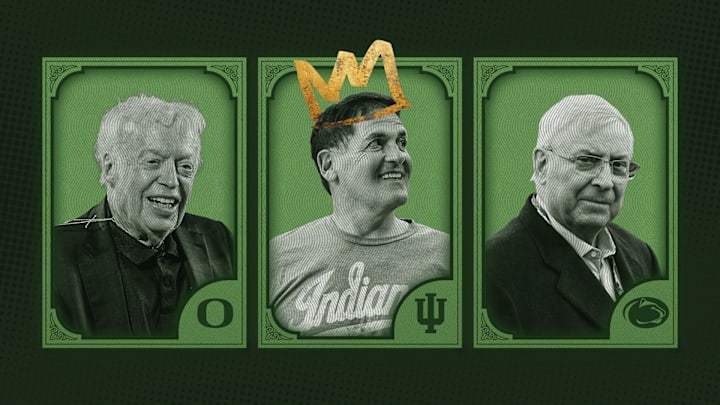
Best known as the cranky owner of the Buffalo Bills (NFL) and Sabres (NHL), Pegula has an estimated net worth of $9.3 billion. He graduated from Penn State in 1973 and made his fortunes in the fracking industry. Oil money goes far in sports, just ask Texas Tech. But with how poorly managed the Bills and Sabres are, the Nittany Lions would gladly just take his money and not his ownership skills.
22. Virginia Tech
- Hoda Kotb, television personality
While she's not the richest Virginia Tech alum, Kotb is probably one of the most well-known Hokies (class of 1981). She formerly co-anchored NBC's TODAY Show and now leads a life of podcasting and filing special reports for the network. She has a reported net worth of $30 million and while it may not seem like a lot, she's a passionate fan of the school and would bring some serious attention to an already fascinating rebuild under head coach James Franklin.
21. SMU
- Ross Perot Jr., real estate developer
The son of the late oil tycoon and unsuccessful presidential candidate Ross Perot, junior benefited from his father's wealth to start his own real estate businesses. The class of 1981 alum has a reported net worth of $6.5 billion and would seriously add to the already abundant funds of the football program (thanks to David and Carolyn Miller).
20. Iowa
- Mark Shapiro, media executive

A member of the class of 1992, Shapiro has a rough estimated net worth between $38 million and $50.3 million. He's got significant holdings in Live Nation and TKO Group so it's not like his assets are worthless in the long run. With that kind of investment in the entertainment world, he could plug his alma mater in with serious resources.
19. Tennessee
- Charlie Ergen, DISH founder
The class of 1975 alum has a reported net worth of $15.5 billion as a result of his work steering satellite and internet giant EchoStar. He also founded Dish Network, the satellite television subsidiary, and would have plenty to spare for his alma mater which is looking to stay relevant in a morphing SEC hierarchy.
18. Ole Miss
- Richard Scruggs, trial lawyer
Why not have one redemption story back another? Scruggs, a former trial lawyer known for beating the tobacco industry on multiple occasions, has an estimated net worth of $1.7 billion. He was disbarred for alleged bribery in 2007 but has climbed his way back to the good graces of Oxford since then. Just as Ole Miss is looking to avoid a regression in the post-Lane Kiffin era, Scruggs' generosity could go a long way.
17. Clemson
- Mohnish Pabrai, investor
Pabrai doesn't have a reported net worth but he manages over $1 billion in assets at his investment firm. It's unclear if he even has an interest in the Clemson football program but I'd be shocked if some light lobbying doesn't shake loose a few dollars from a former Tiger.
16. Utah
- Jon Huntsman, politician
It's not entirely clear what Huntsman's net worth is but he's clearly got cash on hand considering his family has already been donating to the Utes program for years. He previously served as U.S. ambassador to Russia (2017-19) and as the governor of Utah (2005-09). With a program looking to stay relevant after losing long-time head coach Kyle Whittingham to the Big Ten and Michigan, Huntsman's influence and funds could really help.
15. Alabama
- John S. Hendricks, Discovery founder
Hendricks technically attended Alabama-Huntsville but we'll count him anyways. He's the former founder and chair of Discovery, Inc. which ballooned into a television and entertainment giant that recently merged with Warner Bros. His net worth hasn't been pinned down but he's certainly near billionaire status by many estimates. Like Alabama really needs any more assistance but the Crimson Tide may be seeing cracks in their once-thought unbreakable dominance.
14. USC
- Marc Benioff, Salesforce founder

The CEO of Salesforce has a net worth of $7.7 billion and his company hasn't shown any signs of slowing down. He graduated from Southern Cal in 1986 and served as a university trustee. He's clearly a Trojan through and through, and just a drop of his fortunes would help head coach Lincoln Riley jump-start a stagnant program in the Big Ten.
13. LSU
- Todd Graves, Raising Cane's
We're cheating just a little here. The founder and CEO of Raising Cane's actually went to Georgia. However, he is so ingrained with LSU that we're going to call him an honorary alum. He was raised in Baton Rouge, first pitched the business plan for Raising Cane's in a friend's LSU business class and opened the first location practically on LSU's campus. He currently reflects a net worth of $22 billion. The best way Graves could help LSU football is by sponsoring the program and putting a logo patch on the team's jerseys. The popular fried chicken chain would be making a wise investment in a widely seen team on television during the season.
12. BYU
- Ryan Smith, Jazz/Mammoth owner
The current owner of the Utah Jazz (NBA) and Mammoth (NHL) has a net worth of $2.6 billion. Smith is well versed in the world of sports business and is passionate about his home state. His money and assets would have a huge impact on a program looking to get over the hump and claim its first Big 12 title after coming up painfully short in 2025.
11. Michigan
- Larry Page, Google founder
One would think Tom Brady would top this list but instead the co-founder and former CEO of Google and it's parrent company Alphabetis the most affluent Wolverine out there. His whopping $264.4 billion net worth provides ample ability to help Michigan blow past rivals like Ohio State in trying to reclaim the national title.
10. Miami
- Micky Arison, Heat owner

Arison is the former CEO of Carnival Cruises and has a reported net worth of $10.3 billion. While most folks would think Dwayne "The Rock" Johnson, a former Hurricane football player, would be the most involved, it seems Arison is more than equipped. He has won multiple titles as owner of the Miami Heat after all.
9. Texas A&M
- Arch "Beaver" Aplin III, Buc-ee's founder
The founder and CEO of the popular gas station giant Buc-ee's graduated from College Station in 1980. His net worth isn't publicly known but the company is worth billions and just continues to expand across the state and southern U.S. Aplin's generosity could also expand into logo patches on the Aggies' jerseys. Who would say no to that adorable beaver's face on the iconic maroon?
8. Oklahoma
- Harold Hamm, oil magnate
While Hamm didn't attend Oklahoma, he did receive an honorary degree from the university. His net worth is estimated at $16 billion thanks to his success in the oil and gas industry. The Sooners are on the cusp of returning to their former Big 12 glory but this time in the SEC and his funds could put them over the top.
7. Oregon
- Phil Knight, Nike founder
Probably the most well-known billionaire on this list, Phil Knight graduated from Oregon in 1959 and is best known as the founder of Nike. His $31.3 billion net worth has single-handedly kept the Ducks in the national spotlight for decades and has nearly produced a national championship or two. One day it'll all pay off.
6. Texas Tech
- Cody Campbell, oil and gas entrepreneur
Another oil-made billionaire, Campbell already is a man on a mission to get Texas Tech to the top of the college football world. The former Red Raider offensive lineman created an NIL fund that brought a lot of top talent to Lubbock and created the environment for Texas Tech to win the Big 12 and reach the College Football Playoff quarterfinal. It's a matter of time before we might be calling the Red Raiders national champions.
5. Indiana
- Mark Cuban, Mavericks owner

The guy best known for his appearances on “Shark Tank” and as the former owner of the Dallas Mavericks, Cuban put his money where his degree came from and it resulted in a national championship this season. He's got a reported net worth of $6 billion and hasn't shown any signs of slowing down in his investments — tech and sports-wise. Indiana's repeat bid could hinge on how much talent his money could rake in to replace the stars of the 2025 team.
4. Notre Dame
- Jay Jordan, private equity investor
The private equity firm manager doesn't have a publicly known net worth but he's part of a group of billionaires that have pledged to give away at least half of their wealth in life or at death. Jordan has been a top donor to the Fighting Irish and is a big reason why the football team is a perennial contender and has survived being an independent program for so long.
3. Ohio State
- Les Wexner, Bath & Body Works founder
Wexner is the co-founder of Bath & Body Works and Victoria's Secret. He and his family have a net worth of $9 billion and the class of 1959 alum has been a constant financial force in Columbus. Although, his recently revealed ties to the late convicted sex offender Jeffrey Epstein has cloudied his associations with the university.
2. Georgia
- Don Leebern Jr., Georgia Crown owner
The owner of a wholesale liquor empire, Leebern was known as one of the biggest athletic boosters in the country. He passed away in 2024 but his estate remains a boon to Georgia athletics. Leebern was a starting lineman for the Bulldogs in 1959, the same year the team won the SEC and the Orange Bowl.
1. Texas
- Robert Rowling, Omni Hotels & Resorts owner
Rowling, a massive supporter of the Longhorns, has his hands in many businesses. His career began in oil but branched into hospitality, owning the brand Omni Hotels. His estimated $9.2 billion net worth more than explains how Texas remains a premier football program, despite some slips in the last 15 years.
Other schools outside this list have their own mega-donors and wealthy alumni that should get in on the business. The investments in college sports will, indeed, speed up the rate at which amateurism is wiped from existence in the field but long taken advantage of athletes will get their share of what has already become one of the most lucrative American business ventures in modern history.
More CFB news and analysis:
 Add us as a preferred source on Google