
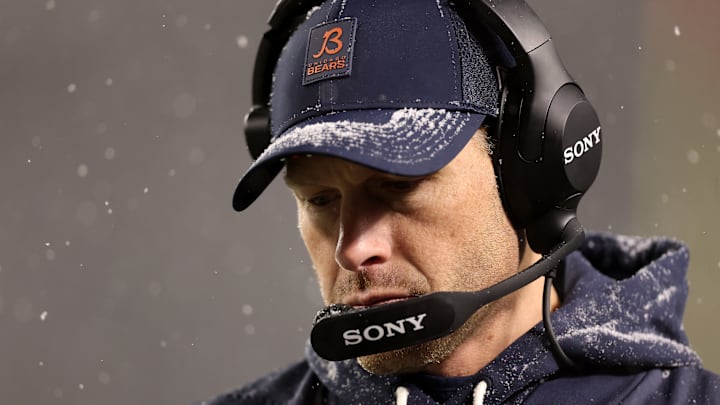
Rather than attempt a win-or-go-home two-point conversion after Caleb Williams' heroic touchdown pass to Cole Kmet with the Chicago Bears' season on the brink, head coach Ben Johnson elected to take the extra point, tie Sunday's game against the Los Angeles Rams, and try to advance to the NFC Championship Game in overtime.
The decision not to go for two raised some eyebrows in real time, especially when considering how magical this Bears' season has been, and only looks worse in hindsight, now that Chicago lost in overtime. With that being said, it's hard to argue against the decision Johnson made.
Why the Bears were right to go for the tie after miracle touchdown

A two-point conversion wouldn't have ended the game, but a failed attempt would have
This is the easiest justification for going for the tie, in my mind. Had the Bears converted the two-point conversion, their odds of winning the game certainly would've increased, but it wouldn't have been a done deal by any means. The Rams still had 18 seconds and two timeouts to work with, and they would've only needed a field goal to win the game.
Sure, Chicago's defense had been stellar all day, but giving the dynamic duo of Matthew Stafford and Sean McVay 18 seconds with a pair of timeouts and ample weapons to turn to and only three points to get feels a choice bound to backfire. The Rams' offense is the best in the NFL by virtually any metric. Matthew Stafford is probably going to win the MVP award. Puka Nacua might be the best receiver in the league. There are just too many reasons to expect the Rams to march down the field with their season on the line and find a way to get it done. We saw the Kansas City Chiefs pull off something similar just a couple of years ago against the Buffalo Bills. Of course, had the Bears missed on the attempt, the game would've been over.
Perhaps if there were no time on the clock, there'd be more of a reason to push the envelope and avoid overtime, knowing the Rams couldn't beat them had the Bears converted, but this was not the situation.
Odds were not on the Bears side to convert the two-point attempt

It was more surprising that the Bears, of all teams, didn't go for the win in this spot because Johnson is their coach. Johnson, a member of the Dan Campbell coaching tree, is as aggressive as they come when it comes to going for it on fourth down or on two-point conversions.
With that being said, the Bears were just 11th in the NFL in two-point conversion rate in the regular season and prior to that Williams miracle, had really struggled on fourth down in the playoffs. The Bears had also dropped numerous passes in this game, which was played in frigid temperatures. Johnson loves being hyper-aggressive, but that doesn't mean the Bears always convert when he is aggressive, especially against a Rams defense that looked good all day in less -than-deal conditions.
Maybe they would've found a way to convert the two-point attempt. The Rams were certainly in a state of shock after allowing a touchdown in that spot to begin with. Still, based on how they'd done for the most part on plays they had to have, the odds didn't feel on their side, at least enough to risk losing their season. With overtime to fall back on, why bother pushing the envelope?
Overtime rules were something for Bears to fall back on

The aforementioned Chiefs-Bills barnburner resulted in a rule change. Gone are the days when one touchdown automatically ends a playoff game. Now, each team is guaranteed at least one possession. Even if the Rams began overtime with a touchdown, the Bears would have a chance to then tie the game (or even win it with a touchdown and two-point conversion. Whether the Bears won the overtime coin toss or not, they'd have a shot to tie or win the game in the extra session.
If the Bears could have lost in overtime without getting a chance to touch the ball, I'd say they should've gone for two to end regulation. They'd still control their own destiny in this case, though. If they went for the tie.
What's even crazier about this whole situation is that Johnson going for the tie actually worked.
Ben Johnson's decision panned out in hindsight

Sure, we'll never know what would've happened had the Bears gone for two after that miraculous touchdown, but we do know what happened after he elected to go for the tie. The Bears got a key stop and had the ball in their hands with a chance to win.
After picking up three first downs in the ensuing possession, the Bears were seemingly a first down away from getting into Cairo Santos' range for a game-ending field goal. Caleb Williams throwing an inexcusable interception cost them that opportunity to win it, but that also wasn't exactly Johnson's fault. The Bears were driving and had a golden opportunity to win the game in overtime, even after electing to pass on going for the win in regulation.
There's only so much Johnson can control from the sidelines, and he had them in position to win this football game. His players failing to execute stinks, but that doesn't show that he should've gone for two in regulation. Hindsight is 20/20, and there were more reasons to go for the tie than the win at the time of the decision.
More NFL news and analysis:
 Add us as a preferred source on Google