
The NFL Combine might seem a bit silly from the outside; how much can we really glean about draft prospects from indoor drills in shorts and a t-shirt? But this is deadly serious business to front offices and scouts: At its core, pro football is a game of size, strength and speed, and Indianapolis is where those things are measured.
Some prospects, like Heisman-winning QB Fernando Mendoza, are so assured of their position in the 2026 NFL Draft that they don't have to sweat, or even really participate in, the Combine festivities. For others, though, this is a crucial opportunity to answer key questions and remove all doubt.
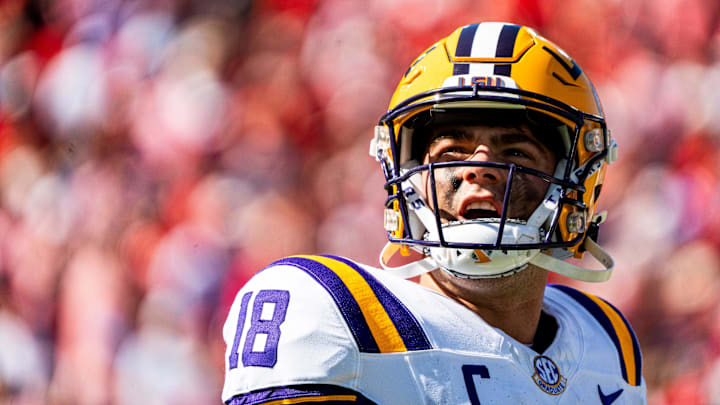
QB Garrett Nussmeier, LSU
The decisions of Dante Moore, LaNorris Sellers and Arch Manning to return to school for one more season has created a vacuum behind Fernando Mendoza at the most important position in the draft. We know from recent history that someone has to fill it — and why can't that someone be Nussmeier?
He appeared ticketed for a top-10 pick just a couple of years ago, when he threw for over 4,000 yards, 29 TDs and 12 picks in his first season as a college starter. But rather than go pro, he elected to return to LSU in 2025, and he and the Tigers offense struggled so mightily that he eventually lost his job.
There were whispers all season that Nussmeier was battling injury, and if that was true, he has an excellent chance to show it in Indy. No non-Mendoza QB in this class, not even Ty Simpson, can rival him for pure arm talent. If he puts on a show at the Combine, he could well find himself the second passer off the board. If he flops, his 2025 tape will only loom larger in evaluators' minds.
RB Nicholas Singleton, Penn State

Quick: Who's the No. 2 running back in this class behind Jeremiyah Love? Ask 10 different people, and you're likely to get 10 different answers, so wide open is this position right now. That chaos also creates an opportunity for someone to differentiate themselves with a big week at the Combine, and while there are plenty of potential candidates — Washington's Jonah Coleman especially — my money is on Singleton.
A five-star recruit under James Franklin, Singleton burst onto the scene as a true freshman, ripping off two big TD runs in a win at Auburn and cracking the 1,000-yard mark on the year. But he failed to make good on that sky-high potential over the next three seasons, alternating explosive plays with maddening inefficiency. Still, the athleticism that made him such a hot commodity in the first place is not in doubt, and all it takes is a big showing at the Combine to get scouts to start believing again.
WR Makai Lemon, USC

On the surface, Lemon would seem to check every box. He carried USC's offense in 2025, putting up 79 catches for 1,156 yards and 11 touchdowns, and his tape is full of highlight-reel plays. There's just one problem though: his size, with the SoCal native generously listed at 5-foot-11 and 195 pounds.
If he measures somewhere along the lines of fellow Trojan Amon-Ra St. Brown (6-foot, 202), we're all systems go. But if he comes in somewhere closer to 5-foot-10, you can bet there will be doubters coming out of the woodwork. As good as Lemon looked in college, it's hard to make a living in the NFL without hitting a certain size threshold, especially for someone who wasn't a pure slot receiver at USC and doesn't want to be one at the next level. The league is just too physical, and we've seen too many dynamic playmakers rendered gadget guys because of physical limitations.
WR Denzel Boston, Washington

Boston has something of the opposite problem. There are no questions about his physical traits: He more than looks the part at 6-foot-4, 209 pounds, and he dominated at the catch point throughout his time at Washington. But that's easier said than done at the NFL level, and scouts will also want to see whether Boston has the requisite athleticism (both straight-line speed and quick-twitch explosiveness) to separate against pro DBs.
Right now the jury is very much out. If you're a fan of a WR-needy team, you should be watching Boston's 40-yard dash and agility drills closely, because they could make the difference between a slam-dunk top-15 pick and someone fighting to go on Day 1.
OT Monroe Freeling, Georgia

It's all too easy to dream on what Freeling could be, especially in a draft class without a ton of no-doubt tackle prospects. He stands 6-foot-7, and he moves as well as you'd expect for someone who was a basketball star in high school, athleticism that helped him improve by leaps and bounds over his first year as a starter at Georgia in 2025.
If there's a drawback here, it's that he's still a bit young. That's true both in terms of a lack of experience and a lack of physicality: Freeling weighed in at just 315 pounds last season, which probably won't work against NFL edge rushers.
Then again, he's one of the youngest players in the draft — he was only on campus for the minimum three years — and it's hard not to wonder how high the ceiling is if he can add the requisite weight while retaining his fluidity of movement. If he crushes the Combine testing and proves that he's not as far away as it might appear on first blush, he could go from project to first rounder in a flash.
TE Oscar Delp, Georgia

Tight end feels a bit like running back in this year's class: There's one consensus top prospect (Oregon's Kenyon Sadiq), followed by complete chaos. There are intriguing receiving threats (Vandy's Eli Stowers, Houston's Tanner Koziol), and there are sturdy blockers, but no one who projects to be able to do both at a high level in the NFL.
Delp has the chance to change all of that. The numbers don't jump off the page — he never reached even 300 receiving yards in a single season at Georgia — but that has more to do with the offense he was playing in than any particular limitations on his part. When the Dawgs did see fit to get him the ball, big plays often followed, and all you have to do is watch him work with the ball in his hands to get a glimpse of his potential.
Think he has a chance to be a big riser post-combine. Watch the acceleration on this catch vs. Kentucky. https://t.co/oTOzup7IEW pic.twitter.com/NRn8xUu6kY
— Jordan Reid (@Jordan_Reid) February 16, 2026
The ability to move like that, while also being a credible blocker at 6-foot-5 and 245 pounds, is rare. If he proves the size/speed combination is for real at the Combine, he could be TE2 with a bullet.
EDGE Rueben Bain Jr., Miami

This one is very straight-forward. Bain was tremendous this year for Miami during their run to the national title game, racking up 9.5 sacks despite commanding constant attention on the edge. But he doesn't have the length of a traditional edge rusher at 6-foot-3, 275 pounds, and that unique build has scouts wondering whether his game will translate to the NFL or whether his future lies on the interior.
For Bain, the Combine comes down to two words: arm length. He needs to prove he's not a historic outlier in that department in order to convince NFL teams to sink a top-10 pick into him. If he comes in at something like 31 or 32 inches, a number with very few successful pro comps, that's a huge red flag no matter how great his college tape.
EDGE/LB Harold Perkins Jr., LSU

Perkins looked like a future star as a true freshman, terrorizing SEC quarterbacks with 7.5 sacks as an edge rusher. But his slight frame was enough for LSU to eventually shift him to off-ball linebacker, where he struggled to make full use of his athletic gifts over the next three seasons.
Granted, an ACL tear in 2024 didn't help matters, and he still has a lot of learning to do. He certainly isn't big or strong enough to make his living up front in the NFL, but he's also a special athlete. Where does his ultimate future lie? And can he ever make good on the potential he flashed in 2022? I wouldn't be surprised if he puts up big Combine numbers that force teams to take another look; he's that good of an athlete.
DT Peter Woods, Clemson

Like Nussmeier, Woods was ticketed for the top of the draft before he was even eligible to declare. Also like Nussmeier, he fell woefully short of expectations in 2025, struggling to make much of an impact for a shockingly soft Clemson defense.
Of course, all the physical tools, the incredible combination of size and explosiveness, are still there; it's not like the Monstars sapped his talent overnight. DTs are more important than ever in an NFL in which every defense wants to defend the run and get after the passer from light boxes, and Woods has every chance to vault to the top of a wide-open position group. He just needs to show scouts in Indy that he's still the player they thought he was two years ago.
CB Jermod McCoy, Tennessee

How high is McCoy's upside? He's being mentioned as a potential first-round cornerback despite missing all of the 2025 season with an ACL tear he suffered last January. He's reportedly back to full health now, and the Combine will be a crucial opportunity to show NFL teams that he hasn't lost any of the physical tools that made him look like a future shutdown guy on the outside. If he moves like his old self and puts injury concerns to rest, the sky is the limit.
S Emmanuel McNeil-Warren, Toledo

McNeil-Warren was an absolute star in college, racking up more than 200 tackles with eight forced fumbles, five interceptions and 13 passes defensed over four seasons. The only problem is that he did all of that at Toledo, raising questions about whether he's a product of lesser competition.
It's worth noting that he's had ample opportunity to prove it against the big boys (Kentucky, Louisville, Mississippi State) and has looked the part. But these sorts of biases have a way of lingering, and the best way for McNeil-Warren to put them out of teams' minds entirely is by showing out at the Combine — much like another former Rockets star, Quinyon Mitchell, did en route to becoming a first-round pick back in 2024.
 Add us as a preferred source on Google