
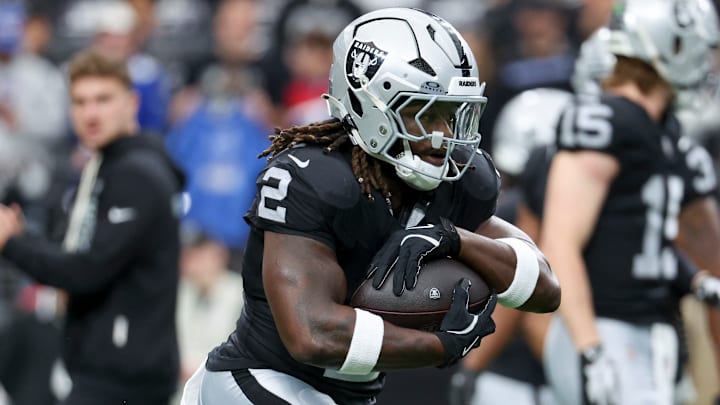
With just 87 yards on 26 carries in the Las Vegas Raiders' season finale against the Kansas City Chiefs, rookie running back Ashton Jeanty put a fittingly meh capper on what was a dud of a rookie season. The former Boise State star failed to reach 1,000 yards on the ground, averaging 3.7 yards per carry, while Pete Carroll and his staff frequently had him off the field on third downs — hardly what the team imagined when it spent a top-10 pick on him in last year's draft. Of course, anyone actually watching Jeanty play knows that he didn't just lose all of his abilities overnight, Monstars-style. Not even Walter Payton would've been able to do much with the miserable support Jeanty was given, a fact not lost on Raiders GM John Spytek.
"I know there's been a lot of narratives out there that he didn't have the season that maybe he deserved or you would expect from the sixth overall pick," Spytek said, via the team’s official website. "Well, that's fine, but it's not just Ashton. There's 10 other people that are out there with him, and it's our job to put a great group of guys around him to help him realize his potential."
Spytek's primarily worried about how to unlock his running back next season, but his quote can apply to any number of rookies in the 2025 draft class. Football is a team game, after all, and it can take time for even the most talented first-year players to find their footing. Jeanty's not the only one who deserves a bit of grace after a disappointing debut.
QB Cam Ward, Tennessee Titans

It's a sign of just how far NFL discourse has come that Ward's been given a decent amount of grace, despite the expectations that come with being the No. 1 overall pick and the ugly overall numbers for both he and the Titans offense. And yes, it is ugly: By just about every metric, Tennessee's passing game was about the least productive in the league this season.
Of course, a metric ton of context is required there. Ward's receiver group was a mess even before the injuries began, suffering from drops and general inconsistency. And the offensive line wasn't much better; in fact, it might even have been worse, forcing Ward to run for his life on a regular basis. But despite all that, despite losing his (underqualified) head coach midway through the year, a reel of Ward's best plays still matches up pretty well with those of Drake Maye, Caleb Williams and any of the NFL's most promising young QBs.
Cam Ward really put out an And1 Mixtape highlight reel pic.twitter.com/NQGQHno6NP
— ‘24/‘25 Tennessee Titans Survivor (@traviebird00) December 30, 2025
Williams feels like a relevant comp here, considering the dysfunction he was dealing with as a rookie and how quickly things changed upon the arrival of Ben Johnson in Chicago. Give Ward something similar — Kevin Stefanski, anyone? — and he could take off.
WR Emeka Egbuka, Tampa Bay Buccaneers

There's no getting around Egbuka's second-half collapse. Through his first nine games, he was sitting on 677 yards and six TDs and generally looked like a future All-Pro. Over his final eight? 261 and zero, respectively, as the Bucs fell all the way out of the playoffs.
I have a hard time holding Egbuka primarily responsible for the number above, though. For starters, the return of Mike Evans, Jalen McMillan and the rest of Tampa Bay's weapons was bound to lead to a decrease in production. But most importantly, it's impossible to talk about Egbuka without talking about the play of his quarterback: Baker Mayfield simply wasn't the same player after suffering a midseason shoulder injury, consistently spraying makable passes and running himself into negative plays.
Egbuka's route-running is still as smooth as ever, and he's still the remarkably versatile receiver he was over the first half of the season. What's more likely: That he forgot how to play overnight, or that poor QB play and a team in tailspin tanked his numbers? Bucs fans have a lot to be anxious about, but this isn't one of them.
EDGE James Pearce Jr., Atlanta Falcons

Two sacks in Week 18 nudge Pearce up to double-digits on the season, a great sign for any rookie pass rusher. The problem is that, when he wasn't getting after the QB on passing downs, he was either off the field entirely or so much of a liability that Falcons fans wished he was. He's a freak athlete with a lightning-quick first step, but he simply doesn't have the build or the bulk right now to be anything close to a three-down player.
All of which should be fine. The problem is the hefty price Atlanta paid (including their first-round pick in 2026) to trade back into the first round to take Pearce in last year's draft. It would've taken a Defensive Rookie of the Year type of effort, at the very least, to make good on that in year one, and Pearce was always the sort of player who was going to need some time and development to really take off.
If he'd been drafted by a team that was more ready and willing to be patient with him, or a team that had the defensive infrastructure around him to mask his limitations, we'd be singing his praises.
LB Jihaad Campbell, Philadelphia Eagles

Generally speaking, it's not a great sign when your first-round pick gets benched midway through your rookie season, as Campbell did when Nakobe Dean returned from injury in Week 12. And to be clear, Campbell is still far from a perfect player; you can tell how far he's yet to go when it comes to diagnosing plays and defending the pass at the NFL level.
But man, when Campbell can just put a foot in the ground and go, you see exactly why Howie Roseman was so excited to land him at the end of last year's first round. His explosiveness and ability to create big plays is truly rare, and he appears to have left the injury concerns that led to his draft-day fall fully behind him. Stop messing around with him at edge, let him focus on outside linebacker and run wild.
DT Tyleik Williams, Detroit Lions

It can be all too easy to label young defensive tackles as disappointments. It's a position of grown men, and not one that lends itself to impact that shows up in the box score. So it's understandable that Williams got written off as a bust midway through his rookie season, especially after the Lions' defense started leaking oil.
I'm still a believer, though. For starters, Williams started playing much better down the stretch, not just standing up against the run but also finally accessing some of the pass-rush juice he'd shown at Ohio State. (From Week 11 on, PFF graded him 25th out of 142 qualifying defensive tackles.) There was always going to be a learning curve at his position, and Detroit didn't help matters by sticking him behind a declining Alim McNeill and DJ Reader (not to mention a depleted linebacking core). He still looks like the player the Lions thought they were getting, and it wouldn't surprise me at all if he became a solid starter in year two. It might not be the position Detroit most needs help at, but well, that's hardly Williams' fault.
CB Will Johnson, Arizona Cardinals

Life is tough for any rookie corner, even more so when you have a hard time staying on the field and getting valuable reps. Sure enough, Johnson has been victimized by some of the league's best wideouts this season, from Puka Nacua to Drake London to CeeDee Lamb. Just look at the numbers, and it'll paint a pretty ugly picture.
That's to be expected for any rookie in his position, though. And it didn't help matters that Jonathan Gannon's scheme didn't allow him to utilize his rangy frame and excellent man coverage skills often enough. With another year of conditioning and weight work, and a defensive coordinator that puts him closer to the line of scrimmage and let's him go to work, the sky is the limit here.
More NFL news and analysis
 Add us as a preferred source on Google