
The odds suggest that this year's Super Bowl between the New England Patriots and the Seattle Seahawks will be a very close game, but that's far from a guarantee. Yes, more often than not, a matchup featuring the best team in the AFC against the best team in the NFC will be close. But still: There have been some major blowouts in Super Bowl history.
With that in mind, let's take a look at some of the most lopsided results in the history of the Big Game.
What's the biggest Super Bowl blowout of all time?

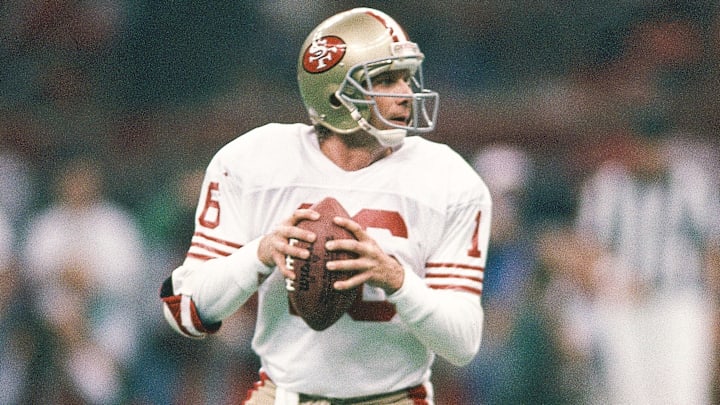
The most lopsided game in Super Bowl history caught just about everyone by surprise. Sure, the San Francisco 49ers were favored as the reigning champs with a 14-2 regular season record in the 1989 season, but the Denver Broncos had John Elway, one of the league's best quarterbacks, on their side. Unfortunately, this one was over before it really started: The first quarter ended with the Niners up 13-3, and by the time the first half ended, their 10-point lead had more than doubled.
The Niners led 27-3 at the break, and after intercepting Elway on the Broncos' first drive of the second half, they immediately scored again, increasing their lead to 34-3. The teams would trade touchdowns later in the third quarter, but the Niners refused to let up. San Francisco scored early in the fourth quarter, and then added another than two minutes later after picking up an Elway fumble. Both teams would turn to their backup quarterbacks soon after, with a final score of 55-10.
Not only did Joe Montana throw for nearly 300 yards and have five touchdown passes, but the Niners' defense intercepted Elway twice and forced four turnovers on the day. It was a dominant performance from start to finish, and one that I doubt will be topped in terms of the largest margin of victory anytime soon.
Five most lopsided Super Bowl results
Rank | Super Bowl (Year) | Final Score |
|---|---|---|
1 | Super Bowl XXIV (1989) | 49ers 55, Broncos 10 |
2 | Super Bowl XX (1985) | Bears 46, Patriots 10 |
3 | Super Bowl XXVII (1992) | Cowboys 52, Bills 17 |
4 | Super Bowl XLVIII (2013) | Seahawks 43, Broncos 8 |
5 | Super Bowl XXII (1987) | Redskins 42, Broncos 10 |
The biggest leads in Super Bowl history

We know about the most lopsided results, but what about in-game leads? Here are the largest leads at any point in a Super Bowl.
Rank | Super Bowl (Year) | Biggest Lead | Time of Lead | Final Score |
|---|---|---|---|---|
1 | Super Bowl XXIV (1989) | 55-10 | 13:51 left in 4th quarter | 49ers 55, Broncos 10 |
2 | Super Bowl XX (1985) | 44-3 | 3:48 left in 3rd quarter | Bears 46, Patriots 10 |
3 | Super Bowl XLVIII (2013) | 43-8 | 11:55 left in 4th quarter | Seahawks 43, Broncos 8 |
4 | Super Bowl XXVII (1992) | 52-17 | 7:42 left in 4th quarter | Cowboys 52, Bills 17 |
5 | Super Bowl LIX | 40-6 | 8:05 left in 4th quarter | Eagles 40, Chiefs 22 |
It should come as no surprise that four of the five largest in-game leads in Super Bowl history also made their way onto the list of most lopsided results in the history of the Big Game. There is one exception to this, though, and it came just last year.
The Philadelphia Eagles had perhaps the most impressive performance of any team on this list, as they jumped out to a 24-0 first-half lead — with 17 of those points coming in the second quarter. They held Patrick Mahomes and Co. off the board through three quarters and ran up the score to 34-0 before the Kansas City Chiefs finally got on the board. The Eagles built their lead back to 34 points midway through the fourth quarter, and despite allowing a couple of garbage-time touchdowns, won their second Super Bowl title very comfortably.
The most lopsided point spreads in Super Bowl history
As mentioned above, the odds suggest this will be a very close Super Bowl. But that's not always true, especially in years past when parity wasn't as well-established in the NFL as it is now. A look at the most lopsided point spreads in Super Bowl history, according to Odds Shark, will show just that.
Rank | Super Bowl (Year) | Point Spread | Final Score |
|---|---|---|---|
1 | XXIX (1994) | SF -18.5 | 49ers 49, Chargers 26 |
2 | III (1968) | BAL -18 | Jets 16, Colts 7 |
3 | XXXVI (2001) | STL -14 | Patriots 20, Rams 17 |
4 | XXXI (1996) | GB -14 | Packers 35, Patriots 21 |
5 | I (1966) | GB -14 | Packers 35, Chiefs 10 |
Super Bowl XXIX (49ers vs. Chargers)

The 1994 San Francisco 49ers have the honor of being the largest favorites in Super Bowl history, and they wasted no time when it came to living up to that -18.5 point spread. The Niners found the end zone on each of their first two possessions and ended the first half up 28-10. They poured it on in the second half, going up by as many as 31 points before a Chargers touchdown and two-point conversion made the score a bit closer than the game really was. The Niners covered the spread comfortably.
Super Bowl III (Jets vs. Colts)
In the eyes of many, the AFL was nowhere near as talented as the NFL in the late 1960s, and because of that, the Baltimore Colts of the NFL were heavily favored to beat the New York Jets of the AFL. But the Jets had other plans: Joe Namath wasn't quite at the top of his game, but New York's defense forced five turnovers (including four interceptions) while Jim Turner drilled three of his five field goal attempts in New York's 16-7 victory. That's right, the 18-point underdogs wound up winning this game by two scores. How about that?
Super Bowl XXXVI (Patriots vs. Rams)

Speaking of massive upsets, not many believed that the New England Patriots were capable of keeping up with the St. Louis Rams team known as "The Greatest Show on Turf." Not only did the Patriots keep up with them, but Tom Brady and Co. led most of the way. And even amid a furious Rams fourth-quarter comeback, the notoriously poised Brady led his team back into field goal range with just 90 seconds to work with, prompting Adam Vinatieri to win the Super Bowl and complete the upset with a 48-yard kick.
Super Bowl XXXI (Packers vs. Patriots)
Not only were the Green Bay Packers the best team in the NFC throughout the 1996 regular season, but they won their first two playoff games by a combined score of 79-16. As a result, they were massive favorites over a Patriots team that hadn't yet added Brady or Belichick (and that had yet to win a single Super Bowl). Drew Bledsoe helped get the Patriots off to a fast start, and New England even led 14-10 at the end of the first quarter. But the Packers would lock in from there, outscoring the NEw England 17-0 in the second quarter and 25-7 the rest of the way while just barely covering the 14-point spread in the process.
Super Bowl I (Packers vs. Chiefs)

Part of the reason why many assumed Super Bowl III would be a blowout is that Super Bowl I had been just two years prior. The Packers were 14-point favorites over the AFL champion Kansas City Chiefs, and wound up covering that spread with ease. They were only up by four points at the end of the first half, but outscored Kansas City 21-0 in the second half, locking up the first-ever Super Bowl win in the process.
More NFL news and analysis:
 Add us as a preferred source on Google