
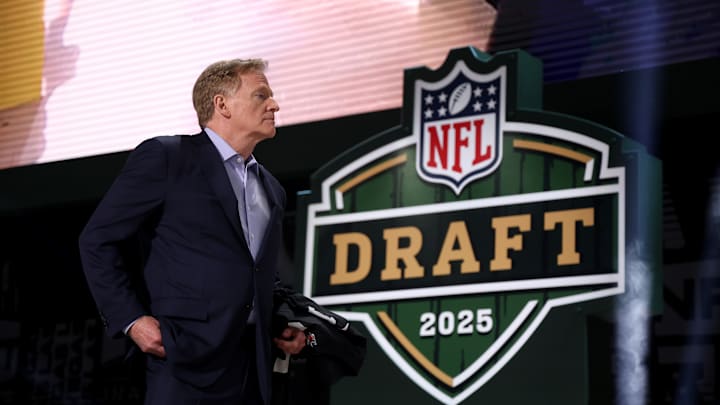
For four lucky fan bases, the 2025 NFL season continues on, with one more win needed to punch their ticket to Super Bowl LX in Santa Clara. But for the rest of the league, it's already on to the offseason — and that, of course, means preparing for the 2026 NFL Draft.
On the surface, determining the draft order would seem to be a pretty simple exercise: Teams are arranged in reverse order of their win-loss record in the previous season, with the worst record picking No. 1 overall, the second-worst picking at No. 2 and so on. But the reality is much, much more complicated. How does the NFL handle ties in the standings? Why are there so many extra picks? And how do trades factor into all this? You've got questions, we've got everything you need to know to become your group chat's draft expert.
Full list of NFL Draft tiebreakers
The draft operates a bit differently than tiebreakers to determine, say, playoff seeding. If two teams finish the previous season with identical records, their draft order is determined not by head-to-head record but by strength of schedule: The team with the lower combined opponent winning percentage will get the higher pick.
What happens if the two teams in question have identical opponent winning percentages? The answer depends on whether they share a division or a conference. If they do, then the usual divisional or conference tiebreakers apply, just like playoff seeding but in reverse (with the team that loses each tiebreaker being awarded the higher pick).
If teams share the same division
Divisional tiebreaker rules apply here. But keep in mind that it's the team on the losing end of each of these — e.g., the team that lost the head-to-head matchup, or with the worse record in divisional games — that "wins" the tiebreaker and picks first.
- Head-to-head win percentage
- Record in divisional games
- Win percentage in games against common opponents
- Conference record
- Strength of victory (average winning percentage of the teams each team has beaten)
- Strength of schedule
- Combined conference ranking of points scored and points allowed
- Combined overall ranking of points scored and points allowed
- Point differential in common games
- Point differential overall
- Touchdown differential overall
- Coin flip
If teams share the same conference but not the same division
Conference tiebreaker rules apply here. But keep in mind that it's the team on the losing end of each of these — e.g., the team that lost the head-to-head matchup, or with the worse record in divisional games — that "wins" the tiebreaker and picks first.
- Head-to-head sweep
- Record in conference games
- Win percentage in games against common opponents
- Strength of victory (average winning percentage of the teams each team has beaten)
- Strength of schedule
- Combined conference ranking of points scored and points allowed
- Combined overall ranking of points scored and points allowed
- Point differential in common games
- Point differential overall
- Touchdown differential overall
- Coin flip
If teams are in different conferences
If the two teams are in different conferences, though, the list of tiebreakers changes a bit. Head-to-head record is still the first tiebreaker, with common games after that.
- Head-to-head record, if applicable
- Win percentage in games against common opponents (minimum four games)
- Strength of victory (average winning percentage of the teams each team has beaten)
- Combined overall ranking of points scored and points allowed
- Point differential overall
- Touchdown differential overall
- Coin flip
How trades affect the NFL Draft order

Of course, anyone even a little bit familiar with the NFL Draft knows that the order in terms of win-loss record is never what the order actually winds up being when the first round finally arrives. That's because, unlike MLB, each one of a team's draft picks is also a trade asset — and unlike the NBA, teams are allowed to move as many picks as they want at any given time.
Teams can negotiate trades at any point leading up to or during the draft, with the ability to swap future picks or players whose rights they currently hold. Just how willing teams are to part with draft capital depends on any number of factors, but we've already seen several trades shake up this year's first round.
The Micah Parsons trade
- Packers receive: EDGE Micah Parsons
- Cowboys receive: DT Kenny Clark, 2026 first-round pick, 2027 first-round pick
Everyone assumed that the Cowboys would eventually agree to a contract extension with their best defensive player and one of the very best in the entire league, even after Parsons got so fed up that he demanded a trade. But we should never underestimate the stubbornness of Jerry Jones: Dallas' long-time owner instead decided to send Parsons to his NFC rivals in Green Bay exchange for Clark and two first-rounders. They'll now pick at No. 12 and No. 20 in the 2026 draft, although most Cowboys fans would probably rather just have Parsons back.
The Sauce Gardner trade
- Colts receive: CB Sauce Gardner
- Jets receive: WR Adonai Mitchell, 2026 first-round pick, 2027 first-round pick
After a scalding start to the season in which they looked like the team to beat in the AFC, you can understand why Colts GM Chris Ballard was willing to go all-in at the trade deadline. And he did just that, addressing his team's biggest weakness by landing the best cornerback available in Sauce Gardner. Unfortunately for Indy, the deal almost immediately went bust: Gardner had a hard time staying healthy, while the beleaguered Colts lost seven in a row to close the year and wound up missing the playoffs entirely. Now the rebuilding Jets will get the No. 16 overall pick in the 2026 draft in addition to No. 2 overall.
The Travis Hunter trade
- Jaguars receive: No. 2 overall pick in 2025 (became WR/CB Travis Hunter), No. 104 overall pick in 2025 (became RB Bhayshul Tuten), No. 200 overall pick in 2025 (became S Rayuan Lane III)
- Browns receive: No. 5 overall pick in 2025 (became DT Mason Graham), No. 36 overall pick in 2025 (became RB Quinshon Judkins), No. 126 overall pick in 2025 (became RB Dylan Sampson), 2026 first-round pick
Hunter entered the 2025 draft as one of the most fascinating (and polarizing) prospects in some time, a true two-way star at Colorado whose exploits at both receiver and corner earned him the Heisman Trophy. How those skills would translate to the pros depended on whom you asked, but the Jags were convinced enough that they sent the Browns a haul in order to move up from No. 5 to No. 2 overall. Cleveland added two immediate contributors in Mason Graham and Quinshon Judkins, and they acquired the No. 24 overall pick in the 2026 draft to boot.
The James Pearce Jr. trade
- Falcons receive: No. 26 overall pick in 2025 (became EDGE James Pearce Jr.), No. 101 overall pick in 2025 (traded to Eagles)
- Rams receive: No. 46 overall pick in 2025 (became TE Terrance Ferguson), No. 242 overall pick in 2025 (became WR Konata Mumpfield), 2026 first-round pick
The Falcons had already acquired one first-round edge rusher in Jalon Walker, but that wasn't enough for GM Terry Fontenot and head coach Raheem Morris. They traded back up into the first round, sending a 2026 first to the Los Angeles Rams to do so, in order to select Tennessee star James Pearce Jr. Pearce posted double-digit sacks in his rookie year and looks like a valuable rotational player at worst moving forward, but that wasn't enough to save Fontenot or Morris from getting canned after another disappointing season. The Rams, meanwhile, are playing for a shot at the Super Bowl, all while enjoying not just one but two first-round picks in this spring's draft.
The compensatory pick system, explained

There will be 257 picks made in the 2026 NFL Draft, more than 30 more than you'd expect from seven rounds of 32 teams (which would get you 224 in total). The difference can be explained by compensatory picks, the league's way of helping teams that lose players in free agency fill that void in the draft.
Not every free agent is considered a compensatory free agent. The NFL uses a proprietary formula to ascribe value to each player, and only those who were in the top 35 percent of the league in the previous year are eligible for inclusion in the compensatory pick calculation. The league office tallies up the total value that each team lost or gained in free agency and teams with a net loss are awarded with up to four draft picks (ranging from the end of the third round to the end of the seventh) of equal value.
Full 2026 NFL Draft first round order
Factoring in the regular-season standings, the results of the Wild Card and Divisional Rounds and the four trades mentioned above, here's how the draft order shakes out from 1-28 this year.
- Las Vegas Raiders
- New York Jets
- Arizona Cardinals
- Tennessee Titans
- New York Giants
- Cleveland Browns
- Washington Commanders
- New Orleans Saints
- Kansas City Chiefs
- Cincinnati Bengals
- Miami Dolphins
- Dallas Cowboys
- Los Angeles Rams (from Falcons)
- Baltimore Ravens
- Tampa Bay Buccaneers
- New York Jets (from Colts)
- Detroit Lions
- Minnesota Vikings
- Carolina Panthers
- Dallas Cowboys (from Packers)
- Pittsburgh Steelers
- Los Angeles Chargers
- Philadelphia Eagles
- Cleveland Browns (from Jaguars)
- Chicago Bears
- Buffalo Bills
- San Francisco 49ers
- Houston Texans
Again, the final four spots won't be set in stone until the clock hits zero in the Super Bowl. We'll be able to put two more spots in pen at the conclusion of conference championship games on Sunday, with the Rams guaranteed the No. 29 overall pick if they lose thanks to their 12-5 regular-season record (the other three remaining teams all finished 14-3).
Everything to know about the 2026 NFL Draft: Location, time and how to watch
Starting in 2015, the NFL decided to take the draft from New York City — where it had been in one form or another since 1964 — and bring it on the road. For the last decade, different cities and fan bases have played host to an outdoor, all-weekend event organized around the seven rounds of the draft.
In 2026, it will be the Steelers' turn, as Pittsburgh will play host to the NFL Draft for the first time since 1948. The draft itself will be spread across three days, from Thursday, Apr. 23, to Saturday, Apr. 25.
Round 1
- Date: Thursday, Apr. 23
- Time (network): 8 p.m. ET (ABC/ESPN/NFL Network)
- Location: Point State Park and Acrisure Stadium, Pittsburgh, Pa.
Rounds 2-3
- Date: Friday, Apr. 24
- Time (network): TBD (ABC/ESPN/NFL Network)
- Location: Point State Park and Acrisure Stadium, Pittsburgh, Pa.
Rounds 4-7
- Date: Saturday, Apr. 25
- Time (network): TBD (ABC/ESPN/NFL Network)
- Location: Point State Park and Acrisure Stadium, Pittsburgh, Pa.
 Add us as a preferred source on Google