
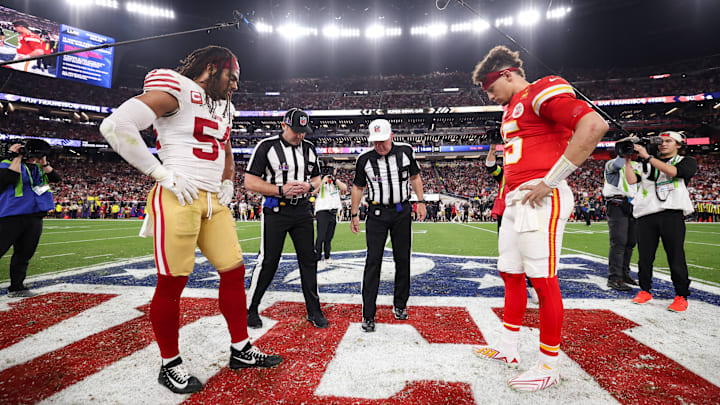
On Super Bowl Sunday, pretty much everything under the sun can be turned into a prop bet, from the length of the national anthem to the color of the winning team's Gatorade bath. But every year, without fail, one particularly silly prop captions the nation's attention: the coin toss.
Sure, putting money on whether a coin will land on heads or tails might seem like an exercise in futility, but since when has that ever stopped us before? And besides: Is a coin toss really as random as it seems? As the Seattle Seahawks get set to square off against the New England Patriots, here's how the coin toss shook out — and how it could affect the game itself.
Super Bowl 60 coin toss result
The Patriots won the toss ahead of Super Bowl 60, with the coin landing on heads. New England chose to defer their choice to the second half, meaning Seattle will start the game with the ball. The Patriots will get it to start the third quarter, which could be crucial if the Patriots manage to play the middle eight minutes right.
How the Super Bowl coin toss works
The Super Bowl begins just like any other football game: with a coin toss to determine which team will receive the ball first. The road team calls it while the coin is in the air, and whichever team wins the toss can choose the following scenarios:
- Receive. This happens sometimes, though less often these days
- Kick. This rarely happens
- Defer their choice until the second half. This is the most likely scenario.
The away team always gets to call the toss, and this year, that's the Seahawks, as the NFC is the designated road team in even-numbered Super Bowls. Although it's worth noting that we don't actually know which Seahawks will be doing the calling; head coach Mike Macdonald has rotated captains on a weekly basis this season, with players like LB Ernest Jones IV, QB Sam Darnold and TE AJ Barner handling duties five times each.
Usually the job of tossing the coin is handled by the game's referee (who serves as the head of the officiating crew), but the Super Bowl is a bit different. The league likes to tap a famous face to do the honors, and since we're in the Bay Area for Super Bowl LX, Niners great Joe Montana handled duties.
Is the Super Bowl coin toss actually 50/50? Science says otherwise
A coin flip is so synonymous with randomness that it's become its own metaphor. But recent studies suggest that the odds actually aren't quite 50/50. Back in 2023, a doctoral student in Amsterdam went above and beyond to find out the truth, conducting a study in which he and his friends and colleagues performed 350,757 coin flips and recorded each result. According to their findings, the flipped coins landed with the same side facing upward some 50.8 percent of the time — a nearly one percent bias that sure doesn't seem like a fluke considering the large sample size.
How can that be? Scientists still aren't totally sure, but the best guess is something called precession. It turns out that a flipped coin doesn't simply spin symmetrically; it wobbles, which means it spends a fraction more time with its initial up side facing up. On the level of an individual flip, a one percent bias doesn't mean very much, and the exact angle at which (and force with which) a coin is flipped can obviously influence things as well. Still, it's something to keep in mind this weekend.
Heads or tails: Which side has hit more often in recent Super Bowls?
Maybe it's precession, or maybe it's small sample sizes. Whatever the case, the Super Bowl coin toss hasn't quite been a 50/50 proposition over the game's 59-year history. Tails has a narrow 31-28 lead in the all time series, including six of the past 10 and a whopping 15 of the past 25.
Super Bowl and Year | Coin Toss Result |
|---|---|
Super Bowl LIX (2025) | Tails (Chiefs) |
Super Bowl LVIII (2024) | Heads (Chiefs) |
Super Bowl LVII (2023) | Tails (Chiefs) |
Super Bowl LVI (2022) | Heads (Bengals) |
Super Bowl LV (2021) | Heads (Chiefs) |
Super Bowl LIV (2020) | Tails (49ers) |
Super Bowl LIII (2019) | Tails (Rams) |
Super Bowl LII (2018) | Heads (Patriots) |
Super Bowl LI (2017) | Tails (Falcons) |
Super Bowl 50 (2016) | Tails (Panthers) |
Super Bowl XLIX (2015) | Tails (Seahawks) |
Super Bowl XLVIII (2014) | Tails (Seahawks) |
Super Bowl XLVII (2013) | Heads (Ravens) |
Super Bowl XLVI (2012) | Heads (Patriots) |
Super Bowl XLV (2011) | Heads (Packers) |
Super Bowl XLIV (2010) | Heads (Saints) |
Super Bowl XLIII (2009) | Heads (Cardinals) |
Super Bowl XLII (2008) | Tails (Giants) |
Super Bowl XLI (2007) | Heads (Bears) |
Super Bowl XL (2006) | Tails (Seahawks) |
Super Bowl XXXIX (2005) | Tails (Eagles) |
Super Bowl XXXVIII (2004) | Tails (Panthers) |
Super Bowl XXXVII (2003) | Tails (Buccaneers) |
Super Bowl XXXVI (2002) | Heads (Rams) |
Super Bowl XXXV (2001) | Tails (Giants) |
Super Bowl XXXIV (2000) | Tails (Rams) |
The NFC has held a surprisingly commanding lead in the coin toss category historically, winning 37 of 22. But take heed: The Chiefs have won the coin toss in each of the last three years.
Does winning the toss correlate with winning the game?

Each team has a different strategy for how it wants to approach the coin toss. The conventional wisdom for years was to choose to receive if you won the toss, but recently that's shifted, as more and more teams opt to defer their choice until the second half — the argument being that getting the ball to start the third quarter, when you have more information about score and game flow, helps you make better decisions. (Not to mention the possibility of getting two straight possessions if you can end the first half with the ball.)
All that being said, though, winning the coin toss has a pretty negligible effect on the game that follows. Whether you get the ball to start the first or second half, what you do with it matters much more: In fact, the coin toss winner is just 26-33 across 59 Super Bowls. They've also lost nine of the last 11, including a whopping eight straight from 2015 to 2022 — a streak that got so bad that it gave rise to the idea of a coin toss curse. Of course, the Chiefs promptly went back-to-back in 2023 and 2024 while winning both coin tosses, so you can decide for yourself whether there's something to that superstition.
Is betting the Super Bowl coin toss ever a smart prop?

If you're betting on the Super Bowl coin toss, either on its own or as part of a larger parlay, just make sure you're doing it strictly for fun. While there might be a slight bias over a very large sample size, flipping a coin remains pretty much random, and that's even before you introduce variables like what the wind is like and how the coin tosser will handle their duties.
If you don't believe us, just ask Vegas: The latest odds at Draftkings have both heads and tails listed at +100, as dead even as you can get. If you can find any juice on one side or the other, it might make sense to pounce on it as a pure value play, but sportsbooks aren't often in the business of handing out easy money.
Really, the only reason books offer coin toss props is to give everyone at home something harmless to be invested in before the actual game kicks off. They even set stricter maximum bet limits than usual, because there's no sharp edge to be gained. Even if you want to try and create a parlay with the coin toss winner winning the game itself, we've seen that things don't work out that way more often than not. So just sit back, relax and enjoy the chaos.
 Add us as a preferred source on Google