
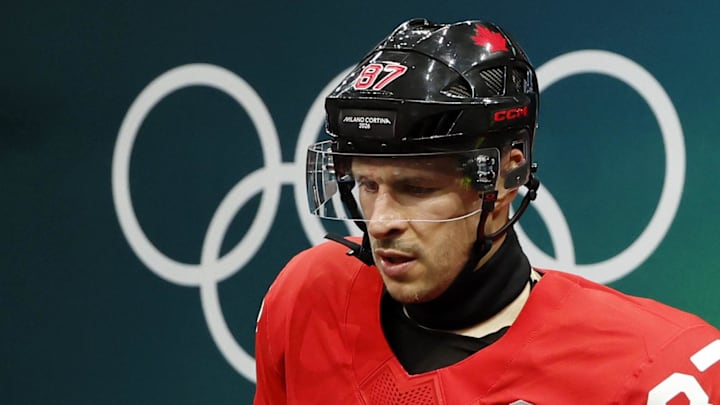
Sidney Crosby’s afternoon ended early during Team Canada’s Olympic quarterfinal on Wednesday, leaving a void in a game that eventually transformed into a thrilling comeback victory sparked by Mitch Marner’s overtime winner. While the celebration in Milan was loud, the update on Crosby’s status was notably quiet, and that uncertainty remains the primary cloud hanging over Canada's gold medal pursuit.
In the immediate aftermath, there was no shortage of reactionary fan takes on social media. The "this is why they shouldn’t be here" crowd immediately found their megaphone, reigniting the long-standing tension between the NHL’s desire to grow the game and its hesitation to risk its biggest assets on international ice. While there may be some truth to the league's wariness, it’s important to remember that the players aren't in Italy by accident—they are here because they collectively bargained for the right to represent their countries.
Sidney Crosby's Olympics injury isn't the first, nor will it be the last

Before the panic reaches a fever pitch, it is important to recognize that Jon Cooper hasn't officially ruled Crosby out of the Olympics.
Via Mollie Walker of the New York Post:
“Sid is by no means ruled out of the tournament,” Cooper said after a well-attended optional practice Thursday afternoon. “We’ve got the best of the best looking at him …We’re taking this day by day. And we’re not going to put anyone in harm’s way. But if he can play, he’s definitely going to. We’ll know more in again in 24 hours.’’
While his current status remains a mystery, it is fair to speculate that Canada feels confident enough to navigate a matchup with Finland without their captain. Doing so would buy precious time to determine if No. 87 can suit up for a potential gold medal game.
If there is a gold medal on the line, you can be almost certain Crosby will be on the ice. This is a player who has reached the pinnacle of the NHL multiple times over, yet representing his country remains a core part of his DNA. Given that this is almost certainly his final Olympic appearance, Crosby isn’t looking for a graceful exit from the sidelines, he's looking for one last chance at the top of the podium.
Crosby isn’t the only star to see his Olympic journey cut short by injury. Switzerland’s Kevin Fiala was stretchered off the ice during a preliminary matchup against Canada and has already undergone season-ending surgery to repair multiple leg fractures. It was a devastating blow for Switzerland and a massive loss for the Los Angeles Kings as they battle for a playoff spot—but it’s also the exact risk these players knowingly accept for the chance to wear their national colors.
The best and worst-case scenarios of NHL injuries at the Olympics

In fact, history shows that even the most grueling Olympic injuries aren't always the career-ending "cautionary tales" they are made out to be. Consider John Tavares, who tore his MCL and meniscus in a quarterfinal match against Latvia during the 2014 Sochi Games. At the time, Tavares was in the midst of a 66-point campaign for the New York Islanders, and the injury cost him the remainder of that NHL season.
However, rather than serving as a permanent warning, Tavares returned better than ever. In 2014-15, he set a new career high with 86 points and fell just short of the Art Ross Trophy. Twelve years after watching his teammates win gold from the sidelines in Sochi, Tavares is back in a Team Canada sweater in 2026, still chasing the Olympic moment he was denied.
Domink Hasek was a different story
Of course, there is a flip side to the risk, and it’s a story that still haunts Ottawa Senators fans two decades later. It was top of mind with players like Brady Tkachuk, Jake Sanderson, and Tim Stützle among others participating at the 2026 Winter Olympics. In 2005-06, Hall of Fame netminder Dominik Hasek was having a vintage season, posting a 28-10-4 record with a .925 save percentage for a Senators squad that looked like a lock for a deep Cup run.
That dream derailed in less than ten minutes. During the Czech Republic’s opening game against Germany in Turin, the 41-year-old Hasek suffered a severe torn right adductor. He never played another game for Ottawa. Without "The Dominator," a juggernaut Sens squad was bounced in the second round, leaving the city to wonder if their best chance at a title had just vanished on international ice
Critics often point to this as the ultimate proof that the Olympics are a dangerous distraction. However, it’s worth noting that the Senators didn't crumble in Hasek's absence. Instead they remained an Eastern Conference powerhouse, finishing with the best record in the league, and reaching the Stanley Cup Final the very next season in 2007.
The Olympics represent the pinnacle of the sport for the players

Every NHL player dreams of lifting the Stanley Cup, but with 32 teams and a grueling path to the Final, that dream is statistically elusive for even the greatest stars. Look no further than how long it took Alex Ovechkin to win, and the fact that Henrik Lundqvist failed to win one. The Olympics offer something different: a condensed, high-stakes assembly of superstar talent where players can secure hockey immortality in a matter of weeks.
This opportunity is so vital to the players that they made Olympic participation a non-negotiable pillar of their Collective Bargaining Agreement. That level of dedication proves that, to the players, this isn't about "managed risk" or "roster management". It is about the soul of the game. Regardless of the headlines or the cautionary tales from critics, the world’s best will continue to jump at the chance to fight for their country. For Sidney Crosby and countless others, the risk of an injury will never outweigh the reward of standing on that podium.
 Add us as a preferred source on Google