
I've visited each and every American sports' Hall of Fame, or at least those I consider important (I'm a bit biased here). I can tell you, with certainty, that the Baseball Hall of Fame takes its product the most seriously. There is a far higher bar for election in Cooperstown, NY than any other. In a way, that makes a lot of sense given baseball as a whole is a sport predicated on statistics.
There is a stat for everything in MLB. Heck, there's even a stat for Hall-of-Fame election, including the percentage of votes needed to achieve baseball immortality. It's 75 percent, folks! BBWAA – the Baseball Writers Association of America – is ultimately responsible for this clown car. That comes with a ton of responsibility and a lot of backlash.
Who votes for the Baseball Hall of Fame?

Per the Hall of Fame website, “Only active and honorary members of the Baseball Writers’ Association of America, who have been active baseball writers for at least ten (10) years, shall be eligible to vote.” In order to receive a vote, a writer must have been a member of the BBWAA for at least a decade as well.
In theory, this is a good thing! It means that writers must put in the time before they are given the right to submit a Hall-of-Fame vote. However, you'd be surprised how that works out. The downside of MLB's decade-long requirement is that these votes can be easy to hang onto, even when said voter hasn't written a word about the sport in years. The BBWAA is loyal to its base, as it should be. That can also lead to false precedents and questionable judgement. Heck just look at this complete list of unanimous Baseball Hall of Fame selections! Here's a hint: There's only been one.
Player | Year | Percentage |
|---|---|---|
Mariano Rivera | 2019 | 100% (425/425) |
Derek Jeter | 2020 | 99.7% (396/397) |
Ichiro Suzuki | 2024 | 99.7% (393/394) |
Ken Griffey Jr. | 2016 | 99.3% (437/440) |
Tom Seaver | 1992 | 98.8% (425/430) |
Nolan Ryan | 1999 | 98.8% (491/497) |
Cal Ripken Jr. | 2007 | 98.5% (537/545) |
Ty Cobb | 1936 | 98.2% (222/226) |
George Brett | 1999 | 98.2% (488/497) |
Henry Aaron | 1982 | 97.8% (406/415)T |
Tony Gwynn | 2007 | 97.6% (532/545) |
A full list of Baseball Hall of Fame voters can be found via the BBWAA website after they are cast. It includes writers from across the country, all of whom have been covering respective teams for at least 10 years, and been BBWAA members for at least a decade as well. A Hall of Fame vote is not easy to receive, as the process is incredibly selective.
Who is eligible for the Baseball Hall of Fame?
In order to be eligible for Hall of Fame voting, a player “must have been active as a player in the Major Leagues at some time during a period beginning fifteen (15) years before and ending five (5) years prior to election,” per the HOF website. A player can only remain on the ballot for 10 years.
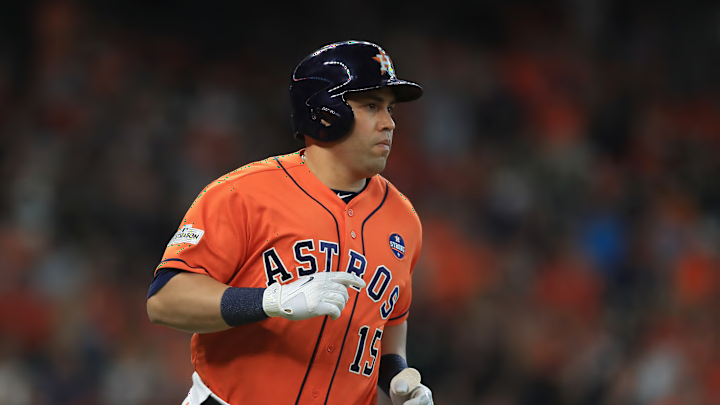
There are plenty of players eligible for the Baseball Hall of Fame this year, but the only stars expected to have a chance at Cooperstown election are Carlos Beltran and perhaps Andruw Jones. Beltran came close last year, but ultimately fell short due to the strength of the class. Jones, meanwhile, has long been underrated on the ballot and has his best chance to reach baseball immortality in 2026 on a weak ballot. If you don't believe me, just look at his JAWS number.
Player | JAWS |
|---|---|
Willie Mays | 73.7 |
Ty Cobb | 69.0 |
Mickey Mantle | 64.8 |
Mike Trout | 64.8 |
Tris Speaker | 62.7 |
Ken Griffey Jr. | 54.0 |
Joe DiMaggio | 52.1 |
Duke Snider | 49.5 |
Andruw Jones | 46.4 |
AVG Hall of Famer | 44.6 |
Richie Ashburn | 44.5 |
Carlos Beltran | 44.4 |
What is the Contemporary Baseball Era committee?

The contemporary baseball era committee is made up of retired MLB players, managers, umpires, executives and writers. They can elect players or executives who were passed over by the BBWAA once their 10 years on the ballot has passed.
This committee consists of 16 members. They can elect players who were passed over from 1980 until current day. There are plenty of players, managers, front office members and commissioners to choose from. The Contemporary Baseball Era committee has come under scrutiny the last few years for refusing to elect players from the steroid era, or those who were linked to the Mitchell Report. For example, Barry Bonds never came close. Manny Ramirez has fallen off the BBWAA ballot, but is likely to receive the same treatment.
Why is the Baseball Hall of Fame in Cooperstown?
The Baseball Hall of Fame is in Cooperstown for good reason. For the longest time, that is where baseball fans believed the sport was invented. Since then, we've been proven wrong. Some version of baseball was played across the globe prior to Abner Doubleday bringing it to upstate New York. Nonetheless, Cooperstown has played a critical role in the development of the sport over its century-plus as the site of the Baseball Hall of Fame. The same can be said about Williamsport for the LLWS and a myriad of international locations that have made it their top priority to grow the sport.
At this point, the Hall of Fame ought to stay in Cooperstown. As someone who has been there, it's all the town has. Their entire identity involves baseball. We can figure out better ways to honor, say, international stars and difficult eras MLB brought upon themselves. For example, there is a Negro League Museum in Kansas City, formerly the home of the Monarchs. There is a Clemente Museum in Pittsburgh, honoring Latin-American players' own version of Jackie Robinson.
Cooperstown is a remarkable place, and I recommend everyone visit to further understand America's pastime. But Hall of Fame voting itself is a complicated process, as revealed above.
 Add us as a preferred source on Google