
Key Points
Bullet point summary by AI
- Albert Pujols is leading the Dominican Republic at the World Baseball Classic, nearing their first title game since 2013.
- He’s earned praise for managing All-Stars like Juan Soto and Manny Machado with a firm yet empathetic approach.
- His leadership style echoes legendary Cardinals managers who balanced accountability with leveraging their team’s unique strengths.
Your eyes have not deceived you during the World Baseball Classic: Albert Pujols, the same man who spent two decades terrorizing opposing pitching with one of the most potent right-handed swings of in baseball history, is managing the Dominican Republic this spring — and he’s faring pretty well, too.
Pujols, who turned 46 this past January, has a star-studded Dominican team only two wins away from its first World Baseball Classic title game appearance since winning it all in 2013. He’s earned rave reviews for his success managing a squad with so many star names, some of whom — including New York Mets outfielder Juan Soto and San Diego Padres third baseman Manny Machado — are well on track to eventually join Pujols in the Baseball Hall of Fame.
But before the Dominican Republic goes any further, they’ll need to take down Aaron Judge, Paul Skenes, and a stacked Team USA roster. However, as Pujols continues proving throughout the WBC, it’s clear that he’s learned from longtime Cardinals skipper Tony La Russa on how to manage a team with a championship-or-bust mentality.
Albert Pujols’ World Baseball Classic success could bode well for his mlb managerial chances

The best players don’t always make the best coaches, and they certainly don’t always make the best managers. It’s an entirely new ballgame when so much of a team’s success is out of your hands; you can build the lineup and organize the training routine, but you’re no longer the one swinging with runners in scoring position or preparing to face the middle of an opposing lineup in a one-run game. Boston Red Sox legend Ted Williams, one of the greatest hitters in league history, even admitted he struggled to connect with his players when he became a manager.
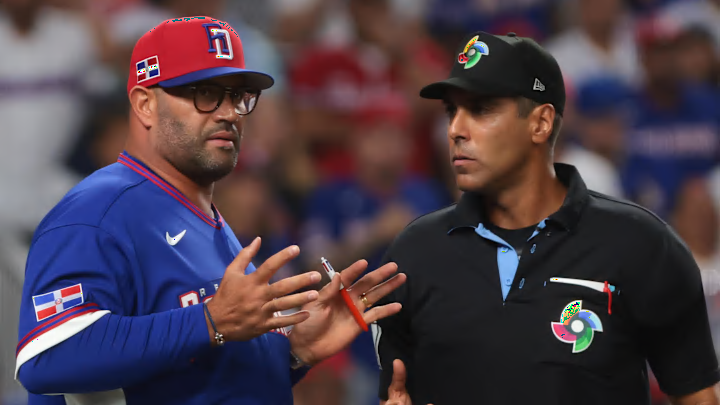
That’s part of what makes Pujols’ work at the WBC so impressive. His players clearly love him, and he might have earned some new fans during a pool play win over Venezuela when he sprinted out of the dugout to argue a call. Pujols didn’t need to go on a Terry Collins-esque rant to make his points heard: He disagreed with the call, and he wasn’t afraid to stand up for his players, even with a four-run lead.
“He’s been in our shoes and truly understands how we feel, how the pieces move on the field, every swing we take, every decision we make,” Soto said. “He’s right there with us through it all, and that makes it something truly special and beautiful.”
The most successful Cardinals managers succeeded because they understood mixing accountability with a team’s strengths and weaknesses. Whitey Herzog used the artificial turf in St. Louis and his players’ speed to win three pennants — and the 1982 World Series — during his time at the helm. La Russa had the likes of Pujols, Jim Edmonds and Matt Holliday anchoring the middle of his lineup, but he also had competent pitching staffs that could keep games close enough for the offense to finally come through.
Pujols spoke with several MLB teams about their manager jobs this past offseason, and the rest of the league should be paying close attention. I recently proposed that the Philadelphia Phillies pursue Pujols next offseason if Rob Thomson retires. Maybe the Cardinals will move on from Oli Marmol to bring Pujols home.
We’d say that Pujols should be a unanimous Hall of Fame inductee in two years, but there will always be that one voter who leaves him off their ballot. They did it for Ichiro, they did it for Derek Jeter, and they’ll almost certainly do it to Pujols, too. But when he unveils the plaque that’ll forever hang in Cooperstown, we’ll see whether the blurb also includes a line about being a 2026 World Baseball Classic champion.
More MLB news and analysis:
- Aaron Judge is running out of time — for both the Yankees and Team USA
- Another Cal Raleigh handshake snub is actually great news for Mariners
- Tarik Skubal’s Team USA letdown offers a lesson ahead of MLB Free Agency
- Freddie Freeman paved the way for Owen Caissie and Canada’s next WBC generation
 Add us as a preferred source on Google