
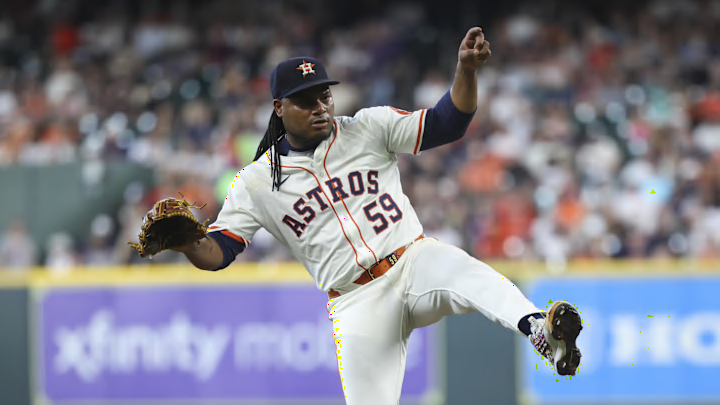
The Detroit Tigers came out of nowhere to sign Framber Valdez to a three-year, $115 million contract (on the date of Tarik Skubal's arbitration hearing, no less). There's something cosmic about that. This could set up a Skubal trade, or it could just mean the Tigers are all-in for Skubal's final year. No matter how you read it, though, it puts a lot of teams in the position of looking for Plan B on the pitching market with precious time to spare.
Valdez was the last proper star without a new contract in free agency. Many thought age and personality concerns could limit his market, but at the end of the day, he landed the highest AAV ever for a left-handed pitcher. Here are other teams that were linked to Valdez — and where they can turn next.
Pittsburgh Pirates

Backup plan: Brayan Bello
The Pittsburgh Pirates were late entrants in the Framber Valdez sweepstakes, to no avail. The Boston Red Sox have a surplus of pitchers, in part due to acquiring Johan Oviedo from Pittsburgh earlier this winter. The Red Sox would do well to clear a path for Connelly Early or Payton Tolle. The Pirates, meanwhile, could use a more dependable fifth starter as Jared Jones ramps up his rehab.
Brayan Bello offers a similar profile to Valdez, only he's six years younger and far more affordable. This past season was Bello's best at the MLB level (3.35 ERA and 1.24 WHIP in 29 appearances, 28 starts). There is some uncomfortable noise under the hood (4.48 expected ERA), but Bello generates tons of ground-ball contact. He ramped up his cutter usage last season to great effect and seemed to find a balance, a confidence, that did not exist prior.
Under club control through at least 2029 at less than $10 million annually, Bello should have no trouble delivering on the value of his contract. Pittsburgh can solidify one of the best pitching staffs in baseball for years to come.
Toronto Blue Jays

Backup plan: Kris Bubic
The Royals are clearly intent on winning games next season, so Kris Bubic won't come easy or cheap. That said, he's on expiring contract and he has never pitched more than 130 innings in a season, so K.C. probably can't label him untouchable. An ex-starter turned reliever, Bubic transitioned back into a rotation role in 2025 and blossomed into the Royals' most dependable ace. His 2.55 ERA was a career-best, with his strikeout rate (24.4 percent) higher than it's ever been as a starter.
It's not as if the Toronto Blue Jays really need more pitching — Toronto has five starters on hefty contracts and a rookie sensation in Trey Yesavage — but their rotation is comprised entirely of righties at the moment, and depth on the mound is never a bad thing. The Blue Jays are flush with resources and desperate to compete at the highest level. Missing out on Kyle Tucker was probably a source of motivation.
As such, trading for Bubic would constitute an ambitious statement. Toronto also has the capital to realistically entertain a long-term contract in the offseason, especially if Bubic pitches well and the Jays mount another deep run.
Atlanta Braves

Backup plan: Chris Bassitt
On the surface, the Atlanta Braves' rotation is fairly well off. Injuries have become a relentless storyline in Atlanta over the past few years, however, so the Braves know the benefit of depth better than most. Valdez is a classic workhorse, a true innings-eater who takes the mound every fifth game and generally delivers stable results.
Chris Bassitt comes with a bit more game-to-game variance at this point in his career, but he should also come on a cheap one-year deal. And durability is Bassitt's superpower: He has made 30-plus starts and pitched at least 170 innings in four straight years now. Bassitt relies on a bendy slider and swooping curves, along with a deep bank of offspeed offerings, so he should age more gracefully than others in his generation.
The command was still there last season, for the most part, as was Bassitt's knack for soft, ground-ball contact. He put up a 3.96 ERA and 1.33 WHIP, with a functional 22.6 percent strikeout rate. He can offer Atlanta some much-needed stability — meaning availability.
San Francisco Giants

Backup plan: Sandy Alcántara
The Miami Marlins continue to bleed talent, not add it, which undermines any pipe dreams of major improvement to last season's 79-win roster. It's unclear if the Marlins would actually trade Sandy Alcántara on top of Edward Cabrera and Ryan Weathers, but it's probably worth a phone call as the San Francisco Giants balance risk versus reward.
Alcántara was quite poor last season overall, finishing with a 5.36 ERA across 31 starts. His ability to pitch 174.2 innings after elbow surgery was promising, however, and he comes on an affordable $17.3 million expiring contract (with a $21 million club option for 2027). Less than four years removed from winning the NL Cy Young award, Alcántara offers tantalizing upside if he can rediscover his past form.
The Giants would love a solid No. 3 behind Logan Webb and Robbie Ray in the rotation. Alcántara is a sinkerballer like Valdez, only with a lot more zip (and a bit more inconsistency, of course). His metrics were down across the board in 2025, but his velocity stayed up after a major injury, so there's real hope here. Miami's phone lines are open, clearly.
San Diego Padres

Backup plan: Justin Verlander
The San Diego Padres finally settled their longstanding ownership debacle, but AJ Preller still has his hands tied financially. It feels like the Michael King extension was his one real expense for the winter, with San Diego left to scrounge the bargain bin the rest of the way. Valdez never felt particularly realistic for that reason.
Justin Verlander spent last season right up the coast in San Francisco, so it's an easy move. Verlander also carries a certain pedigree as a three-time Cy Young winner and future Hall of Famer, which San Diego ought to appreciate. The Padres need to get younger, not older, in the grand scheme of things, but the back of this rotation is severely lacking. Verlander would constitute a one-year investment in a No. 5 starter. That's it. On those terms, San Diego could do worse.
Last season was a series of ups and downs for Verlander, but he settled in nicely as the year progressed with finished with a perfectly adequate 3.85 ERA. He made 29 starts and pitched 152 innings, quelling durability concerns after a brutal final season in Houston. If he can just take the mound on a regular basis and deliver non-catastrophic results, it would help the Friars a great deal.
Baltimore Orioles

Backup plan: Zac Gallen
The Baltimore Orioles felt like the prohibitive favorites to sign Valdez for a while, so this comes as a blow. The O's front office really put in the work to improve the roster this winter, signing Pete Alonso to a five-year deal and acquiring another 30-plus home run bat in Taylor Ward — not to mention their shiny new closer, Ryan Helsley. Where Baltimore is still lacking, unfortunately, is the starting rotation.
Shane Baz's arrival is a fun wrinkle, and Baltimore fans will hope for an extension of Trevor Rogers' 2025 succes and a return to form from Kyle Bradish. But even the best-case outcome for this current O's rotation probably does not get them far into October. There aren't any surefire aces left in free agency at this point, and color me skeptical of Baltimore swinging a blockbuster trade for Tarik Skubal. Zac Gallen, however, is their best bet — and he's clearly within their reach.
Last season was a mixed bag for Gallen (4.83 ERA in 33 starts, 192 innings). The durability factor is huge, as Gallen has always taken on a workhorse's duties for Arizona. He is also two years removed from a third-place finish in Cy Young voting. At 30, there should be gas left in the tank. Gallen's fastball needs to perk up and he needs to hone his command a bit, but if Gallen can embrace the change of scenery and get right mentally, this signing would carry massive upside for the O's.
 Add us as a preferred source on Google