
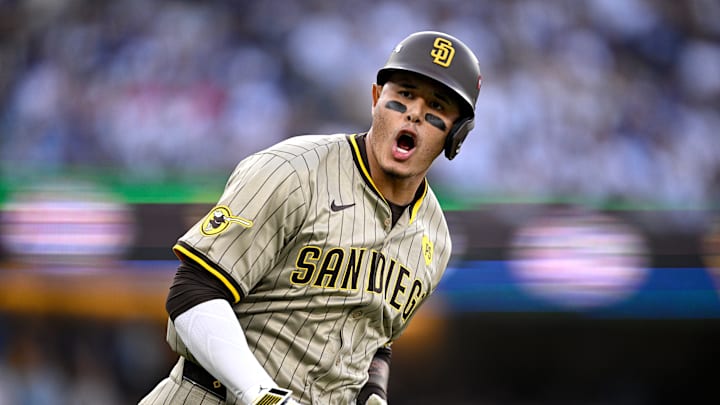
Whether it be Manny Machado, Bryce Harper or your average baseball fan, everyone seems to have an opinion on the Los Angeles Dodgers spending habits, and whether they are good or bad for baseball. Those arguments tend to branch in two directions; either you're in favor of an MLB salary cap, or against it. While players like Machado and Harper may hate facing the Dodgers, there's little doubt LA's spending is good for business and the future of free agency.
Machado's perspective is unique in that he is a former Dodger turned rival. Whenever the Padres play in Los Angeles, the veteran third baseman is met with a smattering of cheers, but mostly hostility. There's a reason for that, as he's embraced life as one of the only true threats to a Dodgers dynasty. But it says a lot that even Machado isn't for rule changes that would otherwise limit the Dodgers ability to spend in free agency.
Why Manny Machado and MLB players are against a salary cap

A salary cap doesn't just impact the Dodgers. It hurts all players, which is why they've been unwilling to discuss it ever since free agency's infancy. Owners argue that a cap would help the vast majority of underpaid players and increase parity without giving much evidence. Small-market owners also suggest they cannot keep up with the likes of the Dodgers in free agency. To that, players point to more creative organizations like the Milwaukee Brewers and Tampa Bay Rays, which find a way to compete despite limited resources.
“I (expletive) love it," Machado said of the Dodgers spending. “I think every team should be doing it. They’re figured out a way to do it, and the (stuff) is (expletive) great for the game honestly. I think every team has the ability to do it. So, I hope all 30 teams could learn from it."
Machado and the Dodgers stars may be rivals on the field, but off of it they are on the same team. Both would be victimized by a salary cap in baseball, as it would essentially serve as a way for owners to reach directly into players' wallets.
“I think our game is very good at what we’re doing," Machado said. “There’s a lot of money being made. Look at what’s going on with the game. The last five years, it’s been great. So, I think a lot of teams have the ability to do what the Dodgers are doing."
Bryce Harper echoed that sentiment, telling Tom Kelly that he "loves what the Dodgers are doing."
Why MLBPA won't bend on a salary cap

MLB is the only core four American sports league without a salary cap. The NFL, NBA and NHL have all caved, and it's limited player revenue in all of those sports. MLB already has a luxury tax system in place that is supposed to deter teams from outspending their peers, while also setting up a trickle-down system for small-market teams. Even that hasn't been effective, as teams like the Dodgers and Mets don't mind paying extra fines if it means more revenue over the course of a long season.
If MLBPA bends on a cap, it creates an unstable environment for its players. This includes veterans who are on the tail end of their deals and could be considered 'cap casualties' as is often the case in the NFL. It'll also limit spending on younger free agents, who no longer control their own market value. Rather, that number will quite literally be capped.
In their argument against the cap, players have also said that it doesn't guarantee parity. In fact, MLB's long season and postseason often leads to surprise champions. Sure, the Dodgers have won back-to-back World Series, but they were one out away from losing last October – and it's not like they dominated the regular season, either, finishing with the third-best record in the National League.
The issue players will run into, however, is the fan narrative. The Dodgers recent dominance, both in spending and in the postseason, has led to recency bias in favor of a salary cap. The vast majority of baseball fans reside outside of New York and Los Angeles. They want a seat at the table, and view the cap (and floor) as a reasonable way to narrow the disparity in spending between the likes of the Dodgers and small-market teams.
It all comes to a head next December, but for now, the players are spinning a narrative many of us can get behind: Let the market determine their value, and force billionaires to pay their fair share.
More MLB news and analysis:
 Add us as a preferred source on Google