
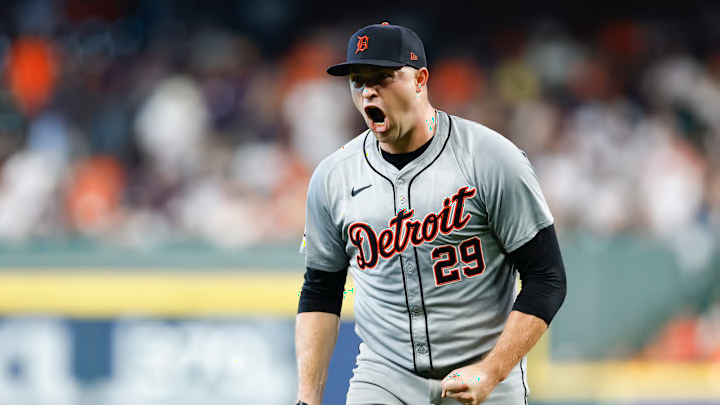
It turns out Tarik Skubal didn't have to wait until free agency to secure a historic payday, as on Thursday a third-party arbiter ruled in favor of the lefty in his arbitration dispute with the Detroit Tigers. The upshot: Skubal will now make a whopping $32 million for the 2026 season — a number that didn't just blow the previous arb record for a pitcher out of the water ($19.75 million, set by David Price) but also broke Juan Soto's overall record of $31 million back in 2024.
Which, to most fans, probably doesn't sound all that earth-shattering. Skubal is one of the two best pitchers on planet Earth right now, the two-time reigning AL Cy Young winner; why wouldn't he deserve to get paid like it? Heck, while $32 million is impressive, it doesn't even put him in the top five AAV's among starting pitchers. You could argue that the Tigers are still getting something of a value here.
Of course, I'm not sure Detroit sees it that way, nor do small-market owners all around the league. Tigers brass tried to sell the arbiter on paying Skubal $19 million, below even Price's record. While scoffing at that number might pass the smell test based on his exceptional resume, it can't be overstated the extent to which it flips the sport's economic model on its ear. And as the sport barrels toward a potential work stoppage when the current CBA expires next winter, Skubal's case will loom large.
MLB owners' demands for a salary cap will only grow louder after Tarik Skubal win

Let's zoom out for a second and remember why the arbitration system exists in the first place. Small-market teams, desperate for a way to compete with teams spending far beyond their financial means in a sport without a hard salary cap, thought that the best way to do so would be to control their homegrown talent for as long as possible. And, sure enough, MLB is unique in this regard: While most players in the NBA or NFL hit free agency for the first time after only four or five years, baseball players can't test the market until they complete six seasons of service time. (Skubal, for example, won't become a free agent until after the 2026 season despite making his MLB debut in 2020.)
The league knew that the MLBPA wouldn't be too thrilled about that gap, so arbitration was created as a sort of compromise: While players only make the minimum for their first three years in the Majors, their salary over the next three will be at least in part determined by their performance on the field and the salaries of their positional peers. In an ideal world, it would be a way to get paid something close to what you're worth without being able to actually shop your services on the free market.
In practice, though, it hasn't really worked out that way ... until now. While arbitration certainly helped (and was certainly preferable to making the minimum), it still wound up holding star players well short of what they'd be able to make in free agency — or even if they were paid commensurate with their standing at their position. Skubal's victory, however, threatens to change all of that. By rejecting Detroit's number and accepting Skubal's, the arbiter essentially said that teams can no longer expect bargains on their best players in the years leading up to free agency. You'll still have team control, sure, but it's going to cost you what it should have been costing you all along.
Of course, Skubal is something of a unicorn; very few pitchers have his resume, much less within their first five full seasons. But this is less about Skubal himself and more about the precedent he's set, one that every pitcher after him will be able to point to as a comparison even if they're not quite as Skubal's level. (Or, in the case of Paul Skenes, if they very much are.) Previously, small-market teams didn't really have to make tough decisions on homegrown players until free agency was looming around the corner, confident that arbitration salaries would remain affordable even to front offices on a budget. If that's out the window, it becomes even harder for the likes of the Pirates, Marlins and Guardians to retain stars — and makes them even more determined to demand something else.
If a salary cap is the deal-breaker, MLB is destined for a lockout

Which brings us back to the two words at the hard of this current round of labor strife: salary cap. It seems like a growing portion of the league's owners aren't just wanting one but are demanding one, giving Rob Manfred his marching orders as the current CBA gets set to expire at the end of the year. That was true even before this week, as the Los Angeles Dodgers continue to make a mockery of the luxury tax system. And it's certainly true now that the prospect of keeping homegrown talent around just got a lot more expensive.
If, say, Cleveland can't count on getting at least four or five cost-controlled years of a top prospect like Travis Bazzana, the one thing that was leveling the playing field with the biggest spenders has now been removed. And the only way to solve that problem, at least in ownership's eyes, is with a hard salary cap: If players are going to just get more and more expensive, smaller markets can only compete if the bigger markets suddenly have to spend way less.
This is resting on a number of faulty assumptions, of course. Even small-market teams can spend more than they have been (or at least we have no choice but to assume that's the case, because they all refuse to open their books to the public). And it's not like a hard cap will solve all of their problems: Those caps also come with salary floors that will force the likes of the Pirates to spend much more than they've grown accustomed to. But the arbitration system was a bedrock upon which MLB's fragile economic peace rested. Now that Skubal has taken a sledgehammer to it, negotiations for the next CBA will only get more tense.
 Add us as a preferred source on Google