
The Cubs may not feel personally impacted by Kyle Tucker signing with the Los Angeles Dodgers, but the rest of baseball sure does. Tucker's four-year, $240 million contract reset the market for elite hitters on short-term deals. His $60 million AAV was borderline untouchable for the rest of the league.
It's tough to blame the Dodgers for taking advantage of a flawed system in search of a three-peat. Only four franchises have achieved such a feat in baseball history. However, in bailing on a Tucker extension so quickly after building up his value, the Cubs didn't do themselves or the 28 other teams competing with Los Angeles on the open market any favors.
Which Cubs are most at fault for Kyle Tucker signing with the Los Angeles Dodgers?

Tucker is, on the surface, a tremendous fit in Los Angeles. He gets to blend in behind bigger personalities, such as Shohei Ohtani, Mookie Betts, Freddie Freeman and Yoshinobu Yamamoto, all the while filling a void in the Dodgers outfield. LA entered this winter with two clear roster holes – bullpen and outfield depth – and filled both with the best players available at those positions. Cheers, Andrew Friedman.
But the Cubs aren't blameless here either, as much the front office has tried to absolve themselves of blame in this situation.
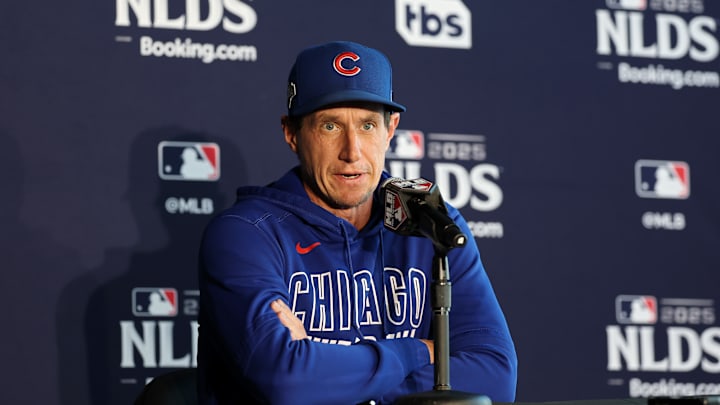
Craig Counsell
Yes, Tucker leaving starts with Counsell, who hurt his value just enough by sitting the star outfielder for what he coined as a 'mental reset' midseason. In fairness to Counsell, Tucker was struggling. He put up an MVP-caliber first half, but he didn't have the same mindset from the plate post All-Star break and was sidelined with a strained left calf for most of September. That limited his production to just 4.4 WAR, which while impressive, is not what we've grown accustomed to from Tucker. It's also why he wasn't able to secure the long-term, $400 million contract he wanted at the outset of free agency.
Kyle Tucker Stats | AVG | OBP | SLG |
|---|---|---|---|
First half | .280 | .384 | .499 |
Second half | .231 | .360 | .378 |
Faced with the options of a long-term contract under his valuation from the Blue Jays, or signing a short-term, $240 million deal with the Dodgers featuring multiple opt-outs, the choice wasn't all that tough to make. Whatever Counsell thought he was doing by giving Tucker a break, in hindsight it appears he over-managed a star who values consistency and an under-the-radar approach, even when he's struggling at the plate.
Jed Hoyer
Rather than pressure Tucker into a contract extension when they acquired him last winter, Hoyer instead opted to let the 28-year-old play out his season at the Friendly Confines in hopes that a summer in one of the most iconic ballparks in America would change his mind about free agency. It didn't work. Then, this offseason, the Cubs were remarkably quiet about potentially bringing Tucker back into the fold, knowing their worst work was already done.
“Kyle had an interesting season with us,” Hoyer said Friday per The Athletic. “He showed the superstar that he is in the first half, and he helped carry our offense in the first half. Obviously, in the second half, he struggled a bit. But he’s a star, and he got paid like a star."
The point Hoyer is missing is that Tucker was the Cubs star. He was under team control throughout last season, at which Chicago could've discussed an extension. They reportedly never broached the subject.
Tom Ricketts
The Ricketts family has invested millions in Wrigley Field and the surrounding area the past decade, buying up apartment complexes, bars and restaurants. In doing so, they've turned Wrigleyville into a destination site that goes beyond baseball. It's been a money-making machine for the ball-club, but the on-field product hasn't always reflected those outside investments.
This offseason, the Cubs' payroll will likely finish above the luxury tax, meaning the team will have to pay a tax on any remaining free agents they sign. That's a great sign for any contending team, but it's also somewhat surprising, then, that they didn't make a run at Tucker. Instead, they signed Alex Bregman as the franchise's big-ticket item. Chicago even traded for Edward Cabrera to fortify their pitching staff. All of that is well and good, but comes short of the impact a healthy Tucker could make long term.
Player | Age | WAR | OPS+ |
|---|---|---|---|
Kyle Tucker | 29 | 4.4 | 143 |
Alex Bregman | 32 | 3.5 | 128 |
Each player has their strengths, with Bregman as the better defender. Tucker has more upside at the plate and is younger. If he were open to a short-term deal – which both the Dodgers and Mets offered him – it's a surprise the Cubs didn't submit such a contract as well for familiarity's sake. Instead, they'll pay Bregman until he's 37 years old, which comes with its own risks.
Why the Dodgers were able to swoop in for Kyle Tucker

The Cubs are not the only franchise to blame for the Dodgers being able and willing to sign Tucker, but this was just about the only scenario in which they'd be able to do so. Los Angeles was a threat from the outset because of their corner outfield need, but they were never going to fork over a long-term agreement with Tucker because of their financial limitations in the decade to come. Yes, even the Dodgers must close their wallets at some point.
But the long-term offer Tucker coveted never came. Even the Blue Jays, which were willing to sign him long-term, only offered $350 million, which came up well short of the $60 million AAV the Dodgers gave Tucker.
Heck, Los Angeles didn't even have to dip into their well of deferred money for Tucker. Only $30 million of Tucker's deal is deferred beyond the four years in his contract. That should terrify the rest of baseball, as the Dodgers could've made this offer even more enticing for Tucker, who is a top-20 player in baseball but certainly not on the level of an Ohtani or Aaron Judge.
Overall, the lack of competitive offers (at or near Tucker's asking price) for the best hitter on the free-agent market is concerning, especially with a lockout looming. The Cubs played a role in that, as did any team that refused to make a real offer to a four-time All-Star.
More MLB offseason news and analysis:
 Add us as a preferred source on Google