
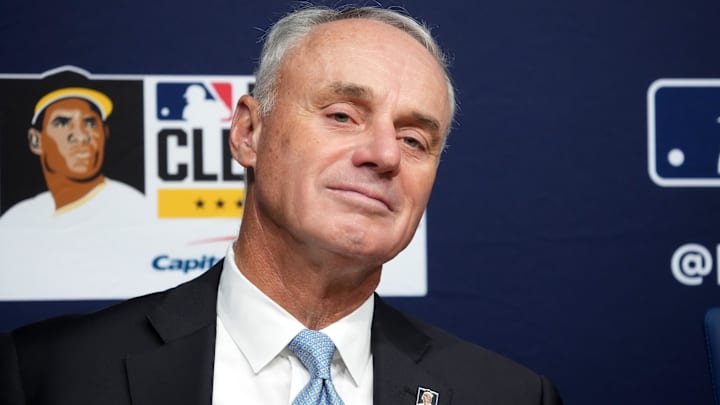
The looming expiration of MLB's CBA in December has most MLB fans dreading the possibility of a lockout. Owners are reportedly dead-set on adding a salary cap and floor, while MLB players are vehemently against any sort of cap. The league, both its teams and commissioner Rob Manfred, have long maintained that they have the good of the sport in mind, that the purpose of a cap is to increase parity. But our first potential glimpse at what a cap proposal might look like suggests anything but.
Heyman: Early estimates suggest proposed salary cap might be set around $260M-280M and floor around $140M-160M.
— Underdog MLB (@UnderdogMLB) February 27, 2026
While there are certainly benefits from this proposal, it's clear why owners want a cap in place, and it has nothing to do with competitive balance.
MLB salary cap proposal proves once again that owners don't care about parity

All we've heard from MLB owners is that teams like the Los Angeles Dodgers are ruining the sport by running obnoxiously large payrolls and signing star players every winter. While, sure, you can certainly argue that the Dodgers are doing things no other team can realistically do, this proposal confirms what MLB players already knew: Small market teams can, and should, be spending more than they have been.
Projected 2026 Payroll (MLB Rank) | Team |
|---|---|
$160 million | High-end of cap floor |
$153.9 million (18th) | Los Angeles Angels |
$146.7 million (19th) | Cincinnati Reds |
$140 million | Low-end of cap floor |
$130.9 million (20th) | Athletics |
$129.1 million (21st) | Milwaukee Brewers |
$120.7 million (22nd) | Pittsburgh Pirates |
$119.8 million (23rd) | St. Louis Cardinals |
$119.2 million (24th) | Minnesota Twins |
$105.3 million (25th) | Colorado Rockies |
$105.2 million (26th) | Tampa Bay Rays |
$102.4 million (27th) | Washington Nationals |
$101.5 million (28th) | Chicago White Sox |
$94.7 million (29th) | Cleveland Guardians |
$78.1 million (30th) | Miami Marlins |
11 MLB teams currently have payrolls below the $140 million cap floor. That number rises to 13 if we use the $160 million cap floor. That's nearly half the league. Two teams haven't even spent $100 million; the $140 million mark nearly doubles the Miami Marlins' projected payroll of $78.1 million. If these teams could have spent $140+ million the whole time, why didn't they? Wouldn't that have helped with the parity problem? It's almost as if parity is not the driving force behind a cap.
Another thing worth pointing out is the disparity between the cap and the floor. How does the cap being double the floor solve anything? There's a reason why, in leagues like the NFL and NBA, the floor is roughly 90 percent of the cap. If it were really about parity, the floor would be very close to the cap, keeping teams on a roughly even playing field. Otherwise, what does this do other than limit the earning potential of the game's best players?
What MLB's salary cap proposal is really about

This proposal is really all about preventing teams like the Dodgers and players like Kyle Tucker from going crazy. Tucker just signed a four-year, $240 million deal with a Los Angeles team coming off back-to-back World Series wins that is spending far more than anyone else. By adding this cap and floor, the Dodgers wouldn't be able to afford spending $60 million annually on one player while still fielding a World Series-caliber team.
The same goes for the 29 other teams. Tucker would still have done well, obviously, but never again would we see the kinds of contracts that stars like Tucker and Juan Soto have signed in the past couple of years.
This proposal is about MLB wanting to control costs. It has nothing to do with parity or making it easier for small-market teams to compete. It's clear that these teams could have spent all along if they really wanted to. They just don't want the Tuckers of the world making $60 million annually.
What a real salary cap proposal should look like

FanSided's Chris Landers outlined what a potential salary cap proposal might look like, and his proposal makes a whole lot more sense than the one Heyman revealed.
Year of implementation | Hard cap ceiling | Luxury tax threshold | Salary floor |
|---|---|---|---|
2027 | $210 million | $190 million | $142.5 million |
2028 | $200 million | $180 million | $144 million |
This proposal makes it so that big market teams can still flex their financial muscles to an extent without going so far beyond the floor. The gap between the cap and floor wouldn't be nearly as wide, making the parity argument more valid. The cap and floor should probably be closer together, but getting all sides to agree will be nearly impossible.
The high-end players would be losing a lot of money in this scenario (or any world with a cap), which is why it's highly unlikely the MLBPA will ever relent, but competitive balance would be far better in this world than in the one Heyman outlined.
The point of a cap should be to improve competitive balance. Otherwise, all it does is line the pockets of the owners. The cap and floor outlined above does not improve competitive balance; all it does is limit the earning potential of the stars and prove that small-market teams could've spent more all along.
More MLB news and analysis:
 Add us as a preferred source on Google