
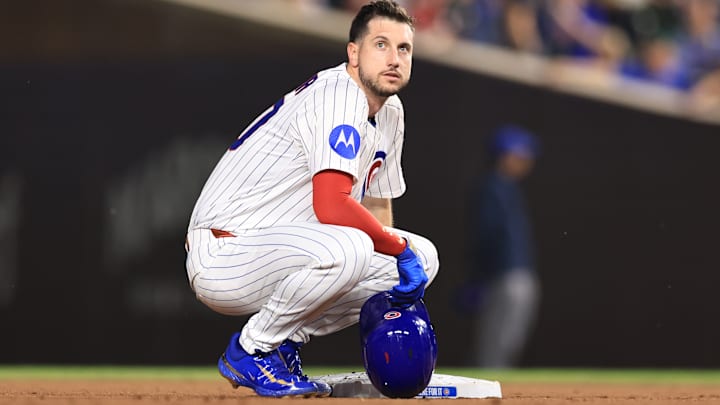
We've reached mid-January, and some of the league's best free agents like Kyle Tucker, Bo Bichette, Framber Valdez and others remain available for the taking. Ranger Suarez just went off the board, but so far that's been the exception in this market. Sure, MLB teams should be more aggressive when it comes to spending money, but there ultimately is a reason that these players are still on the board.
Each of the best free agents available has at least one fatal flaw that teams are scared of and could wind up costing them big-time on the open market.
INF Bo Bichette

Fatal flaw: Defense
Bo Bichette is a 27-year-old who has led the American League in hits twice in his five full seasons, and if it weren't for a September injury, he probably would've done it again in 2025. He's a hit machine who can sprinkle in 20+ home runs and 90+ RBI any given year; so considering that and his age, why isn't Bichette signed by now? The answer is probably because of his defense.
Bichette has been almost exclusively a shortstop throughout his career, but he's one of the worst defenders in the league at that position. It's so bad that most of the teams that are linked to him would play him at second base or third base. The problem, though, is that Bichette still wants to be paid as if he's an elite shortstop. Teams aren't going to give Bichette upwards of $200 million like he probably wants if he's going to be playing a less premium position starting in 2026 or 2027.
Bichette should still do very well because of his age and his bat, but his defense will hold him back from receiving the mega-deal he seeks.
3B Eugenio Suarez

Fatal flaw: Lack of tools
It seems insane that a guy who just wrapped up his second 49-home run season and has hit more homers than anyone other than Aaron Judge and Kyle Schwarber since becoming an everyday player in 2016 isn't generating much public interest, yet Eugenio Suarez is in that boat. And the reason why has nothing to do with his power; he's proven he's a near lock to hit 30+ home runs annually. The issue is ... well, everything else.
Suarez hit .222 with a .298 on-base percentage in 2025. Despite hitting 49 home runs, his wRC+ sat at 125 — a solid number, but not what you'd expect from a guy with that much power. In addition, Suarez ranked in the 25th percentile in sprint speed, the ninth percentile in OAA and struck out 196 times. He doesn't run well, isn't a good defender at third base anymore and struggles to make consistent contact. It takes more than just home runs to get paid handsomely. Suarez should do fine on a short-term deal, but the reason he isn't getting paid like you'd expect from a player who just hit 49 home runs has to do with his inability to do anything else well.
LHP Framber Valdez

Fatal flaw: Chemistry concerns
Framber Valdez is as complete as any starting pitcher on the market. He just wrapped up his fourth straight season with at least 28 starts and 175 innings of work. He generates ground balls at will, and he's finished in the top 10 of the AL Cy Young balloting in three of the last four years. He might be 32 years old, but there's no reason to believe his production will fall off a cliff anytime soon. The reason he isn't getting as much buzz as you might expect probably has to do with his well-documented September incident.
In a moment of frustration immediately after giving up a grand slam, Valdez appeared to intentionally cross up his catcher, Cesar Salazar. If teams are questioning Valdez the teammate, it's unlikely they'd commit to locking him up for the next half-decade — if not longer, as he probably hopes. Teams are willing to take risks with 32-year-olds, but not when there are clubhouse concerns. Valdez might be better off rebuilding his reputation on a short-term, high-AAV deal and re-testing the market after the fact, rather than waiting all winter for a long-term deal that's probably unlikely to come his way.
C J.T. Realmuto

Fatal flaw: Age
J.T. Realmuto's fatal flaw is one he can't really control: By the time Opening Day rolls around, he'll be a 35-year-old catcher with more than 1,200 games caught in his career. His longevity at one of the most grueling positions in the game is remarkable, but how much longer can he remain behind the plate and be a productive player?
We've already seen Realmuto's play decline, and 2025 was his worst offensive season by far. Free agency contracts are about what you can do moving forward, not what you've done in the past. It's clear teams don't think Realmuto is capable of catching 120+ games annually at an elite level anymore, and it's hard to blame them. Unfortunately, there's nothing Realmuto can do about this.
RHP Zac Gallen

Fatal flaw: Qualifying offer
No year is more important for free agents than their platform year; there's a reason Trent Grisham went from a guy who appeared to be on non-tender watch to a guy who received and later accepted the qualifying offer. Gallen was once one of the best pitchers in the National League, but he had his worst season by far in 2025, posting a 4.83 ERA in 33 starts for the Arizona Diamondbacks. He looked better down the stretch, but it was a down year across the board for the right-hander.
Rejecting the qualifying offer meant that Gallen believed he could cash in on a long-ish-term deal at the very least, but it also meant that teams would have to part with additional compensation to sign him. Convincing teams to do so is easy for the Kyle Tuckers of the world. As a starting pitcher coming off his worst season, though, it's a lot more difficult to stomach. Gallen might eventually have to settle on a one-year prove-it deal because of the penalties that come with the qualifying offer, and try again next year when he'd be ineligible to receive one.
OF Cody Bellinger

Fatal flaw: Inconsistent offense
Cody Bellinger's debut season with the New York Yankees was nothing short of spectacular. He hit 29 home runs, drove in 98 runs, had a .813 OPS and played Gold Glove-caliber defense in both corner outfield spots. If that were the expectation moving forward, Bellinger would have no issue locking in a hefty long-term payday. Unfortunately, it's not.
His glove has always been outstanding, but the same cannot be said about his bat. Bellinger had a .751 OPS in 2024, struggling to the point where the Chicago Cubs salary-dumped him to the Yankees that offseason. He had an outstanding 2023 season, but the two years prior saw him slash .193/.256/.355 with 29 total home runs in 239 games before the Los Angeles Dodgers non-tendered him.
Prior to that rough patch, Bellinger had a Rookie of the Year and an MVP under his belt. There's no denying his upside. But his inconsistent offense makes him hard to commit to, especially when he's reportedly seeking a seven-year deal.
OF Kyle Tucker

Fatal flaw: Durability
Kyle Tucker was expected to earn at least $300 million as the clear-cut No. 1 free agent available in this offseason's class, but there's been a lot of smoke lately about him accepting a short-term, high-AAV offer, indicating that teams are unwilling to meet his long-term asking price. His offense plummeted in the second half of this past season, but that can be attributed to a hand fracture that he tried to play through. His defense wasn't as good as it once was, but playing half the time in Wrigley Field's spacious and awkward right field didn't help. The only reason I can think of as to why teams are reluctant to give Tucker the big deal he seeks comes down to durability.
Tucker was banged up virtually the entire second half in 2025, and he was limited to just 78 games played in 2024 as he missed substantial time with a shin injury. Perhaps teams want to see him play a full, healthy season before committing to him long-term. That's about all I can think of on the fatal flaw front. When healthy, Tucker is a true five-tool superstar.
More MLB news and analysis:
 Add us as a preferred source on Google