
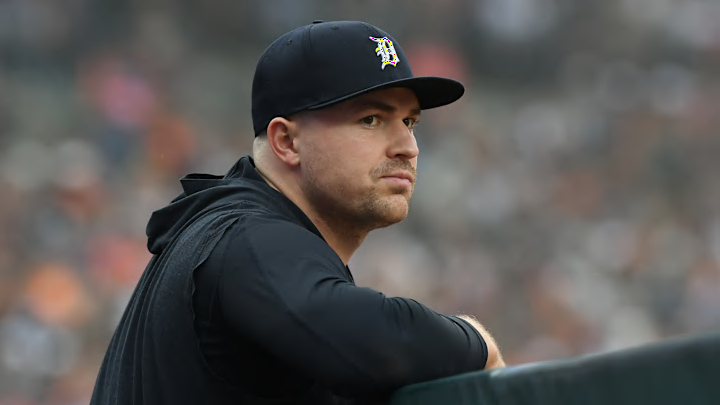
The Detroit Tigers were given one final chance to prove their commitment to Tarik Skubal, and they totally, emphatically whiffed. In his final year of contract arbitration before free agency, Skubal filed for a $32 million salary. Detroit filed at $19 million, which neither side willing to compromise enough to avoid a hearing.
That means — quite simply — that Detroit will need to argue that Skubal is worth $13 million less than his desired salary, and the Tigers will need to make that argument directly to Skubal, while a third party passes judgment. There is no way back from this for Detroit.
Tarik Skubal’s arbitration battle seals his Tigers fate

Skubal’s name has been a constant in trade rumors all winter, even before this seismic rift between the organization and their star pitcher. The odds of Detroit, a cheap, mid-market team, extending the best pitcher in baseball — for potentially $400 million-plus over the next decade — has never been realistic. Now, it’s downright impossible.
Detroit has let multiple generational aces walk over the years. Skubal is just the next in line. If there was any hope of bridging the gap and breaking the trend, Detroit needed to acquiesce to Skubal on some level in 2026 salary negotiations. Yes, $19 million is a historic number for a pitcher in arbitration. No, there’s zero precedent for a player making $32 million. The Tigers probably win this hearing. But sometimes the cold, hard business case can work against a team’s big-picture relationship with a star player.
Forget the “rules” or “standards” of MLB contract arbitration for a second. Skubal is 100 percent worth $32 million. He’s a back-to-back Cy Young winner and the most valuable player on the Tigers roster by a healthy margin. Skubal’s durability and consistency over the last few years has placed him in rarefied air. Besides maybe Paul Skenes, there isn’t a single pitcher who delivers more for his team on an annual basis.
Detroit is basically playing hardball with Skubal. They can get away with $19 million in all likelihood, so they’ll get away with it — even if it drives an even deeper wedge between the two sides ahead of long-term, arbitration-free negotiations next winter. The Tigers are approaching this with a purely capitalist mentality, trying to maximize their investment. Minimum input, maximum output. Skubal would probably love a signal that Detroit is willing to pay him his worth and is serious about a partnership beyond 2026.
Is a Tarik Skubal trade inevitable now?

A Skubal trade is more possible now than ever. If he by some miracle wins his hearing and is slated for $32 million next season, that’s just more motivation for a cheap front office to cut ties. If he gets stuck at $19 million, Skubal has more leverage to publicly decry his circumstances or at least to privately demand change. The overwhelming lesson, really no matter the outcome, is that neither side will come close in contract negotiations next offseason. Might as well sell now, recoup major prospect value, and bank on internal development, which has been Detroit’s M.O. throughout the Scott Harris era.
It’s worth noting just how absurd this all is, too. Detroit’s ownership group is one of the richest in MLB. The Tigers are not in a “small market” either. Sure, Detroit doesn’t have the glamorous reputation of a New York, L.A. or Chicago, but a lot of people live in Detroit. There is a massive fanbase for this Tigers organization and again, ownership is more than capable of footing the bill at $32 million. This is pure organizational penny-pinching.
Skubal is the face of Tigers baseball and really the only reason to take Detroit seriously as a contender in the American League. He’s as close as you can get to a scheduled W every fifth game — or every third or fourth game in the playoffs. Pitching shelf lives can be mercurial sometimes, but Skubal in 29 years old with some of the best stuff in MLB. He peppers his fastball all over the zone without issue; his changeup might be the single best pitch out there. He can get groundballs with his sinker. The slider is magic when he dials it up. There are precious few holes to poke in his repertoire. Skubal commands the zone extraordinary well, he records a metric ton of swing-and-miss, and he’s in the middle of what promises to be a sustained, fruitful prime window.
This was a missed opportunity for the Tigers to at least play nice and go into the season with a positive relationship to their organizational North Star. Instead, Skubal will be frustrated with his contract situation either way, and the Tigers have made it clear as day — publicly, to the whole league — that Skubal is a lame duck. Every big market will be lurking in the shadows, like sharks with the smell of blood.
Which teams can still trade for Tarik Skubal?
Los Angeles Dodgers

The Los Angeles Dodgers are the team best positioned to acquire Skubal, and their quiet offseason only increases the odds of this being their big splash. L.A. has a full rotation right now, but flipping Tyler Glasnow elsewhere shouldn’t be too hard. Emmet Sheehan is a premium trade chip and a potential Skubal replacement in Detroit, while L.A.’s battalion of promising young hitters (Josue De Paula, Zhyir Hope, Alex Freeland, Daulton Rushing) gives the Dodgers plenty of ammo. If any team can stretch their budget to accommodate Skubal beyond 2026, it’s the Dodgers. Read it and weep, other 29 MLB teams.
New York Mets
On the surface, the New York Mets are probably the next most likely Skubal destination. GM David Stearns typically avoids paying sticker price for pitchers, but Skubal is the best in the biz and an exception to the rule. Steve Cohen is baseball’s richest owner and the Mets desperately need a veteran ace to anchor this otherwise unproven, somewhat aimless and injury-prone rotation. Skubal puts the Mets right up there with Philly and Milwaukee as L.A.’s primary challengers in the NL. It just takes the necessary commitment from ownership and the front office. Jonah Tong and Brandon Sproat could pitch for Detroit next season; Carson Benge, Jett Williams and A.J. Ewing are just a few of the Minor League hitters worthy of Detroit’s consideration.
Toronto Blue Jays

Any team willing to pay the necessary price for Skubal will need to be willing to re-sign him, too — or at least make an earnest attempt at it. The Toronto Blue Jays deserve your attention accordingly. Toronto has a sneaky-deep farm system and more than enough MLB-caliber talent to toss Detroit’s direction. This pitching staff is mighty strong after the Dylan Cease and Cody Ponce signings, but Skubal clears them all by a healthy margin. If the Blue Jays can somehow roll out Skubal, Cease, Kevin Guasman and Trey Yesavage as their postseason four, with Shane Bieber in the mix too, it becomes unclear how many AL teams can realistically compete. Yesavage would be the ultimate return chip, though, for Detroit. The Blue Jays also have MLB-ready pitchers like Ricky Tiedemann and Jake Bloss. Potential hitters for Detroit: Addison Barger, Nathan Lukes, JoJo Parker.
New York Yankees
The New York Yankees are playing awfully cheap in free agency this winter, but we know the Yankees have the means to pay Skubal as a team that almost paid Juan Soto. Skubal is, hopefully, a long-term investment, but there is also immediate incentive for the Yankees with Gerrit Cole, Clarke Schmidt and Carlos Rodón all expected to begin the year on IL. New York has young bats, like Jasson Domínguez, Spencer Jones and Ben Rice, along with prospect pitchers like Ben Hess, Carlos Lagrange and Elmer Rodríguez to float to Detroit.
Baltimore Orioles

The Baltimore Orioles are perhaps the most interesting team in the hypothetical Skubal sweepstakes. Traditionally, Baltimore would not come close to qualifying as a team that could pay Skubal as a free agent. But their willingness to shell out $150 million to Pete Alonso does signal a changing of the tides. The O’s are still a smaller market and thus at a huge disadvantage, but after trying to re-sign Corbin Barnes, and after being connected to top free agent arms like Framber Valdez and Ranger Suárez for months, it at least merits consideration. Baltimore lacks quality young pitching to send Detroit (reroute Shane Baz, perhaps? Cade Povich?) but their stockpile of up-and-coming bats is substantial. Coby Mayo, Dylan Beavers, Enrique Bradfield, even Samuel Basallo — all these names could appeal greatly to the power-needy Tigers.
Boston Red Sox
Even after shelling out real assets for Sonny Gray, Willson Contreras and Johan Oviedo, the Boston Red Sox farm system is ripe for plucking. And Boston could still use a proper No. 2 ace to anchor the rotation next to Garrett Crochet. It’s becoming harder to believe that Craig Breslow would go to the lengths necessary to retain Skubal as a free agent, but Boston has an ascendant contender on its hands all the same and more than enough trade ammo to satisfy Detroit. Payton Tolle and Connelly Early could both start next season on the Tigers’ Opening Day roster. Meanwhile, Kristian Campbell, Franklin Arias and Mikey Romero are all promising young bats with potential day-one impact.
 Add us as a preferred source on Google