
Key Points
Bullet point summary by AI
- Five standout college players won't return after missing the NCAA Tournament this past spring.
- Each of these athletes demonstrated elite skills despite their teams' struggles, positioning them for pro opportunities.
- Their performances — highlighted by efficient scoring, rebounding, and defensive versatility — have NBA scouts taking notice.
The NCAA Tournament spotlights 68 of the best teams from all levels of D-I competition every spring. It's a great time of year for basketball fans, whether you're deeply invested in college sports or an NBA fanatic hoping to find your team's next star.
For some future NBA players, however, March Madness is simply not an option. All of these players excelled for their respective teams, but just weren't put in a position to win games. College basketball will miss them, but there's a good chance we see all five contributing on some level as pros in 2026-27:
Tucker DeVries, Indiana Hoosiers

Tucker DeVries, son of head coach Darian DeVries, has been one of the most talented scorers in college basketball for five years now. He spent the first three years under his father at mid-major Drake. He followed his dad to West Virginia, where an injury cut his (first) senior season short. Then he followed his dad to Indiana as a grad transfer, where he put together an excellent final campaign despite the Hoosiers' overall struggles.
DeVries is hovering somewhere in the grey area between second-round pick and undrafted free agent. Regardless, he will get his shot at the next level, even as a 23-year-old with limited athleticism. DeVries scores efficiently from all areas of the court — 60.9 percent at the rim and 33.3 on 3s, often with a high degree of difficulty.
That said, DeVries has a clear, sellable strength: 68.2 percent of his shot attempts came from 3-point range this past season. DeVries offers volume and versatility as a shot-maker. At 6-foot-7, he's a quick-thinking passer. He crashes the glass and exhibits active hands on defense (1.1 steals and 0.6 blocks) despite questions about his frame and agility. As a coach's kid, he should check a lot of intangible boxes for NBA scouts looking for value on the margins.
Nate Bittle, Oregon Ducks

Nate Bittle will be a favorite of the Moreyball analytics crowd. Over half his shot attempts come from 3-point range, where he converted 31.9 percent as a senior, and finished 69.7 percent at the rim. He was one of the best shot blockers in college basketball; he inhales rebounds and shows real passing chops for a 7-footer with an NBA frame. There's just a lot to like here, despite his advanced age at 22 years old.
The senior bucked modern trends and spent five years with the Ducks. He averaged less than seven minutes per game as a freshman and gradually expanded his role and contributions over time, becoming a cornerstone piece these last couple years. He averaged 16.8 points, 6.9 rebounds and 2.6 assists in a career-high 31.1 minutes this season, with 1.8 blocks to boot.
This was a trying season for the 12-20 Ducks, but it's hard to attribute their offensive shortcomings to a player as efficient off-ball as Bittle. He has a long enough track record individually to overcome the non-ideal circumstances of his final campaign, putting him firmly on the second round radar.
Juke Harris, Wake Forest Demon Deacons

Juke Harris will have lucrative NIL offers on the table after an explosive sophomore season for the Demon Deacons. He averaged 21.3 points and 6.5 rebounds on 58.1 percent true shooting, with some NBA Draft projections placing him as high as the late first round.
The 20-year-old will want a certain level of guaranteed compensation and security before he commits to the NBA, but nowadays, with so many freshmen opting to run it back, the path should clear for Harris to receive the necessary promises. Harris is a springy athlete with NBA size. He hit 33.2 percent of his 3s on over seven attempts per game, but he's also an explosive slasher who gets to the foul line often.
Harris will need to answer some questions on defense, but he's a clear pro-level athlete. It helps that he rebounds so well for his position, too. He's not an NBA on-ball engine, but Harris' low turnover rate relative to high usage at Wake Forest is an impressive indicator. His profile as a three-level scorer should be easy to capitalize on in the pre-draft process.
Hannes Steinbach, Washington Huskies

Hannes Steinbach arrived at Washington after starting his career with Würzburg in Germany. He led the Germans to the championship game at the U-19 FIBA World Cup last summer, a major boon to his draft stock before he set foot on a collegiate court. He did everything necessary with the Huskies to establish himself as a first round lock, with the potential to go as high as the lottery.
Steinbach exhibits incredible touch, fluidity and strength in the power forward spot. His lack of rim protection is a common knock on defense, but Steinbach moves his feet well and is great at defending vertically to impact shots on the interior, even if it does not result in blocks. He also puts a lid on the possessions; he's the best rebounding prospect in the 2026 class.
Lower 3-point volume leaves some questions about Steinbach's exact offensive profile, especially if he's not an everyday center. But he's incredibly coordinated and fluid, shooting 70.6 percent at the rim with elite touch. He also hit 75.9 percent of his free throws, so the shooting outlook is extremely positive. He's also an effective face-up scorer, using his tree-trunk legs and a strong frame to bulldoze mismatches as a slasher. He will be one-and-done at UW.
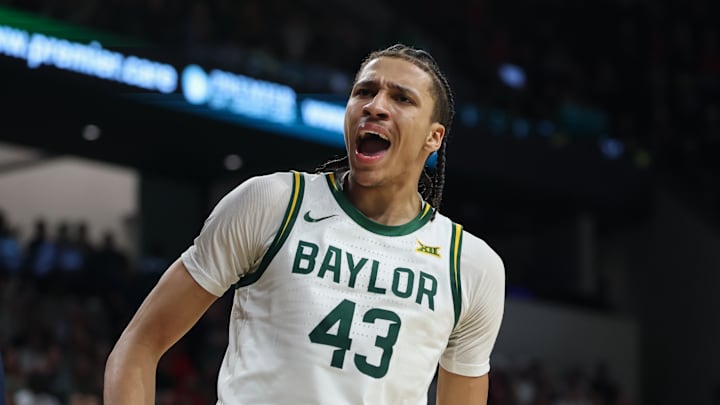
Cameron Carr, Baylor Bears

Baylor vastly underperformed expectations this season, but there were multiple individual standouts. Tounde Yessoufou, a five-star freshman, averaged 17.8 points and is right on the bubble between a return to school and a potential first round selection in the NBA. Then there's Cameron Carr, who arrived with the Bears as a junior transfer from Tennessee. After barely playing across two years with the Vols, Carr — himself a former top recruit — exploded out of the gate for Baylor, and somehow sustained that momentum over an entire season.
Carr averaged 19.2 points, 2.7 assists and 1.3 blocks on 64.0 percent true shooting, hitting 39.4 percent of almost six 3-point attempts per game. Baylor was able to lean on Carr in a variety of spots: running off screens, spotting up, as a trailer in transition. He's not a huge self-creator, but Carr generates such gravity off-ball. He's also a bouncy athlete in the extreme, able to time cuts and finish lobs with effortless flare.
Turnovers are an issue for Carr when he overextends himself, but lanky wings who can space and finish as prolifically as Carr often plug neatly into a broader team context at the next level. He's also a chaos engine on defense, with remarkable shot-blocking numbers for a wing and active hands as a free safety on the perimeter. He's less staunch as an on-ball stopper, but Carr's ability to cover ground, plug gaps and generate turnovers is immensely valuable.
A return to school would be shocking at this point. He's a first round lock, with potential to rise into the lottery with a strong pre-draft process.
More March Madness news & analysis:
 Add us as a preferred source on Google