
So much of NBA discourse is focused on how specific lineups perform against specific matchups. But what about the lineups we simply don't see enough of? So many NBA teams, from the basement-dwellers to the crème de la crème, would benefit from a bit more logistical creativity.
Here are five uncommon lineup configurations from five NBA teams. My hunch: all five of these lineups can pay off in big ways, both short and long term.
New Orleans Pelicans

Position | Name |
|---|---|
G | Jeremiah Fears |
G | Jordan Hawkins |
F | Trey Murphy III |
F | Zion Williamson |
C | Derik Queen |
The New Orleans Pelicans are dead last in the Western Conference at 6-22, which is especially problematic since they don't own their 2026 first-round pick. These are dire times for the Pelicans, but if there's a silver lining, it comes in the form of Derik Queen — the 13th overall pick back in June, and the player for whom New Orleans traded its (potentially very valuable) 2026 pick.
Queen has electrified an otherwise dour fanbase, averaging 12.8 points, 6.6 rebounds and 4.0 assists on 50 percent shooting. On Dec. 8 in San Antonio, he put up 33 points, 10 rebounds and 10 assists, one of the most impressive rookie performances in recent memory.
Naturally, a Pelicans lineup we need to see more of involves Queen. It also happens to involve Zion Williamson, whose recent oblique injury made it so this lineup won't see the floor for a while — if ever again. That said, assuming the Pels can't dump Zion's contract in a trade, and assuming that Williamson gets healthy again before long, New Orleans should give this lineup an extended trial.
Jeremiah Fears, Queen's fellow lottery pick, has been just as impressive this season. That is foundation upon which New Orleans' future will be built. Queen's quick processing and bully-ball scoring, combined with Fears' fearless slashing and dynamic, three-level scoring, gives the Pelicans a robust foundation upon which to build the offense. Zion, when healthy, is a walking paint touch, an explosive transition scorer, and a legitimate point forward. The Pels can stagger the offensive flow chart with three viable creators, all occupying different areas of the floor.
Jordan Hawkins and Trey Murphy round out this grouping as the two best shooters on the Pelicans' roster, both comfortable drifting off-ball and attacking seams in the defense, without demanding significant touches.
This lineup has spent 13 possessions on the floor together — with a point differential of +107.7 per 100 possessions, per Cleaning the Glass. That's a noisy number and doesn't mean much. But this is a fun group, and probably what most closely resembles the future of Pelicans basketball, whatever that entails.
Charlotte Hornets

Position | Name |
|---|---|
G | LaMelo Ball |
G | Kon Knueppel |
F | Sion James |
F | Tidjane Salaün |
C | Ryan Kalkbrenner |
The Charlotte Hornets aren't consistently winning games yet, but the future hasn't felt this bright in a hot minute. Kon Knueppel is on a historic path for a rookie, drilling 95 3s through 27 games. He's averaging 19.4 points, 5.4 rebounds and 3.6 assists on .477/.409/.923 splits. If the season ended today, he'd probably win Rookie of the Year.
Knueppel always felt like a safe bet for immediate production, but not even the most optimistic member of the Hornets front office could've predicted this level of impact from the jump. More than just a knockdown shooter, Knueppel is handling off of screens, beating closeouts and scoring efficiently on drives. He's one of the most polished 20-year-olds in recent memory.
It makes sense for Charlotte, like other rebuilding teams, to lean into its youth movement. This lineup features three rookies — Knueppel, Sion James and Ryan Kalkbrenner — along with last year's lottery pick, Tidjane Salaün. LaMelo Ball's future is in doubt, but he's still 24, and he's still Charlotte's best player by a healthy margin.
Charlotte nailed the 2025 draft. Beyond Knueppel, James and Kalkbrenner already feel like 10-year vets. Liam McNeeley has a chance to contribute for a long time, too. The Salaün pick a year ago was a bit more controversial, but to his credit, the French 20-year-old has found his stride, albeit in limited minutes. He's hitting 48.6 percent of his 3s (compared to 28.3 percent as a rookie). Two weeks ago, he dropped 21 points in 22 minutes on five made 3s against Chicago.
If Salaün evens out as even a slightly above league average shooter, with his range and athletic tools, Charlotte might be onto something. It's at least worth exploring more. Knueppel and James are lights-out shooters and sharp connective passers, while LaMelo's offensive generation and Ryan Kalkbrenner's rim-running (82 percent at the rim!) give this group a lot of balance. This lineup is +55.5 PTS/100 in 23 possessions.
Orlando Magic

Position | Name |
|---|---|
G | Jase Richardson |
G | Anthony Black |
F | Noah Penda |
F | Franz Wagner |
C | Goga Bitadze |
The Orlando Magic began the season in a funk, but are now within 1.5 games of the No. 3 seed in the East. There's a lot of season left, of course, and Franz Wagner's ankle sprain is a significant setback. But at the end of the day, Orlando still feels like one of the teams best positioned for a deep run in the NBA's most wide-open conference.
Paolo Banchero and Desmond Bane are bonafide All-Stars and central to what Orlando hopes to accomplish this season. But a fun potential wrinkle — and stop me if you've heard this before — would be an influx of youth. Orlando has a couple extremely promising rookies in Jase Richardson and Noah Penda, but neither has garnered significant playing time to date. What if that changed?
Richardson is the most plain and obvious solution to what still ails the Magic: shooting. Orlando is 26th in 3-pointers made and 25th in 3-point percentage. Bane was meant to help, and he has, but the Magic need more volume from beyond the arc. Richardson is much more than a catch-and-shoot guy, but it's one of his great strengths — and one the Magic can lean on.
Richardson has point guard instincts (and a point guard's frame), but he spent the majority of his lone season at Michigan State off the ball. That, in a way, makes him perfect for Orlando. He's great at relocating into open space, attacking errant closeouts, and finishing out of a variety of actions.
As for Penda, the Magic are +1.7 PTS/100 better with him on the floor already. When he shares the floor with Goga Bitadze, Orlando's best interior anchor on defense, the Magic overwhelmingly outscore opponents.
Penda is 7-for-11 from deep so far this season, a small but encouraging sample. Put him and Richardson on the floor, with Wagner and Anthony Black applying pressure on the rim offensively and versatility on defense, and Orlando checks a lot of boxes. This lineup wouldn't be a regular staple necessarily, but it fits — and it could give the Magic's youth a chance to break out in more impactful roles.
San Antonio Spurs

Position | Name |
|---|---|
G | Dylan Harper |
G | Stephon Castle |
F | Devin Vassell |
F | Keldon Johnson |
C | Victor Wembanyama |
The four-man group of Dylan Harper, Stephon Castle, Devin Vassell and Victor Wembanyama has played a grand total of 42 possessions this season. That is absolutely wild to consider. Injuries are part of the reason why, of course. Both Harper and Wemby have missed time. But in reality, it comes down to a simple lack of interest or investment from the San Antonio Spurs' coaching staff.
This shouldn't necessarily be read as criticism. San Antonio is one of three teams to beat OKC and currently sits third in the West, only a half-game behind Denver, despite their aforementioned trials. Mitch Johnson has done a fabulous job engineering what Wembanyama might describe as "sophisticated basketball," Spursian by nature.
But we ought to see more of this group, point blank. Dylan Harper has looked like a star, but he's only averaging 21.8 minutes per game. He scored 21 points in 28 minutes in the NBA Cup final. A couple days later, he dropped 24 in 22 minutes against the unassuming Wizards. Harper gets to the rim like an office worker drinks morning coffee. It's his lifeblood. The rookie is attempting 57 percent of his shots at the rim, in the 100th percentile for guards. He creates advantages and collapses the defense with such effortlessness. It's something the Spurs need to lean into.
That brings us to the elephant in the room — the reason this particular lineup configuration has been so scarce to start out the year: De'Aaron Fox. The Spurs made their blockbuster trade for an All-Star point guard right before Harper fell into their lap via the NBA Draft lottery. It was not planned, but San Antonio now has a clear burgeoning star, and the No. 2 overall pick, buried in a loaded backcourt.
Fox is still excellent, and he's unequivocally "better" than Harper in a vacuum. For now. The Spurs are trying to win games, and thus the best players will dominate touches. Stephon Castle has done nothing to diminish his standing in the rotation, either. But there is also an element of inevitable future reckoning. Harper will make these conversations more difficult over time, not less. He's not a player the Spurs want to stifle in any way.
When Harper, Castle, Vassell and Wemby share the floor with [insert PF here], the results are excellent: +72.4 PTS/100 (100th percentile), 79.3 eFG% (100th percentile), 37.9 percent field goal rate (100th percentile). Harper and Castle is very much the backcourt of the future in San Antonio. I'm not sure what that ultimately means for Fox, but the Spurs need to let Harper cook with the regulars more often.
Philadelphia 76ers

Position | Name |
|---|---|
G | Tyrese Maxey |
G | Jared McCain |
F | VJ Edgecombe |
F | Paul George |
C | Joel Embiid |
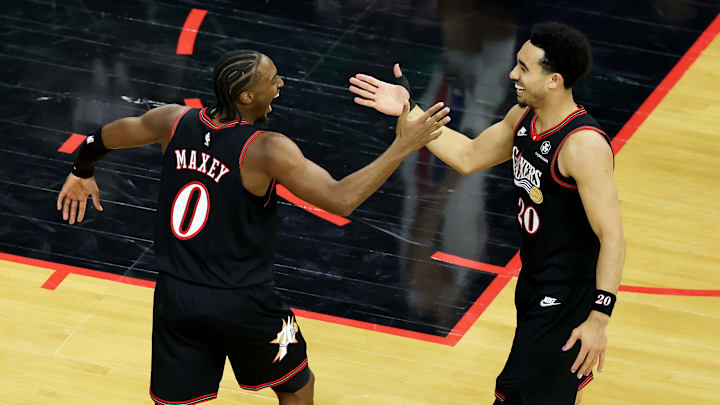
This lineup has not played a single possession together this season, which feels borderline insane. Jared McCain has been back in the lineup for 17 games, averaging a meek 17.9 minutes. I'll admit: it has not been pretty. But after the season he had as a rookie, the onus is on Nick Nurse and the Philadelphia 76ers to get him up to speed — to work through bumps in the road as he returns from both leg and thumb injuries, rather than banishing him to the doghouse any time the matchup becomes remotely unfavorable.
McCain returned to a very different Sixers team than the one he left midway through last season. Not only is Tyrese Maxey healthy, but Philadelphia has since traded for Quentin Grimes and lucked into VJ Edgecombe with the No. 3 overall pick. That has mucked up the backcourt hierarchy. Maxey, Edgecome and Grimes are all playing incredibly well to begin the season, too, which makes it even harder for McCain to establish his foothold.
The rationale for Nick Nurse's usage (or lack thereof) of McCain is simple and justifiable on the surface. He's the weakest link defensively for a team that is already pushing the limits of how small and fast a team can play without suffering catastrophic defensive consequences. Embiid's off-and-on injuries have also diminished his overlapping availability with McCain, not to mention how Embiid's absences can impact Philadelphia's already-fragile defensive ecosystem.
This is the simple truth of the matter, though: McCain is a talented individual, with a level of feel and skill that seldom manifests at such a young age. The Sixers will come to regret not playing him more, especially if he ends up buried and traded away within the next year or two. Such prophecies of doom are probably premature, but it's not especially difficult to imagine Philadelphia fumbling this situation. They need to work deliberately to unlock the Jared McCain who averaged 15.3 points on 58.9 percent true shooting as a rookie.
This lineup is not without its defensive limitations, but Maxey has made vast strides as an individual defender, even since last year. Edgecombe is small for a wing, but he's one of the most electric and bubbly athletes in basketball. He can defend bigger than his listed height and fly around in passing lanes. Paul George is still an incredible defensive Swiss Army Knife, and Embiid is starting to show hints of his all rim protection skill. There's enough here to insulate McCain, himself more physically strong and savvy than he gets credit for.
Offensively, this group has immense potential. Embiid still draws double teams on almost every touch, even when he can't hit the ocean from the beach. Maxey has become the most dynamic scoring "small" guard in the NBA. Edgecombe can do the little things — space, cut, pass, finish — while George can bomb 3s and freestyle a bit. Throw in McCain, with his high-volume shooting and complementary playmaking, and there aren't many weak points for the opposing defense to exploit.
It's clear that Nurse would rather plug either Quentin Grimes or Dominick Barlow into the McCain slot nowadays, but the Sixers need to give their 21-year-old guard the chance to get right.
 Add us as a preferred source on Google