

On the night of the 2025 NBA Draft, a lot of attention was paid to Cooper Flagg, as the all-but-guaranteed No. 1 overall pick landed with the Dallas Mavericks and immediately became the face of the franchise. Elsewhere, Kon Knueppel immediately helped to transform the Charlotte Hornets, VJ Edgecombe made a substantial impact on the Philadelphia 76ers, and Dylan Harper added another mega-talent to the San Antonio Spurs arsenal.
When it comes to the Atlanta Hawks, the gratification was delayed, but it's coming soon. The Hawks made a trade with the New Orleans Pelicans on draft night that was almost universally praised to the highest degree. Atlanta moved the No. 13 pick, which became Derik Queen, to the Pelicans for an unprotected first round pick in the 2026 NBA Draft and the No. 23 pick in 2025, which became Asa Newell. Adding to the intrigue was the reality that the 2026 pick was not only unprotected but it was the better of the New Orleans and Milwaukee first round pick, meaning that Atlanta had a "double" chance (not quite double, but the sentiment applies) to land near the top of the 2026 board.
The Pelicans stumbled mightly out of the gate and, while they are playing better basketball of late, Atlanta is still in a position to potentially jump into the top four when the NBA Draft lottery takes place in May. With that as the backdrop, the focus in this space is to highlight the best possible pick that the Hawks could make at each of the top four draft spots. Functionally, this operates as a March "big board" of sorts, with a lot of room for changes in the future, but it also showcases the immense talent of the 2026 class and just how helpful it would be to Atlanta's future if the ping-pong balls bounce in a favorable direction.
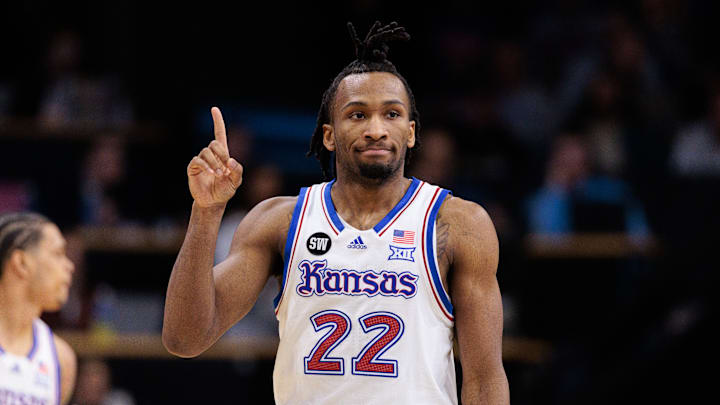
No. 1 overall: Darryn Peterson, Kansas
An important thing to note about the top of the 2026 class is that the group includes at least three viable No. 1 pick options. As such, it is not as if Peterson is in his own tier or anything close. In fact, it is a log jam in the top three to the point where any of the three options would be quite reasonable.
With that out of the way, Peterson gets the slight nod here for upside purposes, as the 6-foot-5 guard has the traditional superstar package of traits that makes him incredibly appealing. This season has been strange at Kansas, including a number of high-profile early exits for Peterson, but when he's been playing, the highs have been quite high. He's an elite shooter. He's a big-time athlete. He has real defensive upside. The whole thing is there ... as long as the medicals check out in a positive direction.
If they don't, obviously things will change, but the Hawks putting Peterson in the mix alongside Jalen Johnson, Dyson Daniels, Nickeil Alexander-Walker, and others would be incredibly appealing.
No. 2 overall: Cameron Boozer, Duke

Boozer has his detractors who worry about his "lack of upside," simply because he is not the most explosive athlete in the world. Still, the Duke superstar has been, very clearly, the best player in college basketball at the age of 18, and Boozer has been a high-level winner at every single level of youth basketball.
Boozer is the National Player of the Year frontrunner, averaging 22.6 points, 10.0 rebounds, 4.0 assists, and 2.2 stocks per game. His efficiency is off the charts, including 64.9 percent on two-point attempts and 40.4 percent on 3-point attempts with 67.4 percent true shooting overall. He is leading the country in virtually every catch-all metric, including BPM, and Boozer sits atop the KenPom Player of the Year race by a comically wide margin.
In short, he's awesome.
There is some question about Boozer's fit with Johnson, as both players are best at the "4" on the positional spectrum. However, Boozer projects as a player who could play small-ball 5 in certain configurations, and Johnson can flash to the 3 when needed given his diverse skill set. Moreover, drafting for "fit" at No. 2 overall is a fool's errand, and Boozer's versatility is a part of his appeal, rather than a limiting factor.
No. 3 overall: AJ Dybantsa, BYU

As noted above, there are at least three No. 1 overall pick caliber players, so it's not a shot at Dybantsa to have him at No. 3 on this list. Dybantsa is a 6-foot-9 forward who could be a superstar at the NBA level when looking at his ability to score, physical tools, and potential two-way appeal.
Dybantsa is currently leading the country in scoring at 24.8 points per game, and he is doing so on 60.9 percent true shooting. In Big 12 play, Dybantsa has been even more productive, putting up more than 26 points per game, and his secondary skills (defense, playmaking) have come to the forefront more often of late.
At times, Dybantsa's shot selection wavers a bit, and his defense has sometimes been inconsistent. With that said, he's done a great job at checking the boxes that NBA teams want to see, and 6-foot-9 forwards who can do all of what Dybantsa can do are not readily available. It is easy to dream about Dybantsa and Johnson forming a forward duo that may be unmatched outside of Boston's Jayson Tatum and Jaylen Brown.
No. 4 overall: Caleb Wilson, North Carolina

It is fair to say that there might be a slight drop after the top three but, in a lot of drafts, Caleb Wilson would be in the mix for the No. 1 overall pick. He's that level of prospect.
Wilson suffered a fractured hand in February that currently has him sidelined by, but he was playing at an unbelievable level prior to that injury. The 6-foot-10 forward is averaging 19.8 points and 9.4 rebounds per game as the top player on North Carolina's roster, and he has put up at least 20 points in 17 of 24 games this season.
Wilson has also shined against top-level competition. Against Peterson and Kansas in November, Wilson put up 24 points, seven rebounds, four assists, and four steals in a win. Against Boozer and Duke in February, he put up 23 points (on 8-of-12 shooting) in an upset win. Wilson has regularly been the best player on the floor even in high-level situations, and he has the potentially additive appeal of being from the Atlanta area.
Overall, Wilson's athleticism is striking at his size, and he has impressed with varied skills as the season has gone along. The concerns, if there are any, come from 3-point shooting (where he's not a big-time threat right now) and a bit of uncertainty on his best possible role at the NBA level. Like with Boozer, scouts may worry about his positional fit next to Johnson but, with respect to Houston guard Kingston Flemings and others, Wilson is still the best available player if the Hawks draw the No. 4 overall pick on lottery night.
More Atlanta Hawks news and analysis:
 Add us as a preferred source on Google