
Key Points
Bullet point summary by AI
- The South Region boasts multiple NBA prospects, including the reigning national champions and last year's runner-up, both loaded with talent.
- Scouts will closely monitor a group of 15 standout players, each bringing unique skills and potential to the professional level.
- This high-stakes tournament provides a crucial stage for prospects to elevate their draft stock and secure a spot in the NBA.
The NCAA Tournament bracket is set and March Madness is afoot, with 68 teams and thousands of players all competing for the same trophy. For NBA Draft purposes, this is the best opportunity to watch almost every major prospect play in a high-stakes environment, all in rapid succession.
There's plenty of intrigue in the South Region, where the reigning champs from Florida claimed the No. 1 seed, followed by last year's runner-up Houston in the No. 2 seed. Both teams are loaded with NBA prospects, while Illinois, Vanderbilt and other teams will also be under the microscope for scouts. Here are the 15 best prospects you need to know from the South quadrant:
15. Kylan Boswell, Illinois

Projected Draft Range: Second Round
There is natural concern with an older 6-foot-2 guard who's a career 32.8 percent 3-point shooter (31.1 percent this season), but Kylan Boswell checks so many other boxes for the Fighting Illini. He's built strong, and he uses that frame to carve out below-the-rim finishes with tremendous success. His poise in the pick-and-roll, the steady hand with which he guides the offense, should appeal to NBA teams hoping to find a guard who can simply limit mistakes and set the table for the second unit. He's also a hellacious on-ball defender, even if a low steal rate works against him. Boswell plays like a vet and should get a fair shake in the NBA as a result.
14. Duke Miles, Vanderbilt
Projected Draft Range: Undrafted
Duke Miles dropped 30 points on Tennessee in the SEC Tournament opener and scored 19 in a close loss to Arkansas in the final. The Vandy point guard will be fighting an uphill battle in the NBA at 6-foot-2 and 175 pounds, but Miles leads the SEC in steals (2.7), gets to the free throw line a bunch and is an overall electric on-ball generator, able to apply pressure on the rim and set up the offense without coughing up many turnovers. This is his sixth year in college basketball and he's already 24, but he has done enough this season to earn a real shot in the NBA.
13. Zvonimir Ivisic, Illinois
Projected Draft Range: Second Round
Zvonimir Ivisic left the John Calipari ecosystem after two years to join his older brother, Tomislav, at Illinois. The result has been a slight decrease in playing time, but probably his best season to date metrically. Ivisic is shooting a comical 83.3 percent inside the arc. He can space out to the 3-point line, too. At 7-foot-2, he's also averaging 2.1 blocks in 17.8 minutes. Not a typo. Ivisic can look a half-step behind the action at times, but he just consumes space and offers a grade-A rim deterrent. There's an interesting push-pull between him and his brother, who shoots the lights out but can't really defend. Anyhow, Ivisic could stick around another year, but he'll turn 23 shortly after the draft so now is probably the time to take a leap of faith.
12. Alex Condon, Florida

Projected Draft Range: Second Round
Alex Condon still has questions to answer regarding his physicality, as limited core strength and a high center of gravity can put him in foul trouble against more bullish interior scorers. That said, it's hard to deny the scope of production at this point, especially since it leads to winning for the Gators. Condon is a rangy, mobile rim protector. His 3-point shooting as cratered as a junior, but there's enough volume (plus reasonable touch indicators) to believe he can become a stretch five in the NBA. Condon's passing is the real selling point. He processes the floor quickly and gets creative with his deliveries. Shot-blocking, floor-spacing, high-IQ bigs who compete hard tend to get a runway at the next level.
11. Rueben Chinyelu, Florida
Projected Draft Range: Second Round
Rueben Chinyelu has started over 70 games for Florida over the past two seasons, contributing in small ways, often on the margins. He just feels like a classic second round big man: 6-foot-11, 245 pounds with a tank-like build and a voracious appetite on the glass. That one sellable skill that almost certainly translates to the next level. Chinyelu throws his weight around on defense and blocks some shots, too. He finishes efficiently at the rim, even if that's generally the extent of his contributions on that end. He is the best rebounder in the SEC, maybe in all of college basketball, and that is a valuable skill that folks too often overlook.
10. Álvaro Folgueiras, Iowa
Projected Draft Range: Return to school
Álvaro Folgueiras was a draft sicko favorite at Robert Morris, generating big expectations for his team-up with Bennett Stirtz under Ben McCollum at Iowa. This season has yielded mixed results, and to put it bluntly, Folgueiras does not always pass the eye test. He's not especially strong or even fluid, yet he converts all sorts of funky finishes around the rim, where he's shooting 73.8 percent. He's a savvy connective passer who limits turnovers. He rebounds effectively. The defense is better than the surface numbers look. He almost certainly returns to school in hopes of a senior season breakout, with the first round within reach. But if the Hawkeyes can find some magic dust in March, anything is possible.
9. Chris Cenac Jr., Houston

Projected Draft Range: 15-30
Chris Cenac Jr. entered his freshman season as a projected lottery pick. That outcome is not entirely off the table at this point, but there's a good chance he ends up weighing NIL offers to potentially stay in school for a second year. Cenac is a mess defensively right now, although the effort is commendable and he's a major athlete. He's 19, so there's ample time to put the pieces together. His decision-making on offense is best described as a work in progress, but teams are often willing to be patient with 6-foot-11 bigs who can shoot and handle as smoothly as Cenac. He makes some incredible plays in iso; the spot-up gravity is real. He attacks the glass well, despite a lighter frame. He probably should run it back, but if there are first round offers on the table, Cenac probably declares.
8. Joseph Tugler, Houston
Projected Draft Range: Second Round
Joseph Tugler's offensive limitations are real. He averages more turnovers (1.3) than assists (1.2) as a junior. He has attempted a grand total of 14 3-point field goals across three years at Houston. And yet, he's also a brute-force machine at the rim (74 percent) and a prolific offensive rebounder. That should give him enough marginal utility to support what might be the single most impressive defensive profile in the class. Tugler averages 1.4 steals and 1.5 blocks in 23.4 minutes; he's 6-foot-7 and 230 pounds, with light feet, able to switch on the perimeter or wage battle on the block. He could return to school and finish out four great years with the Cougars, but there will be interest in a potential All-Defense candidate hiding in the second round.
7. Pryce Sandfort, Nebraska
Projected Draft Range: Second Round
Pryce Sandfort, brother of OKC wing Payton Sandfort, led Nebraska to a 20-0 start this season. He's among the most efficient high-volume shooters in college basketball, running off screens, pindowns and the like, and needing very little space to pull the trigger. He has vastly expanded his offensive profile this season, too, beating closeouts, slinging impressive passes into tight windows and keeping turnovers to a minimum. He even boasts active hands on defense. Low rebounding and free throw numbers are natural drawbacks for the analytics crowd, but Sandfort looks like a plug-and-play, star-in-his-role type. Another season with the Cornhuskers is very possible, but he could end up a lot higher on boards than expected if he shoots the lights out in pre-draft workouts.
6. Henri Veesaar, North Carolina

Projected Draft Range: 20-40
Henri Veesaar has a chance to really lock up a first round bid if he can lead North Carolina on a March Madness run without top-four prospect Caleb Wilson. Especially when so many underclassmen will inevitably decide to run it back in college. Veesaar will need to answer some questions defensively, where he's not a great rim protector, but his offensive skill set maps beautifully onto the modern NBA game. He's a strong, powerful rim finisher who's also hitting 42 percent of his 3s on almost three attempts per game. Veesaar sets broad screens, is frequently deployed as a hub around the elbow, and does everything a team could ask for in a connective, play-finishing big.
5. Thomas Haugh, Florida
Projected Draft Range: 10-25
Thomas Haugh popped on NBA radars last spring when he played a critical role in Florida's national title run. Now he's back as the centerpiece of a No. 1 seed, with a chance to boost his stock as high as the lottery. Haugh offers a ton of clear role player traits that should broaden his appeal, especially among teams hoping to contend next season. While he's not much of a self-creator on the wing, Haugh is an explosive vertical athlete who can get behind the defense for lobs, attack closeouts in a straight line, and keep the defense honest with a healthy volume of 3s. He makes plays on defense (2.1 stocks), he crashes the glass, and he does not need copius touches to influence the game in a positive way.
4. Bennett Stirtz, Iowa
Projected Draft Range: 15-30
Bennett Stirtz is a lottery talent in my book. There are natural and not-unfounded concerns about an older guard with a negative defensive projection, but Stirtz is probably the most masterful capital-P, capital-G Point Guard in college basketball. He exerts total command over Iowa's offense, playing a comical load of minutes. He offers a 2.3 AST:TO ratio; he's bombing 37.6 percent of 3s on high volume. What Stirtz lacks in sustained burst, he typically compensates for with craft. His footwork, gear shifts and pull-up jump shot put a lot of college defenders six feet under. Stirtz is going to be targeted on defense due to a thinner frame, but he's active off-ball, racking up 1.5 steals per game. The instincts are stellar on both ends. He just knows the ins and outs of this sport in a way few other 22-year-olds do. A smart NBA team will pick him up and reap the rewards.
3. Keaton Wagler, Illinois

Projected Draft Range: 5-14
My precise order for these guards will read as spot-on to some and total nonsense to others, but it's just that kind of class. All these guys are extremely close, for what it's worth, and team context will matter at the next level. That's especially true for Keaton Wagler, who's the weakest defender of the bunch, despite his plus positional size at 6-foot-6. Wagler is not an NBA athlete at first blush. He lacks physicality and he doesn't really turn the corner well. But the dude is A) a hyper-elite shooter and B) endlessly creative, able to herky-jerky, shake-and-bake his way to pull-up jumpers or open passing lanes. He's so smart, so clever, with so many counters to what are, on the surface, defensive advantages. Pair his vision and craft with lights-out shooting, out of a variety of actions, and there's a clear path to offensive stardom at the next level.
2. Tyler Tanner, Vanderbilt
Projected Draft Range: 20-40
Look, Tyler Tanner goes against everything the modern NBA claims to value in a guard. He's generously listed at 6-foot even, with a featherweight frame that is going to create issues at the next level. Teams want size, versatility, physicality. Tanner does not really deliver on that front. But man, he just checks every other box. It's becoming harder and harder to fade the Vanderbilt sophomore. He's a hard-wired competitor, wreaking havoc on defense, punching above his weight on the glass, and exhibiting bountiful skill offensively. Tanner's 3-point shooting has come on strong after a rough freshman campaign; he gets it off quickly and with touch, able to calibrate his exact load time and release point based on the defense's contest. He's a bursty downhill driver, able to get up above the rim when a lane opens up. He sees the floor impossibly well for such a small guard, with a 2.8 AST:TO ratio. If he's 6-foot-4, he's the top point guard in a loaded class.
1. Kingston Flemings, Houston
Projected Draft Range: 4-8
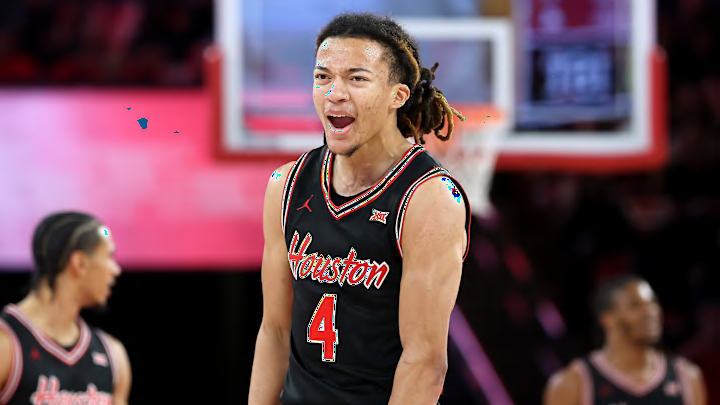
There's not much debate in the No. 1 spot here, as Kingston Flemings began the season red-hot and never really let his foot off the gas pedal. Next to Darius Acuff, Flemings is probably the most composed freshman guard in the country. He's a natural-born leader, both in the locker room and on the court. He doesn't get sped up or out of control, yet he can play a breakneck speed. His first step is unmatched in this draft class. Flemings puts instant pressure on a defense and fruitfully extends advantages, delivering pinpoint passes mid-sprint and finishing with power or finesse at the rim. He gets to the free throw line. He's a relentless on-ball defender and pickpocket. He is, for my money, the best "pure point guard" in the 2026 class, if such a thing still exists.
More NBA Draft news and analysis:
 Add us as a preferred source on Google