
Key Points
Bullet point summary by AI
- The Midwest Region features refined upperclassmen aiming for the NBA's first round come June.
- Multiple prospects could enhance their stock with strong performances ahead of the NBA Draft.
- This group’s versatility and productivity could reshape several NBA rosters next season.
The NCAA Tournament bracket is set and March Madness is finally here, which means this is the last opportunity for NBA Draft scouts to analyze prospects in a competitive environment. Nothing can tank or explode a prospect's stock quite like a single elimination tournament where every performance carries the weight of the world.
The Midwest Region of the bracket does not have the heavyweight freshman talent of teams like Duke, Kansas or BYU. But it does have some of the most refined and productive upperclassmen in the country, many of whom will be hoping to hear their names called in the first round come June. There are also plenty of sleepers worth putting on your radar. Let's dive in:
15. Ugonna Onyenso, Virginia

Projected Draft Range: Undrafted
Virginia senior Ugonna Onyenso made a statement with nine blocks (in only 22 minutes) in Virginia's loss to Duke in the ACC Championship Game. He gave Wooden Award frontrunner Cam Boozer more problems than just about any other defender to cross Duke's path this season. Onyenso is averaging 3.0 blocks in 18.5 minutes for the season; it does not take much imagination to envision his role at the next level. He's an agile 7-footer with a huge wingspan and impressive timing as a rim protector. He's mostly a screener and dunker on offense, but he's attempting one 3-pointer per game this season — so there's hope that he can space the floor one of these days. It's easy to see him as an energy big who can come off the bench and muck up the middle of the floor.
14. Johann Grünloh, Virgina
Projected Draft Range: Return to school
German 7-footer Johann Grünloh was on draft radars last season as an international prospect but decided to come stateside and play under Ryan Odom at Virginia. He hasn't carried a huge load as a freshman in a crowded frontcourt, but there's plenty to like as a 3-and-D center. He's shooting 35 percent on almost two 3s per game and he's averaging 2.2 blocks in 21.1 minutes. Grünloh can get into foul trouble and he's a bit stiff when asked to defend out in space, but the baseline instincts, packed in a massive frame, put him on the right path to becoming a viable anchor at the next level. He's mostly a play-finisher on offense at this point, but Grünloh executes his role at a high level. Another year at UVA could put him in the first round conversation.
13. Tamin Lipsey, Iowa State
Projected Draft Range: Second Round
Tamin Lipsey will have natural skeptics as a 6-foot-1 guard shooting 31.1 percent on 3s and 64.4 percent on free throws. That are not unconcerning numbers, but here's the deal: the dude knows how to play. Lipsey fruitfully orchestrates a dynamic Iowa State offense, delivering slick passes out of the pick-and-roll and using his bowling-ball frame to absorb contact and attack the rim on drives, where he finishes at a 62.9 percent clip. His steal numbers are off the charts and his brain works at warp speed, with an impressive 3.3 AST:TO ratio as the Cyclones' lead ball-handler. If the shot comes around even a little bit, Lipsey has all the tools to succeed, and that fact he's still attempting almost four 3s per game counts for something.
12. Blue Cain, Georgia

Projected Draft Range: Return to school
Blue Cain probably returns for his senior season in Athens, where he'll get a chance to really pop on NBA radars as the leader of a talented UGA team. But the Dawgs aren't half-bad now, and a loud March could help Cain's case. He does not always look like an NBA athlete at first blush, but his stop-start handle and incredible craft on below-the-rim finishes makes a real dangerous slasher. He's not a high-volume assist guy, but Cain sees the floor well enough and he doesn't commit silly turnovers. Moreover, on the other end, he's a gutsy defender despite his lighter frame, with great instincts in a free safety role. He checks a lot of the boxes teams care about in a potential secondary ball-handler and connective guard. Do not sleep on him.
11. Amari Allen, Alabama
Projected Draft Range: 20-40
Amari Allen was the 64th-ranked recruit in his class, but the Alabama freshman has skyrocketed into the first round conversation thanks to his usefully diverse skill set. Every NBA team wants dribble-pass-shoot wings. Allen does all those things, hitting 36.5 percent of his 3s, attacking the rim with clever gear shifts, and using his strength to take bumps and redirect defenders at the rim. He's active on defense, competitive on the glass; there's not a ton to knock him for at this stage of his development. He isn't overly explosive as an athlete, which can limit him in certain matchups and situations, but it's rare to find a 6-foot-7 , 19-year-old wing with Allen's versatility and IQ.
10. Milan Momcilovic, Iowa State
Projected Draft Range: Second Round
Milan Momcilovic has been a fringy NBA prospect for years now, but this season might be what fully breaks him into the draft conversation. Momcilovic is shooting 49.6 percent on 3s (on 7.5 attempts) and 54.5 percent on 2s, including 26-of-32 (81.3 percent) in his limited rim attempts. There is basically no more efficient scoring profile for a wing in this year's class. A shot-maker of Momcilovic's caliber, at 6-foot-8 and 220 pounds, is not exactly an everyday discovery. He shoots comfortably off of movement. His high release point, along with clever footwork, has made him a real threat in the mid-range. Momcilovic is more or less passable on defense; he doesn't create much action at that end, but he's not a complete stiff. He won't rebound, the passing volume is low, and he's primarily ground-bound. But man, anyone shooting like this, at his size, has a good shot in the pros.
9. Malachi Moreno, Kentucky

Projected Draft Range: Return to school
Malachi Moreno has stepped up to the plate for Kentucky amid Jayden Quaintance's almost season-long absence. He has started 28 of 34 games, emerging as a quality rim deterrent with the right package of offensive skills to capture NBA attention. He will still fade into the background a little too often, but Moreno's length and agility as a 7-footer puts his defensive ceiling higher than most. He's also a skilled short roll passer, able to locate cutters or swing it to shooters without pause. His range has not fully expanded out to the 3-point yet, but Moreno is a 70 percent free throw shooter who exhibits touch in the mid-range. He probably returns to school in order to establish himself in a more load-bearing offensive role, but if the Wildcats can find some March magic, Moreno could definitely test the waters.
8. Allen Graves, Santa Clara
Projected Draft Range: 20-40
Allen Graves ranks fourth in the nation in BPM (13.4), behind only Cameron Boozer and two star upperclassmen in Yaxel Lendeborg and Zuby Ejiofor. He's playing a more niche role still for Santa Clara, but the 6-foot-9 freshman is an exceptional defender — with range and instincts leading to 2.0 steals and almost a block per game in 22.5 minutes. Graves is also hitting 41.6 percent of his 3s, scoring efficiently at the rim or in the mid-range, and rebounding exceptionally well on both ends. Graves could work his way from relative obscurity into the first round mix, especially if the Broncos pull off an upset or two. Another potential route would be returning to school, maybe hitting the transfer portal, and really blossoming as a sophomore who's a bit more front and center.
7. Morez Johnson Jr., Michigan
Projected Draft Range: 20-40
Morez Johnson Jr. has proven essential in Michigan's jumbo-sized frontcourt, doing just about everything on the defensive end. He's 6-foot-9 and 250 pounds, but he can switch effortlessly on the perimeter and muck things up in the paint with a long wingspan. His physicality and timing, especially as a weak-side shot blocker, is a potent mix. He's less polished on offense, but Johnson led the Big Ten in field goal percentage this season. His powerful frame works wonders in the paint, where he's an explosive leaper with a lineman's strength on straight-line drives. He can space the floor a bit, shooting 39.3 percent on a low volume of 3s. That's a new development, and his 78.7 percent free throw clip bodes well for Johnson's long-term shooting projection. If he can speed up his processing a bit and add more ball skills, the upside is considerable.
6. Nate Ament, Tennessee

Projected Draft Range: 10-20
Nate Ament is a real tough cookie to crack from an NBA Draft perspective. He began the season projected as a top-five pick, and not without reason. It's hard to find 6-foot-10 wings who can dribble, shoot and pass — and Ament's shot-making flashes in high school were especially tantalizing. He's also an active defender, with a lengthy wingspan and the agility to mirror ball-handlers on the perimeter. The problem is... Ament is just not very athletic, and it shows up with poor finishing numbers (53.8 percent at the rim). He rarely dunks; Ament can get downhill, eat up space and draw fouls, which is a positive sign. But when he can't turn the corner or draw favorable contact, he becomes woefully inefficient. Size, a low turnover rate and a smooth jump shot all point to a bright future for Ament, but the downside can feel a little too steep at times.
5. Christian Anderson Jr., Texas Tech
Projected Draft Range: 15-30
Texas Tech and Christian Anderson are limping (almost literally) into the Big Dance, but Anderson has done enough over the course of this season to solidify his first round bid. The depth of this guard class could convince him to return to school and angle for an even higher slot next year, but Anderson would be playing with fire at that point. A lightweight frame — 6-foot-2 and 165 pounds, allegedly — works against Anderson, but he's extremely skilled and endlessly confident. Anderson is a deadeye shooter with deep range, comfortable firing off the dribble (his preferred mode) or spotting up. He's shooting 42.5 percent on eight 3s per game this season. He's also dishing out a conference-leading 7.6 assists, with incredible live-dribble vision coming off screens and DHO actions. He doesn't get to the rim much, which could be a complicating factor in the NBA, but Anderson's touch is elite. If he can add a bit more muscle and refine his shot profile a little bit, the ceiling (at least offensively) is sky-high.
4. Aday Mara, Michigan
Projected Draft Range: 15-30
Aday Mara's performance in Michigan's Big Ten Tournament loss to Purdue was, shall we say, subpar. But he has overwhelmingly excelled this season, particularly on the defensive end. Mara led the conference in blocks (2.6) in just 23.1 minutes per game. At 7-foot-3, his sheer size is a deterrent for opponents hoping to set foot in the paint. But he's also more nimble than he gets credit for, with sharp timing and a steady motor. Mara will need to answer stamina questions and stay out of foul trouble at the next level, but even if he's a 25 MPG kind of player, his impact in those minutes could far outweigh many of his peers in this draft. Mara is also quite intriguing as an offensive player. The shooting indicators are rough, but he's an elegant screen-and-roll partner with an incredible talent for mapping the floor and rifling quick-hitting passes to an open teammate. His outlet passes off of rebounds are also awesome; some real Kevin Love magic is happening there. Bigs as smart and imposing as Mara deserve an extended leash in the NBA.
3. Joshua Jefferson, Iowa State

Projected Draft Range: 15-30
Joshua Jefferson has gradually expanded his skill set each and every season, becoming a damn special player for Iowa State as a senior. He is the orbital focus of the Cyclones' offense — a high-volume facilitator at 6-foot-8, 220 pounds. Jefferson can attack the rim with long, arrhythmic strides. He can post up smaller defenders and bully them on the block or see the whole floor and locate the open teammate once the defense collapses. He's shooting a career-high 34.5 percent on 3s, attempting 3.2 per game. He's not an explosive, jittery athlete, but Jefferson handles various defensive assignments with aplomb and showcases his quick hands, averaging 1.7 steals. He's too smart and too productive to discount at this point, even if his ground-bound play style will lead to some skeptics.
2. Yaxel Lendeborg, Michigan
Projected Draft Range: 10-20
Yaxel Lendeborg will be 24 years old when the next NBA season starts, which could scare some teams off — especially in the late lottery range. That said, it's hard to deny the scale of productivity and impact for Lendeborg this season. At 6-foot-9 and 230 pounds, he's just kind of good at everything. He can hit spot-up 3s, attack closeouts, deliver sharp passes on the move and operate as a frontcourt hub offensively. On the other end, he covers a ton of ground, seamlessly switching between interior and exterior matchups. He rebounds well. The stock numbers (4.8 BLK%, 2.2 STL%) border on elite. Lendeborg has improved each and every season. He's chameleonic on both ends, with a Moreyball shot profile (87 percent of his shots at the rim or from 3-point range) that probably scratches an itch in analytics-forward front offices.
1. Labaron Philon Jr., Alabama
Projected Draft Range: 8-16
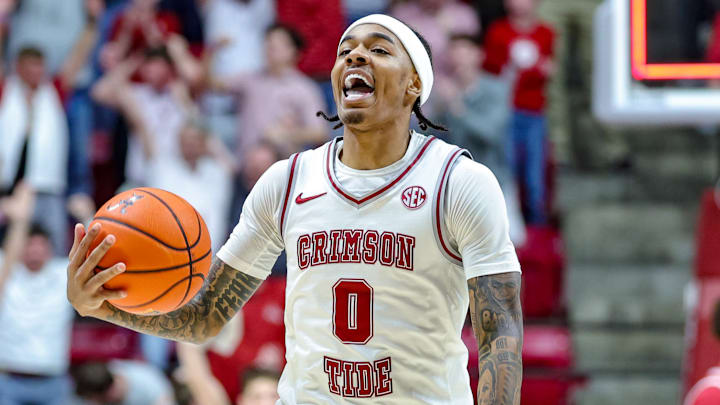
Alabama has been dealt a difficult blow with No. 2 scorer Aden Holloway arrested on marijuana charges and unavailable for the tournament. That just puts a bigger load on Labaron Philon's shoulders, but the sophomore is built for the moment. Philon was a last second stay-or-go decision for last year's draft, but he returned to Alabama and has profited greatly. Philon's touch, ball-handling craft and defensive activity level all popped as a freshman, but this season he ramped up his 3-point volume and got to the free throw line more often, able to withstand contact on drives due to gains in lower-body strength. Philon is still a bit thin for a modern guard, but his ability to change speed and direction off the dribble makes him a complete handful to stay in front of. He has proven his mettle both on- and off-ball at Alabama, while his active hands and relentless motor on defense help him overcome a lot.
More NBA Draft news and analysis:
 Add us as a preferred source on Google