
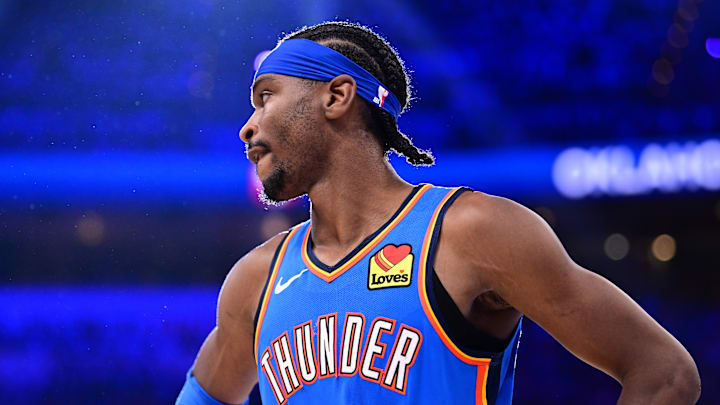
The Oklahoma City Thunder are still the clear championship favorites, but they're no longer invincible. On Dec. 10, they beat the Phoenix Suns by 49 points in the semifinals of the NBA Cup, pushing their record to 24-1 and their average point differential to a historic, astronomical plus-17.2 points per 100 possessions. Seventeen of their wins had been by double digits, nine had been by 20 or more. They weren't just the best team in the NBA, they were maybe on track to become the best team ever.
And then they lost to the Spurs in the NBA Cup Final. Six days later, they lost to the Timberwolves. A week after that, they picked up two more losses, back-to-back and both against the Spurs. They opened January with a win and then lost on a buzzer beater to the Suns, followed a day later by a 27-point loss to the lowly Hornets. They broke the losing streak but needed overtime to beat the Jazz.
That makes the Oklahoma City Thunder 7-6 in their last 13 games. And while they're still the betting favorite to repeat and miles ahead of their competition by almost any statistical measure — they're beatable. Here's what we've learned in those seven losses about how to stop a juggernaut.
Win the possession battle

One of the Thunder's biggest strengths is the way they control possessions. They force a ton of turnovers and don't give them away at the other end. They control the defensive glass and usually have a huge edge at the free throw line. Jared Dubin tracks these numbers on a per-game basis for Last Night In Basketball, and estimates that the Thunder average 3.7 more possessions per game than their opponents, the second-best margin in the league.
However, in their seven losses they have had the exact same number of possessions as their opponents, wiping away their advantage. Different opponents have managed this in different ways. The Timberwolves attempted 47 free throws to the Thunder's 30. Across their three matchups, the Spurs only had four more turnovers than OKC. Phoenix was plus-10 on the offensive glass.
No team has really managed to dominate the Thunder in all three areas in the same game, but leveling the playing field there, one way or the other, gave them a chance to steal a win.
Keep Shai off the free throw line

Gilgeous-Alexander is one of the league's most feared individual scorers, and his ability to get to the free throw line is a key tool in his arsenal. About a quarter of his points have been scored at the free throw line, and he draws a foul on 17.6 percent of his isolation possessions, one of the highest rates in the league. Sometimes it feels like he can manufacture high-quality scoring opportunities out of thin air.
SGA averages 9.2 free-throw attempts per game this season and got to the line 13 times in their first loss of the season, to the Trail Blazers back in November. But in the six most recent losses, he's managed just 6.8 free-throw attempts per game. The Spurs, in particular, did a great job on him, holding SGA to 17 free-throws in three games. Devin Vassell, Julian Champagnie, Harrison Barnes and De'Aaron Fox spent a combined 104.4 possessions as his primary defender without committing a single shooting foul.
There's only so much a defense can do on this front without some luck and help from the referees, but knowing that SGA is always looking to draw contact and being as careful as possible not to give up any easy ones makes a huge difference.
Attack the basket looking to score

The Thunder defense is incredibly aggressive, with a slew of long, active perimeter defenders who swarm the ball. But that aggressiveness and length plays a role off the ball as well — they're incredibly switchable, and they rotate well, closing down driving lanes and smothering open space at the 3-point line. To beat them, you have to be able to make contested shots (because open ones are so hard to come by).
What that means is that you're often better off driving and trying to finish over and through their rim protectors than driving and kicking, swinging the ball hoping they'll make a mistake in their perimeter rotations.
Look at Devin Booker here, passing up an off-balance layup to kick it out for a tightly contested 3-point attempt.
That's a particularly egregious example. But the Thunder defense is a different animal, and shots that might seem open on the perimeter often aren't by the time the ball is released. That's why just taking the tough finishes around the basket is often the better play against them — particularly when you're a supporting player spotting up. Watch Harrison Barnes turn down a reasonable 3-point attempt to attack the paint, and use his strength against SGA.
The Thunder defense has given up roughly the same number of drives per game in their wins as in their losses. The difference is that in the losses, opponents have finished much better on drives — 50.3 percent, compared to 41.9 percent. When you throw in a few extra trips to the free throw line, you have the Thunder giving up a lot more points on dribble penetration in their losses.
Some of this is based on the personnel opponents have been able to throw at them. Devin Booker and Dillon Brooks drove 25 times in their win against the Thunder, passing just five times and scoring 21 points on those drives. Collin Sexton and Miles Bridges passed just five times on 20 drives, scoring 19 points. Keldon Johnson and Harrison Barnes passed just three times on 25 drives, scoring 32 points.
In most cases, 3-pointers are a way for underdogs to introduce variance into a game, and hopefully catch an upset with enough outside attempts to make the math fall in their favor. But the Thunder defense is good enough to take some of the shine off that strategy. Keeping things simple, attacking and finishing has given some teams an edge against OKC.
Get lucky

The Thunder are loaded with capable 3-point shooters, but they aren't an elite unit at creating or making 3-pointers. They're ninth in the league in the number of open and wide-open 3-pointers they create per game (35.6), and 15th in 3-point percentage on those shots (36.5 percent). In their seven losses, they've created roughly the same number of open looks but made just 30.8 percent.
We see a similar pattern at the other end. On the season, the Thunder defense has allowed opponents an average of 35.2 open and wide-open 3-point looks per game, and opponents have hit 37.8 percent. In losses, those numbers have been 34.4 attempts, made at a 39.2 percent clip.
Defenses — both the Thunder's and those of their opponents — have a lot of control over how many open looks they surrender per game. But once a player is open enough to make the decision to shoot, whether the shot goes in or not is, no longer, a question of defensive skill or execution. It's about the skill of the shooter and luck. In their losses, the Thunder have missed open looks and their opponents have made them.
Nothing here is particularly nuanced, and the game plan you'd draw from all this information is roughly the same as you'd use against any team. Limit your mistakes. Protect the ball. Finish around the basket. Make your open jumpers and hope the other guys don't. What's matters most here is how slim a margin for error the Thunder leave. You can't just dominate in one of those categories and count on all else being equal.
On Nov. 26, the Timberwolves made 10 more 3-pointers than the Thunder, shooting 17-of-37 from beyond the arc, compared to 7-of-26 for OKC. They lost by 8 because they let Shai Gilgeous-Alexander get to the free throw line 17 times, only scored 14 points on 49 drives and turned the ball over 16 times.
The Thunder can be beaten. But you do it by playing perfect, or damn near close to it.
More NBA news and analysis:
 Add us as a preferred source on Google