
Key Points
Bullet point summary by AI
- The Western Conference Finals between San Antonio and Oklahoma City highlights how rookie contracts shape modern NBA rosters under the current CBA.
- Scouts now prioritize guards who combine athleticism with strength to handle the league's growing emphasis on physicality.
- The draft's deep pool of small guards will test teams' ability to identify prospects who can survive against the Spurs' and Thunder's brute-force style.
The San Antonio Spurs toppled the Oklahoma City Thunder in Game 1 of the Western Conference Finals, winning 122-115 in overtime to steal home-court advantage. Many believe (rightfully) that this series is the "real" championship duel. There simply is not an Eastern Conference team on the level of San Antonio or OKC right now.
When it comes to the 2026 NBA Draft, there's a lot we can learn from both teams. The Spurs and Thunder are on the younger side, with mostly homegrown cores that are the result of great execution in recent drafts. The league is ever-evolving, as is draft evaluation. What made a prospect special 10 years ago might not hold weight in 2026. The league is often reacting to the latest, greatest feat in team-building. The Warriors made every team want to play small. Now every team wants to play big, like Denver or OKC.
Here's what scouts and opposing GMs can gleam from watching the NBA's current heavyweights duke it out:
A rookie's first contract is more important than his second contract

In the past, we'd discuss "upside" in the draft through an extreme long-term lens. The "two years away from being two years away" lens. And while we can still do that, the league's current collective bargaining agreement really drives home the value of immediate contributions. There just isn't as much flexibility on the margins for high-spending teams nowadays. Once a talented rookie graduates to that second NBA contract, your ability to acquire depth around them restricts. Those first and second tax aprons are dynasty killers (see: Celtics, Boston).
The Spurs, for example, basically have their three best players — Victor Wembanyama, Stephon Castle and Dylan Harper — locked up on rookie contracts, which are well below market value. That setup allows the Spurs to trade for De'Aaron Fox (and extend him at four years, $221 million) without compromising their depth.
OKC has reached the point where Shai Gilgeous-Alexander, Chet Holmgren and Jalen Williams are all extended to lucrative contracts. How does Sam Presti keep their depth up? Through his mountain of draft assets, which he stockpiled diligently before the Thunder's breakout. Now Ajay Mitchell is playing critical minutes on a rookie deal, when he's probably "worth" $30 million-plus. Those picks also gave OKC the flexibility to acquire Jared McCain on a rookie deal. Cason Wallace is on his rookie deal. Thomas Sorber and Nikola Topić are on breakout watch next year. And OKC has two top-20 picks to mess around with this summer. When it comes time to extend Mitchell and McCain, OKC can figure it out. Maybe Presti just trades them for more picks and repeats the process.
When the CBA makes it harder and harder to add depth in free agency to acquire salaries via trade, the golden ticket for sustained improvement is the draft. It's more important, now than ever, for contenders to draft well, not just the teams tanking to the bottom. This is what separates OKC from every other team.
Strength or functional athleticism — NBA guards need both, ideally

The 2026 draft features a deep pool of smallish guards projected in the lottery, which is odd considering the NBA's increasing emphasis on positional size. Darius Acuff Jr. and Kingston Flemings are both under 6-foot-3 barefoot. Labaron Philon weighs in at 176 pounds. How NBA teams navigate perceived talent versus the unstoppable evolution of the sport will be fascinating to watch in real time.
So what can help a guard prospect break through in today's NBA? In the case of Stephon Castle, Dylan Harper and Shai Gilgeous-Alexander, it helps to be tall. But there are other important qualities: burst, dexterity, and now more than ever, strength. Physicality.
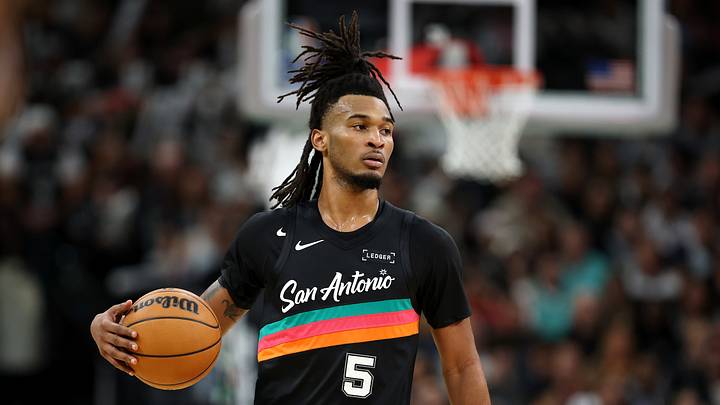
Harper took over Game 1 with seven steals and 24 points, scoring frequently with his signature layup package. The Spurs and Thunder, really, are operating under the same playbook. Multiple ball-handlers, all with the quickness, shiftiness and bullish strength necessary to plant two feet in the paint. They can all score below the rim, off of two feet, with balletic footwork and a willingness to absorb contact.
There aren't any true analogs for San Antonio's backcourt duo (and especially not for SGA) in this year's class, however. What's more important for teams selecting outside the top four in the lottery will be determining which "small" guards can hang with these jumbo, brute-force ball-handlers. Who has the physical tools and skill package necessary to overcome perceived limitations and survive on the floor in against a Spurs or Thunder-type opponent. Because that will be the ultimate goal.
Flemings is my highest-ranked, non-Darryn Peterson guard prospect. He clearly lacks ideal measurements for the modern game (6-foot-2½ barefoot, 6-foot-3½ wingspan), but he's a nuclear athlete, with the sprint speed of De'Aaron Fox, mixed in with the lateral agility and functional, controlled vertical explosiveness to impact plays all over the floor on defense. He can jump passing lanes, mirror ball-handlers at the point of attack or fly in from the weak-side to disrupt shots at the rim. On offense, if he can add just a little bit of core strength to better hold his line on drives, Flemings is going to create and extend advantages with ease. He's too smart and too quick, with too much defensive equity, to fade simply because of measurements.
To me, Flemings very much belongs in the same conversations as Ajay Mitchell, if we want a relevant point of comparison.
At the end of the day, small guards are not antiques. They aren't completely out of fashion. There is a place in the league for Fred VanVleet or Jalen Brunson, obviously.
More NBA news and analysis:
 Add us as a preferred source on Google