
Key Points
Bullet point summary by AI
- Miami (OH) finished a perfect 31-0 regular season, becoming the first DI team since 2021 to do so.
- Critics argue the RedHawks' weak schedule undermines their NCAA Tournament credentials.
- The debate centers on whether the selection committee should prioritize perfect records or proven power-conference strength.
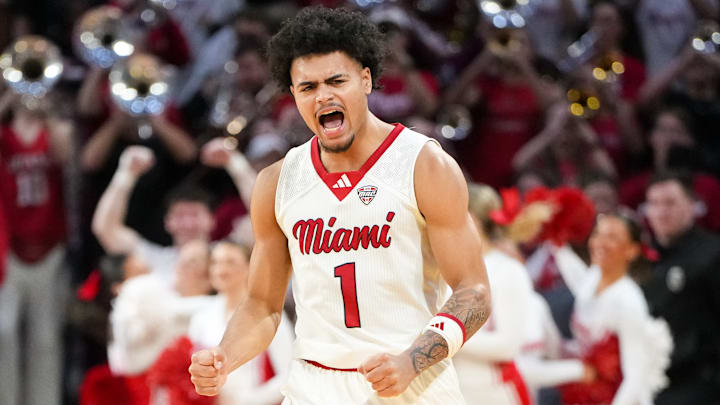
Miami (Ohio) has run the gauntlet. The RedHawks found themselves in a dogfight in their regular-season finale against Ohio on Friday night, pushed into overtime by a Bobcats team they hadn't beaten on the road since 2011. But as they've done all year long, Travis Steele's team delivered in the clutch, getting five points from Peter Suder in overtime to secure a thrilling 110-108 win — and remain the lone undefeated team in men's Division I hoops.
MIAMI OF OHIO HOLDS OFF OHIO IN ATHENS IN OVERTIME AND THE REDHAWKS FINISH THE REGULAR SEASON UNBEATEN AT 31-0!! pic.twitter.com/jyTJCphVdt
— Alec Crouthamel (@AlecCr12) March 7, 2026
Miami is the first men's DI team to finish the regular season undefeated since Gonzaga back in 2020-2021, and the first team to go at least 30-0 in the regular season since 2014-15 Kentucky. It's a truly remarkable story, a plucky mid-major playing an exciting, full-court brand of basketball and delivering in key moments time and time and time again in a way we haven't seen in quite some time.
And yet, even now, after the perfect regular season is secured, there are still plenty of naysayers who want the RedHawks on the wrong side of the NCAA Tournament bubble. Hopefully, Miami will take care of business in the MAC Tournament and remove all doubt about its March Madness status. But even if they stumble at some point during conference championship week, there can no longer be any doubt that this team has earned its at-large bid — especially considering the quality of the bubble competitors it would be going up against. And to prove it, we're going to swat down every single argument people are making against Miami's tourney chances, one by one.
They haven't played anybody
This is the first thing all the contrarians love to bring up the moment you have the audacity to express a single ounce of joy over the fact that a mid-major has completed a perfect regular season. And sure, strictly speaking, it's true: Miami ranks 275th in KenPom's overall strength of schedule metric, and they've played just one team inside KenPom's top 125 (Akron, a three-point win at home back in January). The non-conference schedule looks particularly damning on paper, a whopping 361st out of 365 DI teams — including three Division II schools that won't be considered as wins by the selection committee.
I'm not going to try and sugarcoat those numbers, or insist that actually Miami's schedule has been better than you think. But I am going to tell you that it's not the RedHawks' fault: Thanks to reporting from Matt Brown of the Extra Points newsletter and Jeff Eisenberg at Yahoo Sports, we know that Steele and his athletic department tried to desperately to schedule a number of power-conference schools including BYU, Kansas and Ohio State. And yet, every time, they were turned down, told in no uncertain terms that bigger programs only wanted to play other top-tier teams that would boost their NET ranking or bottom-feeders that would be a virtually guaranteed win.
That left Miami in a tough spot. Scheduling the RedHawks was a no-win proposition for the big boys: If you win, it's at best a Quad 2 but more likely a Quad 3 that won't mean much come selection Sunday; if you lose, it's a black mark on your tournament resume. It's no wonder that Miami's schedule looks the way it does. And it still bears repeating: Winning 31 straight games without a single stumble is hard, no matter what the competition looks like.

They aren't good enough to win one tournament game, let alone multiple
After pointing to Miami's strength of schedule, attention will probably turn next to their underlying metrics. The RedHawks currently rank No. 90 in the country according to KenPom, a number more befitting an Ivy League champ than a viable at-large team. That metric takes into account not just the teams Miami has played, but how they've played against them: And the RedHawks have played a ton of very close games that could well have swung either way in the final minutes, hardly the sign of a powerhouse.
Miami ranks 70th in offensive efficiency and just 140th in defensive efficiency. They have a real lack of height that would be exposed against Power 4 competition, and they have a hard time both defending dribble penetration and preventing open 3s that come beause of it. If they do make the tournament one way or another, they'll probably be a trendy team to pick against, and I'll probably be right there with everyone.
But I can't help but feel like this argument is being selectively applied. Look at the teams that Miami will be compared against if it finds itself on the bubble: the likes of Indiana, Auburn, Ohio State and SMU. Those teams are 5-12, 8-13, 8-11 and 8-11, respectively in Quad 1 and 2 games, and have an ugly 12-39 combined record against Q1 opponents. Those numbers don't paint the picture of a team good or consistent enough to win two or three games in March — and unlike Miami, they've had ample opportunity to prove themselves.

The goal is to choose the best teams, not the most deserving
Which brings us to our final point, one articulated by former Auburn coach Bruce Pearl last week: that the goal of the selection committee should be to select the best at-large teams in the country, rather than the ones who have the most deserving resumes.
Does 29-0 Miami (OH) deserve a March Madness bid? 🤔@JalenRose, @coachbrucepearl & @jamalmashburn debate the nation's only undefeated team 👀 pic.twitter.com/VyXizQgApa
— TNT Sports U.S. (@TNTSportsUS) February 28, 2026
This feels self-evidently wrong to me. Sure, I might pick Pearl's former team head-to-head against Miami on a neutral court if they were to play tomorrow. But so what? Auburn had its chance to prove that it was one of the best teams in the country, and it's failed time and time again. So we're now supposed to give them yet another chance, despite knowing exactly who they are and what their ceiling is? How many opportunities are we expected to give to power conference teams?
The RedHawks are almost certainly not viable Final Four contenders. But the entire point of the NCAA Tournament, the reason it's become the phenomenon we know and love, is because of the chances it's given to teams like Miami. These are two weeks in which even the little guy is given 40 minutes to play the game of its life, to shock the world. I have no interest in rewarding teams that have proven beyond a shadow of a doubt that they're not good enough. I'd much rather reward one that has been systematically denied that chance for reasons completely out of its control.
 Add us as a preferred source on Google