
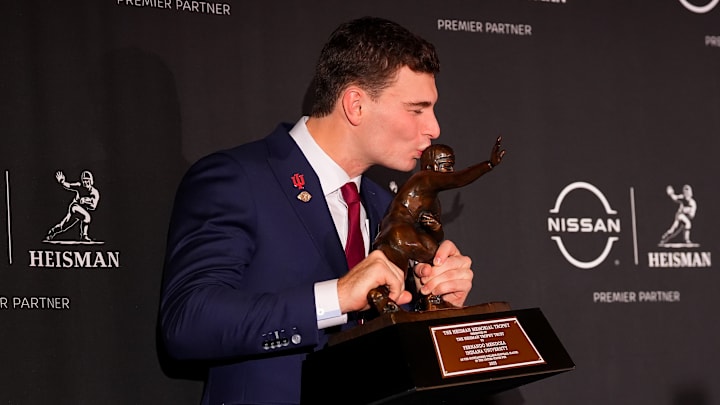
The votes are in! Fernando Mendoza was awarded the Heisman Trophy and it wasn’t a particularly close vote. Mendoza won by a landslide with 2,362 points to Diego Pavia’s 1,435 as runner-up. But where does Mendoza’s convincing win land in the most historic margins of victory? It’s actually not as large as you might think. We’ll dive into that and what it means.
Final Heisman voting. pic.twitter.com/rH0HHVEapu
— Ralph D. Russo (@ralphDrussoATH) December 14, 2025
With the Heisman Trophy win, Mendoza now has three awards this season – he also won The Maxwell and the O’Brien award. This past season, he not only led Indiana to the No. 1 overall seed with a 13-0 record, but he’s going into the CFP, having thrown for nearly 3,000 yards, 33 touchdowns and just six interceptions.
He earned the Heisman and it’s clear why he was the favorite for the second half of the season. Let’s compare his dominant wins to some of the others in the history of the Heisman Trophy.
By the numbers: How Fernando Mendoza’s margin of victory compares to previous landslide winners
YEAR | WINNER | POINTS | MARGIN OF VICTORY |
|---|---|---|---|
2019 | Joe Burrow | 2,608 | 1,846 |
1968 | O.J. Simpson | 2,853 | 1,750 |
2006 | Troy Smith | 2,540 | 1,662 |
1993 | Charlie Ward | 2,310 | 1,622 |
1991 | Desmond Howard | 2,077 | 1,574 |
1998 | Ricky Williams | 2,355 | 1,563 |
1986 | Vinny Testaverde | 2,213 | 1,541 |
2013 | Jameis Winston | 2,205 | 1,501 |
1955 | Howard Cassady | 2,219 | 1,477 |
2021 | Bryce Young | 2,311 | 1,357 |
1963 | Roger Staubach | 1,860 | 1,356 |
1951 | Dick Kazmaier | 1,777 | 1,353 |
2025 | Fernando Mendoza | 2,065 | 927 |
Mendoza’s historic win doesn’t even crack the top 10 of the largest margins of victory. Despite winning by 927, Mendoza’s wasn’t nearly as high as some of the other landslide wins. Joe Burrow holds the highest margin of victory with 1,846. For context, he received 2,608, meaning no other finalist had at least 1,000 points. There have been several other ones, including OJ Simpson’s win over Leroy Keyes, Troy Smith over Darren McFadden and Charlie Ward over Heath Shuler, who all had at least 1,600-point margins.
That’s not to say that Mendoza’s season wasn’t remarkable. The big thing with large margins of victory is that it means you were the consensus best player that year. Though you could make an argument for Jeremiyah Love and Diego Pavia, it was clear since Indiana’s win over Penn State, Mendoza was the frontrunner.
The same could be said about every player with a significant margin of victory with the Heisman award; they dominated the vote for a reason.
Will season awards motivate Fernando Mendoza to finish with a national title?
The good thing with Mendoza’s award haul is it’s further proving Curt Cignetti has turned this program into a near powerhouse in the two seasons he’s been there. But the individual awards tell one story, winning a national championship is the ultimate prize. And if he comes up short, you have to think how much that would affect the end of his legacy with the Hoosiers.
All signs are pointing toward Mendoza departing for the NFL Draft and coming up short of a national championship would have to be a letdown. While he may have had a strong, statistical season, it means nothing without winning a national championship.
Mendoza has had the best season of any Indiana football player so he’ll always have that. The way he’s turned Indiana into a national contender this year is remarkable. But the difference between being a good college football player and a great one is winning that national championship. He’d be foolish to come back just to win a national championship. Drew Allar did that and killed his draft stock.
If Mendoza can finish the job with the individual accolades as well as the team ones, this season could go down as one of the best in history.
More Heisman Trophy news and analysis
 Add us as a preferred source on Google