
The NFL is full of stars with long, outstanding careers. Players like Aaron Rodgers, Derrick Henry, Ja’Marr Chase, and Myles Garrett have long been stars and continue to contribute at a high level to this day. There are some players who have long careers because coaches are chasing talent. These are the draft busts that coaches and general managers think they can fix. Guys like Marcus Mariota, Carson Wentz, and Justin Fields will get chance after chance in the hopes they find what made them great.
Then there’s a third group. This is a group that we’ve seen do it at the NFL level, but with no real explanation, the production dried up, and we never saw it again. These are more popularly called “one-hit wonders.” The NFL has some really well-known one-hit wonders. And there are a few we’re watching to see if they will be one-hit wonders in today’s NFL (we’re keeping a close eye on Brian Thomas Jr., Chuba Hubbard, Calvin Ridley, and Sam LaPorta). However, history is full of the biggest one-hit wonders.
10. Jamal Anderson
Atlanta Falcons
Jamal Anderson is an example of a player who was decent for a while, exploded into one of the best players in the league, then went right back to decent before turning into a bad player. Anderson had a roller coaster of a career that only lasted eight years. He has a top-20 rushing season in the history of the league, even to this day, but he never had another season with 1,100 or more yards. He was a consistent producer, if not unspectacular.
In 1998, the Falcons decided to go all in on the rushing game. They rushed Anderson 410 times in the regular season. He rushed for 1,846 yards and 14 touchdowns. The reason the Falcons rushed him so much is that he was incredibly effective. He rushed for 90 first downs. In the playoffs, he rushed another 70 times for two touchdowns. He added a receiving touchdown in the playoffs. Between the regular season and playoffs, he touched the ball 517 times.
Then, predictably, he got seriously hurt the next season. After the Falcons' disappointing Super Bowl loss, Anderson tore his ACL in 1999. This wasn’t the torn ACL of today. This impacted the rest of his career. After a fine year in 2000, Anderson tore his ACL again in 2001, and that ended his career. We’ll forever have the Dirty Bird, but the sheer volume of carries in ‘98 changed his whole career.
9. Mike Anderson
Denver Broncos
The Denver Broncos had one of the best running backs of the era in Terrell Davis. Unfortunately, after dominating for a few short years, injuries started to catch up with him. That opened the door for rookie Mike Anderson to be the guy. And, boy, was he the guy.
Anderson rushed for just under 1,500 yards with 15 touchdowns. Remember, this was his rookie season. For his efforts, he won Rookie of the Year. He was largely led by some insane performances, including 251 yards against the Saints, 195 yards against the Seahawks, and 187 yards against the Raiders. In the playoffs, he faced the historic 2000 Baltimore Ravens defense, so he didn’t get much going.
The next season, Mike Shanahan equally split time between Davis and Anderson, frustrating early fantasy players everywhere. Anderson spent most of the rest of his career as a backup running back, as the Broncos went from Davis to Clinton Portis. Anderson was able to squeeze out one last 1,000-yard season, but he will always have the one “hit” in his rookie year.
8. Lynn Dickey
Green Bay Packers
Unlike many others on this list, Lynn Dickey was given chance after chance before he finally broke out. He started games in nine seasons and spent a decade in the league before finally breaking out at 34 years old. He was a gunslinger by the most intense description. He threw for more than 4,000 yards, 32 touchdowns, and a ridiculous 29 interceptions. It was the Jameis Winston season before Jameis was born.
He broke the Packers record for most yards per attempt with 9.2, and it hasn’t been broken despite Brett Favre and Aaron Rodgers playing in Green Bay (although, it was tied by Rodgers). Dickey came back to Earth after the 1983 season, and he was out of the league after two more seasons.
Dickey holds an interesting place in Packers history. He doesn’t have the championships of Bart Starr or the eye-popping stats of Rodgers and Favre. However, he did have a stretch where he was supposed to take them to the next level. Between the broken leg that caused him to miss a full season and the ineffectiveness and inconsistency in his command, Dickey's career in Green Bay didn't come close to where it should have.
7. Derek Anderson
Cleveland Browns
One of the most recent one-hit wonders, Derek Anderson came out of nowhere to beat out a superstar quarterback prospect for a franchise that has been known for terrible quarterback play. Brady Quinn was supposed to save the Cleveland Browns. His drop in the 2007 NFL Draft gave the Browns a franchise QB at 22nd overall.
Instead, that guy ended up being Derek Anderson, at least for one season. Anderson was a sixth-round pick of the Baltimore Ravens who didn’t even make it out of September. He was claimed by the Browns off waivers, and he was the starter two years later. Anderson came in for Charlie Frye in Quinn’s rookie season,
Anderson led the Browns to a 10–6 overall record and made the Pro Bowl, replacing Tom Brady who dropped out due to “injury.” With Anderson a free agent after the season, many thought he would sign a big deal elsewhere with Quinn in the QB room. However, he ended up signing a three-year deal worth a total of $27 million. A concussion in the 2008 preseason started him off on the wrong foot, and he was benched by that November. He continued to battle with Quinn the rest of his Browns career before moving on to the Panthers.
6. Nick Foles
Philadelphia Eagles
Well, that’s one heckuva “hit.” Nick Foles went toe-to-toe with Tom Brady in the Super Bowl and won. Not only did he beat Tom Brady, but he beat Brady after he threw for 505 yards, which remains a Super Bowl record. There has never been a shot-for-shot Super Bowl like that. Foles was incredible that game, but first, let’s talk about his run to get there.
Carson Wentz was having an MVP season prior to his knee injury in 2017. Foles had returned to the Eagles for a second stint after being somewhat of a journeyman. He returned to be the backup, and Wentz was already showing the ability that made him a second-overall pick.
Many thought the Wentz injury would end the Eagles' season with a huge “what if,” but the Eagles didn’t know the X factor they had at their disposal. Foles led them to their first playoff win in nine years, beating the Falcons 15-10 in the Divisional Round. Then, the Eagles dominated the Vikings in the NFC Championship Game. In the Super Bowl, he was on the receiving end of the Philly Special, one of the greatest plays in the history of football. He won Super Bowl MVP for his efforts. He eventually tried to be the starter for the Jaguars and Bears, but he never found the success he had in this one pocket of superstardom.
5. David Tyree
New York Giants
This truly is one hit and done. David Tyree might not even be a household name, but his play might be the best in Super Bowl history. The situation demanded some magic. The New York Giants were down to the New England Patriots. They put together one of the best rosters in football history, and they went 16-0 in the regular season. The Giants' defense played its heart out and kept Eli Manning and company in the game.
In the fourth quarter, Manning was surely getting sacked. Multiple Patriots stars had their hands on him, but he got away and launched the ball in the air. Rodney Harrison, one of the hardest-hitting safeties of his era, tried to pry the ball away from David Tyree at the launch point. Instead, Tyree secured the ball to his head and didn’t let it hit the ground. The Giants ended up winning that Super Bowl thanks to the Helmet Catch.
And that was it! Tyree never had a big season in the league, and he never produced like even a top-four wide receiver. He suffered a knee injury before the 2008 season (the year after the Helmet Catch), and he would never play another game for the Giants. He played one season with the Baltimore Ravens before retiring.
4. Barry Foster
Pittsburgh Steelers
The Pittsburgh Steelers were desperately trying to put the mediocre 1980s behind them when they entered the last decade of the 20th century. After winning four Super Bowls in the ‘70s, the Steelers won just two playoff games in the ‘80s. The Steelers dominance of the NFL felt over, but they were trying to find their identity in the 1990s. That started with a dominant running game.
It looked like they had something with Barry Foster. He was averaging more than five yards per attempt in his first two seasons, but he wasn’t given much of an opportunity. When he was finally given the rock, he dominated. After never breaking 100 attempts in a season, the Steelers rushed with Foster 390 times in 1992. He rushed for 1,690 yards and 11 touchdowns. He finished first-team All-Pro at running back and second in MVP voting behind Steve Young.
This was the first year of the Bill Cowher era, and he thought he had his bell cow. Unfortunately, injuries ruined what came next. He was still effective in 1993, but he was limited to 711 yards in nine games. On the last play of his career, a fourth-and-goal in the AFC Championship, Foster had a Neil O’Donnell throw tipped away to lose the game. He was traded to the expansion Carolina Panthers, but he failed a physical and retired.
3. David Boston
Arizona Cardinals
The Arizona Cardinals were just a moribund franchise in the 1990s and early 2000s. There really wasn’t anything to hang their hats on. From 1983 to 2007, the Cardinals made the postseason once. They had a good player here or there, like Simeon Rice and Aeneas Williams, but it was largely unwatchable football.
Then, it looked like the Cardinals finally had a star. David Boston came out of nowhere to put up 1,598 receiving yards in 2001. To this day, it’s still the receiving yards record for the Cardinals despite guys like Anquan Boldin, Larry Fitzgerald, and DeAndre Hopkins donning a Cardinals uniform. It’s not like this was a surprise. Boston was the eighth overall pick out of Ohio State in 1999.
The All-Pro became a free agent a year after his breakout season, and the Cardinals could not afford to bring him back. The San Diego Chargers signed him to a seven-year, $47 million contract. He lasted one season into the seven-year deal. Boston immediately got suspended, then tore his knee, missing the whole year. After one actual season with Miami, he was out of the league. He tried to make a comeback in Canada, but the stacking knee injuries made him a completely different player.
2. Josh Gordon
Cleveland Browns
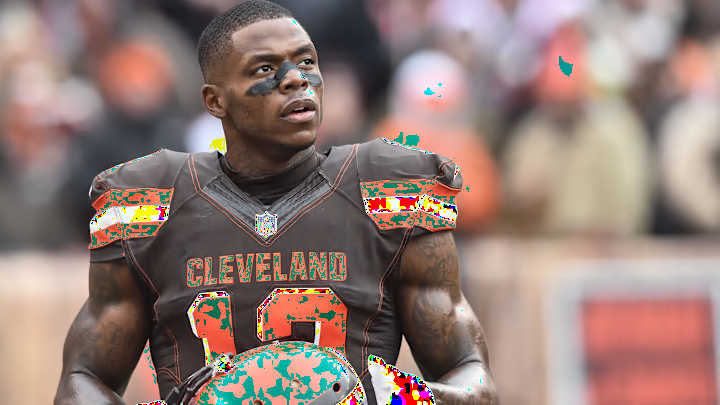
Josh Gordon is a story that has been told again and again. A player who should have changed the way the Cleveland Browns operated, Gordon could not avoid trouble with the league, mostly to do with drugs. First, let’s talk about the good. Gordon led the NFL in receiving yards in his sophomore season, going for 1,646 yards and nine touchdowns. He did that in just 14 games.
The next season, Gordon played just five games after he was suspended for 10 games by the league and one game by the Browns. The next season, he didn’t play a game after violating the league’s substance abuse policy again. He was then suspended to start the 2016 season. Right before he was eligible to return (four games), Gordon entered himself into a rehabilitation facility, and he never ended up playing football that year. He wasn’t reinstated until the end of the 2017 season.
After the Browns cut Gordon following Week 1 of the 2018 season, the New England Patriots decided to give him a try. After that, Gordon was given chances to play for the Chiefs, Seahawks, and Titans, with stints in the CFL and the XFL along the way. He will always be the biggest "what if" in the history of the league.
1. Robert Griffin III
Washington Commanders
Robert Griffin III and Andrew Luck were supposed to transform the league. The number-one and number-two overall picks of the 2012 NFL Draft both had fantastic rookie seasons. Griffin, who was not considered on the level of Luck as a prospect, had the better rookie season. He threw for 3,200 yards, 20 touchdowns, and just five interceptions. He also rushed for more than 800 yards and seven touchdowns.
It looked like RGIII would take the world by storm and turn around the Washington football franchise. They made the playoffs against the Seattle Seahawks, but that’s where things took a turn for the worse. He further injured his knee, which was injured in December. He had to get surgery to repair his ACL and LCL.
RGIII was pushing to return by Week 1 in 2013. It was an arbitrary date, as missing a week or two to get fully healthy probably would have saved his career. However, his head coach was Mike Shanahan, and he had a different look at the game. Griffin looked different in 2013, and he was clearly building himself back up. He was eventually shut down to avoid injury, and that started Kirk Cousin’s career. Griffin was mediocre for the rest of his career, as injuries continued to impact his effectiveness.
More NFL news and analysis:
 Add us as a preferred source on Google