
Key Points
Bullet point summary by AI
- The Baltimore Ravens have made a bold move to reshape their defense ahead of the critical 2026 season.
- A five-time Pro Bowl edge rusher is now set to anchor new head coach Jesse Minter's aggressive scheme.
- This acquisition positions Baltimore to capitalize on a potentially vulnerable AFC North landscape this fall.
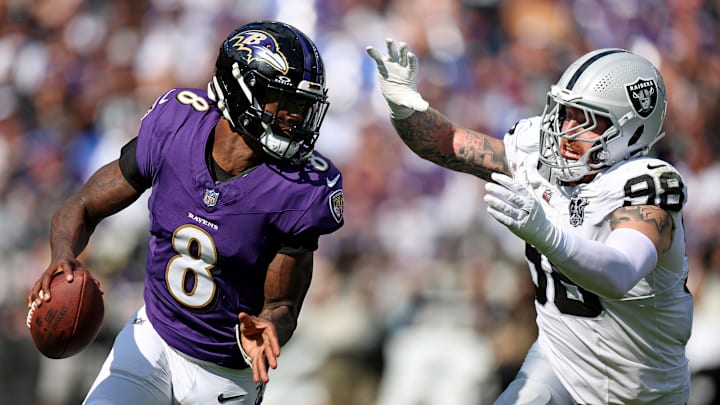
The Baltimore Ravens made the first major splash of the NFL offseason on Friday night, acquiring five-time Pro Bowl edge rusher Maxx Crosby from the Las Vegas Raiders in exchange for two first-round picks.
This is a dramatic all-in move after the Ravens' disastrous 2025 campaign. Baltimore is hoping to extend Lamar Jackson and right the ship next year, with Crosby as the crown jewel of new head coach Jesse Minter's defensive scheme. The AFC North was a complete letdown last season. Can it be any better in 2026? Here's how the landscape shapes up post-trade.
4. Cleveland Browns

Cleveland won five games last season despite boasting the No. 5 defense in estimated points added per play (-0.10) and No. 4 in yards allowed (283.6). The quarterback situation is dire. Neither Shedeur Sanders nor Dillon Gabriel showed much of anything positive, while the imminent return of Deshaun Watson is the equivalent of patching a twice-used bandaid on a gushing bullet wound.
There are countless reasons to dislike Watson at this point, but he's also just bad. He has not produced winning outcomes on a consistent basis since 2023. He has not played more than seven games in a season since 2020, and odds are a double-whammy Achilles injury won't help. Watson is too richly compensated to not enter camp as QB1, so the Browns probably won't bring in marquee competition. Kyler Murray and Geno Smith feel like long shots; Kirk Cousins or Russell Wilson don't really move the needle for me, personally.
Cleveland can still win games on the strength of its defense. Myles Garrett just set the NFL sack record and won unanimous DPOY. There's talent around him, including Defensive Rookie of the Year Carson Schwesinger at linebacker. But the exit of Jim Schwartz as coordinator, followed by the hire of a deeply unproven Mike Rutenberg in his stead, is a real bummer. With all due respect to Todd Monken, he did nothing special with all the talent at his disposal in Baltimore. Odds are he's a step down at head coach compared to Kevin Stefanski, despite the latter's baggage.
Why on Earth would anyone believe in the Browns at this point?
3. Pittsburgh Steelers

Mike Tomlin stepped down as Steelers head coach after nearly two decades on the sideline, a welcome change of pace for Pittsburgh fans tired of year-over-year mediocrity. And yet, their decision to hire Mike McCarthy, a 62-year-old retread with a much shorter window than past Steelers hires, came as a deflating confirmation of this front office and ownership group's priorities.
McCarthy, to be clear, has done incredible work in the past. He won a Super Bowl in Green Bay. Those Cowboys teams were competitive, if not quite Super Bowl-caliber. But therein lies the problem: It's been a while since McCarthy felt like a coach who could raise a team's ceiling. Much in the vein of Tomlin, he's an experienced floor-raiser. The pedigree is there, but the league has probably evolved beyond him.
Say what you will about Tomlin and his lack of recent postseason success, but Pittsburgh performed vastly above its means last season. Beyond DK Metcalf, there weren't many weapons for 42-year-old Aaron Rodgers to rely on. TJ Watt is still awesome, but at 31, he's beginning to reach the downward slope of his prime.
Pittsburgh has a quarterback situation to figure out, but the options are limited. If Rodgers re-signs, as so many still expect, the Steelers probably take a modest step forward under McCarthy. The hire of Brian Angelichio, former Vikings passing game coordinator, as OC was a pleasant surprise. But the defense will almost certainly regress in Tomlin's absence, and Pittsburgh just feels like the sort of aging, ill-conceived roster that is primed to come off the wheels.
2. Cincinnati Bengals

This is probably an ill-fated ranking. There is so much working against the Bengals at this point, from Joe Burrow's health to Trey Hendrickson's departure and the god-awful state of their offensive line. At the end of the day, however, it's hard not to be romantic about Burrow and this offense. When the Bengals are healthy — when the Bengals are able to establish a baseline of continuity and forward momentum — this is still a Wild Card team. At least in theory.
Last season was a dark journey of the soul in Cincy, as Burrow missed over half the season. But he came back late, even when the playoffs were a pipe dream, and reaffirmed his commitment to not only winning but putting on a show for the fans. Burrow averaged a career-worst 226.1 passing yards per game across his eight starts, but he's only a year removed from leading the NFL in that category.
For all the discourse around Cincinnati's poor asset allocation, the offense is still stacked around Burrow. Ja'Marr Chase, Tee Higgins and Andrei Iosivas comprise an elite wide receiver room. The Bengals have the firepower to produce a top-five offense. Primarily, the front office just needs to sign (or draft) a few half-decent blockers to protect their franchise quarterback.
We cannot count on Cincinnati's health at this point, but in terms of absolute ceiling, the Bengals sit far above Pittsburgh and Cleveland. Burrow is the best quarterback in the NFL when he's on, the value of which is hard to overstate. How does the defense fare without Trey Hendrickson? Not well, probably, but if the Bengals can be the 20th-best defense instead of the 30th-best defense — I know, a high bar — this team should win enough shootouts to contend.
1. Baltimore Ravens

The Ravens are the obvious frontrunners at this point. We all said the same thing last offseason, of course, so take this with a grain of salt. Lamar Jackson missed four games last season and never quite looked himself. John Harbaugh, one of the winningest coaches of the last two decades, is no longer on the sideline. And yet, despite very reasonable doubt, it's hard not to single out Baltimore in an otherwise weak division. Cleveland, Pittsburgh and Cincinnati all have more glaring red flags. Baltimore just needs better health and a bounce-back year from its franchise QB, the two-time MVP.
New head coach Jesse Minter should help unlock what is, on paper, a dominant defense. Maxx Crosby applies constant pressure on opposing quarterbacks and he is perhaps the most dominant individual run-stopper in the sport. That trade was probably a slight overpay; two first-round picks for a late-20s edge rusher coming off of season-ending knee surgery is a gamble. And yet, it's worth it for a team hoping to take advantage of the wide-open AFC field. The conference has seldom felt this wide open — this winnable.
Declan Doyle takes over offensive playcalling duties after spending 2025 under Ben Johnson in Chicago. His system won't translate one-for-one, but after seeing the work Johnson and Caleb Williams did with the Bears, it's hard not to feel good about what Doyle can accomplish with the most productive dual-threat quarterback in the NFL. Last season was a bump in the road for Jackson, but he's still a plus-plus athlete whose arm talent and improv skills have never been in question. He needs to stay healthy and establish a rhythm. He also needs to exorcise some postseason demons. If Jackson is more like himself, however, this Ravens offense has Derrick Henry, Zay Flowers and Mark Andrews, with a scheme that should be much more favorable than it was under the prior regime.
There are unknown variables at play with any new head coach, but the Ravens are a cut above the rest on paper. If this was a more competitive division, perhaps we could fade Baltimore a bit until there's an on-field proof of concept. Since the Bengals, Steelers and Browns could all be five-win teams next season, however, Baltimore gets the No. 1 spot — with a chance to extend their advantage in the weeks and months ahead.
More NFL news & analysis:
 Add us as a preferred source on Google