
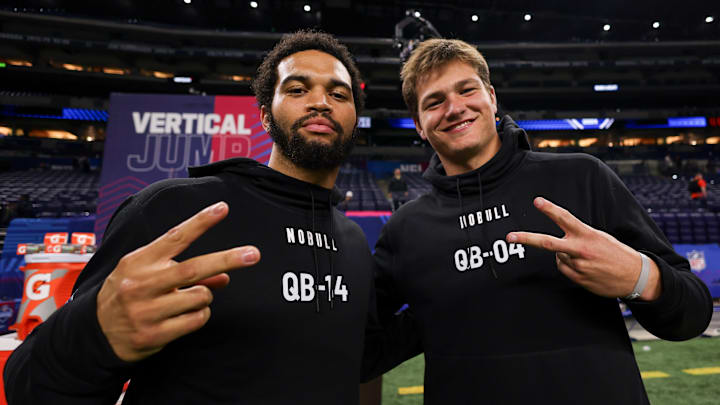
Caleb Williams made his much-anticipated postseason debut for the Chicago Bears on Saturday night. But for a while, it felt like the magic had finally worn off, as the Bears were down 21-3 at halftime to their rivals from Green Bay. What came next was a rollicking comeback, which saw Chicago score 25 points in the fourth quarter to secure a 31-27 victory and advance to the second round.
The comeback was punctuated by Williams making, perhaps, his greatest throw yet at the NFL level, finding Rome Odunze off one leg to keep Chicago's faint hopes alive on fourth down with under six minutes remaining.
The game hangs in the balance and this is what Caleb Williams does. pic.twitter.com/AuUs0CduPo
— Ian Rapoport (@RapSheet) January 11, 2026
On Sunday night, fellow 2024 draftee Drake Maye will get his turn, as the New England Patriots host the Los Angeles Chargers in the Wild Card round. Regardless of how that game plays out, Williams has reignited the conversation around which member of the 2024 QB class reigns supreme. Let’s hash it out.
Present: Who is better right now, Drake Maye or Caleb Williams?

We can cut to the chase here. As awesome as Williams was on Saturday night — and as awesome as he’s been in the clutch all season long — it’s hard to mount an argument in his favor right now. Chicago has faced better competition, to be sure. Williams has played from behind and performed under genuine pressure far more frequently. But just about every trackable, half-meaningful statistic points to Maye as the better quarterback right now.
New England’s lack of competition has been a common point of emphasis for skeptics, but Maye handled his business against the teams in front of him. It is what it is. He led the NFL in completion percentage (72.0) and yards per attempt (8.9) in just his second season. The man is 23 years old. For what it’s worth (not that much), he also led the NFL in QBR (77.2).
He threw for more yards (4,394) and touchdowns (31) than Williams (3,942 yards and 27 touchdowns). He tossed one more interception (eight to Williams’ seven), but completed 14.1 percent more of his pass attempts, albeit on slightly lesser volume. Ultimately, they broken even in the overall turnover department, as Williams committed nine fumbles to Maye’s eight.
The advanced numbers are where Maye pulls away even more. He was No. 1 in the NFL — number one! — at 0.26 Estimated Points Added (EPA) per play. Williams finished 13th at 0.07 EPA. Maye obviously led in total EPA as well at 169.96 — almost 50 points ahead of second-place Jordan Love at 120.84. Williams, on the other hand, finished with 49.36 EPA overall. This is but a single, imperfect metric, but it’s a good summation of a QB's total impact. Maye lapped Williams a few times this season.
Williams has his special traits, of course. He turns it up in the fourth quarter, almost without fail. If he can become more consistent early in games moving forward, his value will skyrocket. Williams is also the most Mahomesian improviser in the NFL. He’s such a freakish athlete inside and outside the pocket, able to shake tackles and extend plays with sheer evasiveness. That throw on fourth-and-eight to keep Chicago alive in the fourth quarter on Saturday was quite possibly the most impressive throw we’ve seen all season.
So the upside is there with Williams. Maye is more polished — and is an incredible athlete in his own right, to be clear — but Williams flashes a ceiling of uncommon elevation. Enough to make this more of a debate long term.
Verdict: Drake Maye
Future: Who will have the better career, Drake Maye or Caleb Williams?

So yeah, this is where the debate really beings. Williams probably has the highest ceiling in the abstract, what-if sort of sense. He’s a singular athlete, in a mold NFL fans (and front offices) have come to appreciate. He can chuck it as far as anyone, he’s a ballet dancer under duress and there is clearly an unteachable clutch gene — a real knack for meeting the moment. All that favors Williams.
But, let us not undersell Maye, who is almost a year younger than Williams and currently much further along on his developmental curve. These early years count for a lot, and Maye’s decision-making polish should help him continue to maximize his tools. You could argue, right now, that Maye is the best or second-best QB in the NFL. Mahomes still has stock in that conversation, while Josh Allen and Joe Burrow are difficult to write off. Lamar Jackson is still in the mix, too. But Maye has a strong case; He’s an MVP frontrunner for a reason. Just reaching Maye’s current level, even if he never improves, will be a challenge for Williams. God forbid if he keeps evolving.
All this talk of Williams’ supreme athleticism should not be read as a disregard for Maye’s incredible toolkit. He ran for more yards than Williams this season. He, too, can extend the life of plays outside the pocket, deliver challenging throws off-balance and scramble for chunk yards when needed. Maye is probably more effective on designed runs, too, especially between the tackles.
Maye has earned the Allen comparisons from the jump, but few expected such rapid progress from the UNC product. Allen spent years battling through turnover issues before he put all the pieces together. Maye is 23 and he’s already a model of quarterback efficiency. He’s getting the ball out quickly behind a mediocre offensive line. He’s dropping passes into bread baskets 40 yards downfield with pinpoint accuracy and touch. On a fundamental level, Maye just holds a massive advantage over Williams.
This has been a season of tremendous growth for Williams, who started at a much steeper disadvantage as far as decision-making, footwork and touch are concerned. Williams has ramped up his processing in a big way and become far more comfortable navigating the inherent pressure-cooker of NFL defenses. But even so, there are still times where his mechanics get away from him and his targeting system fails. Maye is so damn consistent. Williams has made immense, borderline unfathomable, progress, but he’s still playing catch-up.
These are two incredibly talented quarterbacks. As of right now, I’d say Williams is good — even very good — while Maye is great. Can Williams achieve greatness in the years to come? Yes, but when one considers Maye’s advanced starting point, youth and his own potential for growth, New England’s signal-caller still holds a clear edge long term. Football is unpredictable, and much can change about this debate in the years ahead. Williams and Maye are both going to stick around a long time. For now, though, Maye sits atop his draft class. While Williams may have the highest theoretical ceiling, the median potential outcome overwhelmingly favors Maye.
Verdict: Drake Maye
 Add us as a preferred source on Google