
Key Points
Bullet point summary by AI
- The San Francisco 49ers face a pivotal decision on their quarterback's future after this season.
- Detroit must decide if their high-paid quarterback can lead them to championships post-coach changes.
- Minnesota and Atlanta must act now to avoid being trapped by upcoming quarterback contracts.
The Arizona Cardinals and Miami Dolphins did something that NFL teams should really try to avoid doing: locking themselves into big contracts for non-elite quarterbacks. Sure, Kyler Murray and Tua Tagovailoa were playing good football at the time they signed their extensions, but both teams had to eat a lot of salary this offseason to move on, with those extensions ultimately setting the team back.
What could they have done instead? Aside from simply not signing them to the extensions, they could have traded them pre-extension while their value was higher, or they could have worked out a post-extension trade a year or so sooner while other teams may have still had interest in them. There are a few teams around the league that currently fall into one of those categories and should try to get out from their current quarterback before the bottom falls out.
Brock Purdy: San Francisco 49ers

I'm not saying that the San Francisco 49ers need to trade Brock Purdy right now. The amount of dead cap that would accelerate onto the team's 2026 and 2027 cap would make that virtually untenable, so you need to try to win with Purdy in 2026. But Mac Jones showed that Kyle Shanahan can win games without a high-paid quarterback, so there's going to come a point where Purdy could be dealt.
2025 Stats | Record | Completion Percentage | Touchdown Rate | Interception Rate |
|---|---|---|---|---|
Brock Purdy | 7-2 | 69.4 | 7.0 | 3.5 |
Mac Jones | 5-3 | 69.6 | 4.5 | 2.1 |
That point is next offseason, where the 49ers could trade Purdy post-June 1 and save money on the 2027 cap, though it wouldn't help the 2028 cap. If the 49ers aren't clearly on a path to title contention after this upcoming season, the team can likely get solid assets back in a trade.
This isn't to say Purdy is a bad quarterback or anything. Do I think his success has been aided by landing in the perfect spot? Sure, but if it were solely about that, Trey Lance would have been successful, right? It's more that I think a game-manager type like Jones can be successful with Shanahan in a way that that type of player can't be most places, so maybe San Francisco doesn't need to be paying big bucks for a quarterback. Getting out of Purdy's deal next offseason can create needed flexibility, and the 49ers can either bring Jones back for cheaper than Purdy or look elsewhere for quarterback talent.
Jared Goff: Detroit Lions

Have the Detroit Lions gone as far as Jared Goff can take them? Maybe!
After going 15-2 in 2024 and looking like a championship contender, the Lions lost both their offensive and defensive coordinators to head coaching positions elsewhere. The OC loss was big, as Ben Johnson went on to lead the Bears to the postseason in his first season with the team while the Lions were 9-8 and missed the postseason.
I don't think that Goff's success in Detroit was all about Johnson, but I do think that contributed heavily. Now, the Lions are in a spot where they have a quarterback making the sixth-most money on an annual basis but who took a step back at age 31. It wasn't a big step back, but any drop in production has to be concerning. Goff is a depreciating asset, and the Lions risk putting themselves in a long-term hole if they hold on too long.
Like with the 49ers and Purdy, the Lions should treat 2026 as a make-or-break year for Goff's future with the team. If they aren't true contenders this season, it should be time to explore a move this offseason while they can still get something of value back for Goff.
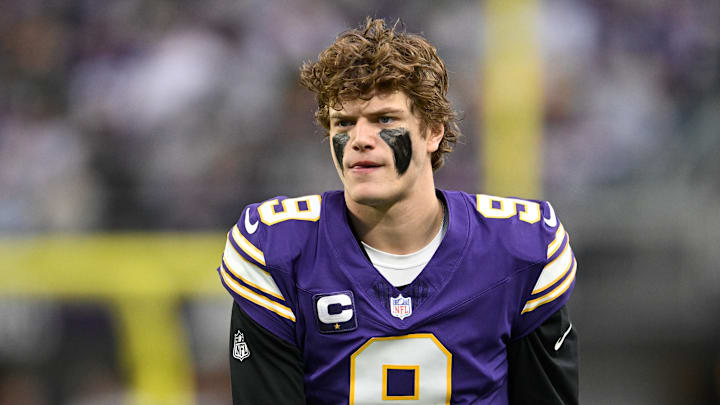
J.J. McCarthy: Minnesota Vikings

Now we move on to the "trade him before you even have to consider an extension" guys, beginning with J.J. McCarthy.
I think McCarthy still has upside as an NFL starter, but the Minnesota Vikings have been actively looking for his replacement and — funnily enough — found it in Kyler Murray, so if they're ever going to get value for him and not be locked into his 2027 salary, this offseason is the time to make a move.
Trade McCarthy now and you don't get anything near what you paid for him back, but you still can get something from a team that looks at the very weak 2026 NFL Draft quarterback class and decides it's worth taking a shot on a reclamation project like McCarthy.
But wait until next offseason, after a season in which McCarthy will only see the field in the event of a Murray injury, and a lot of that appeal is gone. He'll be a year closer to free agency. He'll be competing with a much stronger rookie class, limiting his market.
Michael Penix Jr.: Atlanta Falcons

Michael Penix Jr. is another recent first-round pick who has already been replaced, as the Atlanta Falcons brought in Tua Tagovailoa to take his place in 2026.
The argument for trading Penix is the same argument as trading McCarthy. I suppose, in theory, the Falcons could think a year playing behind Tagovailoa could be what Penix needs to take over in 2027, but the reality is that decisions like that don't work. Now is the time to trade Penix while he theoretically has value left.
If I'm an NFL general manager, I'd view Penix as a better project to take on than McCarthy.
2025 Stats | Starts | Completion Percentage | Touchdown Rate | Interception Rate |
|---|---|---|---|---|
Michael Penix Jr. | 9 | 60.1 | 3.3 | 1.1 |
J.J. McCarthy | 10 | 57.6 | 4.5 | 4.9 |
I don't know if that's a widespread view among actual NFL general managers or not, especially when McCarthy was better at actually winning football games, which probably matters in this discussion. I also think Penix has less name recognition, which might mean his market post-2026 offseason will evaporate faster than McCarthy's, making now the time to trade him while there's still a chance to get something back that can help the Falcons make a run at the NFC South title.
More NFL news and analysis:
 Add us as a preferred source on Google