
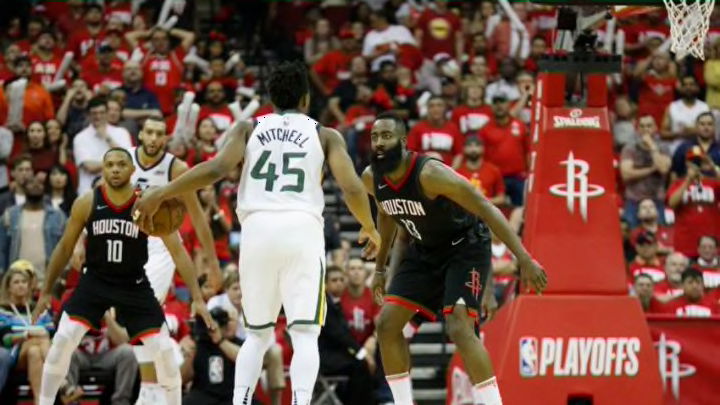
The screen-heavy offensive system of the Utah Jazz can go to the next level if Donovan Mitchell becomes more comfortable taking pull-up 3s.
No one could have expected that when the Jazz took Donovan Mitchell with the No. 13 pick in the 2017 NBA Draft that just 10 months later, he would be leading Utah to a first-round victory in the playoffs. Much of his lightspeed progress came as a result of his dynamism with the ball in his hands, but what makes him truly scary is how much room he has still to grow.
For modern ball-handlers on the floor with toolsy big men and better spacing than at any point in league history, options are plentiful in the halfcourt. Mitchell was in contention for Rookie of the Year because he picked up an elite handle and passing instincts right away was able to stay on the floor defensively, and spaced the floor when the ball wasn’t in his hands. He reaped the benefits of the Jazz’s tendency with bench units to play a wing at the power forward spot and learned how to play incredibly smart basketball with Ricky Rubio over the course of the Jazz’s 29-5 finish.
Utah’s offense is based on spontaneity bred from intense scheming. You get the ball as the result of a premeditated, space-clearing set and you better make the right decision. By the time the playoffs came around in 2018, Mitchell was playing incredibly smart basketball. He attempted at least 20 shots in all but two of Utah’s playoff games, completely taking over the offense.
The next level for his game and Utah’s offense as a whole will come when defenses have to respect Mitchell’s pull-up 3. While the best offenses do indeed give their lead creator plenty of room to operate, they also benefit because so many guards today can nail 3s off the dribble. Mitchell, on the other hand, has a way to go in that area.
The rookie shot 29.3 percent on those looks, despite making 34 percent of his total 3s. However, that overall efficiency is convincing evidence that he can get better pulling up. Mitchell has tremendous touch around the basket, finishing floaters and scoop layups with the type of feel that can’t be taught. And he nailed tough 3s regularly all year, meaning a greater willingness to pull up in the airspace the Jazz system manufactures could be all it takes to take Mitchell to the next level.
There is plenty of room for shots like this within the Jazz offense if Mitchell becomes confident taking them.
One of the most common sets the Jazz run is a simple horns screen play at the top of the key, in which two big men set screens on opposite sides of the ball-handler, with one flaring out behind the arc and the other rolling to the basket. What takes it to an elite level is the individual creativity of Utah’s players. Mitchell taking more 3s off the bounce would force yet another consideration onto the defense.
Look at the instantaneous decisions a horns set forces on the defense. This structure comes from the wing, pushing Mitchell toward the middle of the floor with Jae Crowder near the baseline. Carmelo Anthony has to keep an eye on Crowder while tagging Rudy Gobert going toward the rim, then the weak side defense has to rotate to prevent a Gobert finish. Crowder makes the smart decision to find Royce O’Neale in the corner before Paul George can recover.
Here’s another example of a more free-flowing horns set that opens from a down screen. In this situation, instead of a normal structure where the better shooter is popping out from the double-high screen and the better finisher is rolling, the Jazz have to get creative with both Gobert and Derrick Favors in the game. Gobert pops to the top of the key while Favors rolls to the basket for a Rubio lob.
The reason horns works so well for the Jazz is because they have so many interchangeable parts. As we just saw, they can make Gobert the popper with the intention of resetting the offense with a dribble hand-off, or they can put a smaller player on the floor for a more traditional version. Players like Crowder and Joe Ingles can play the role of the screener or the ball-handler.
Plus, the combination of every threat on the floor at once can create easy points out of much simpler stuff at the end of games or in late-clock situations:
The full effect of Mitchell adding a pull-up 3 comes into view here. With a whirling dervish of screening and movement whipping through Jazz halfcourt sets, a dynamic shot like that would make Mitchell truly impossible to guard individually. And with the amount of skill at each position for Utah, forcing the defense to send help is a victory for the Jazz.
We saw that dimension added to the Jazz offense when Gordon Hayward started to incorporate those daring shots more often. Gobert’s finishing ability demands the Lakers’ attention on the interior here, while Julius Randle knows Boris Diaw is a threat from deep. There’s no good option, and in the pocket of space behind the screen that Los Angeles’ uncertainty opens up Hayward bombs.
Defenses have gone over screens against Mitchell since the beginning of his rookie season. That kind of attention is tough to pull up against, but the young guard has the lift and footwork to get contested pull-up jumpers off like some of the best in the league.
Watch Michael Kidd-Gilchrist fail to recover in time to contest Mitchell’s floater here.
Think about what could happen if the pull-up became a more reliable part of Mitchell’s game and defenses had to worry about that on top of everything else. An angle like the one MKG takes there would be deadly, allowing Mitchell a straight-line view of the basket.
When Mitchell gets an inch, he’s comfortable taking those looks.
It’s similar to what we saw from Hayward during his final year with Utah, when the All-Star shot 41.7 percent on pull-up 3s, which shows a remarkably similar progression on the part of Mitchell, just two years removed from being a complete non-shooter at Louisville, to what Hayward underwent becoming one of the best offensive players in the NBA working within the screen-heavy Jazz offense.
That number was actually higher than his overall mark, signaling a new level of comfort with the hand and footwork necessary to get those shots off, as seen above.
Last season, with Hayward gone and Mitchell and Rubio establishing themselves, Utah was fifth in the league in dribble hand-off frequency and first in the percentage of possessions finished by a pick-and-roll ball-handler. Both of those befit a steadier diet of Mitchell pull-ups. Now, the Utah coaches, led by Quin Snyder, know Mitchell can run the offense. In close games, things will look much more like what we saw in the playoffs against Oklahoma City, giving Mitchell the green light in isolation and on contested 3s.
Finally, the Jazz have a pace problem. Utah could easily creep up from 16th in offense if they play faster all year long. Mitchell’s off-the-bounce creativity could help there too. Utah is too good a screening team not to incorporate more drag screens in transition to get Mitchell revved up on his way to the hoop. With a head start on his defender and comfort pulling up for 3, that type of offense would create a few easy points every night.
The transition from Hayward to Mitchell took no time at all, and the Jazz have picked up right where they left off, returning to the second round of the playoffs. But their horns-based offense has more room to grow with Mitchell at the helm. The team is unpredictable and fun to watch already, but Mitchell gaining confidence stroking pull-up 3s out of those horns sets would bring a new challenge to defenses already stretched thin by Utah’s versatility.
 Add us as a preferred source on Google