
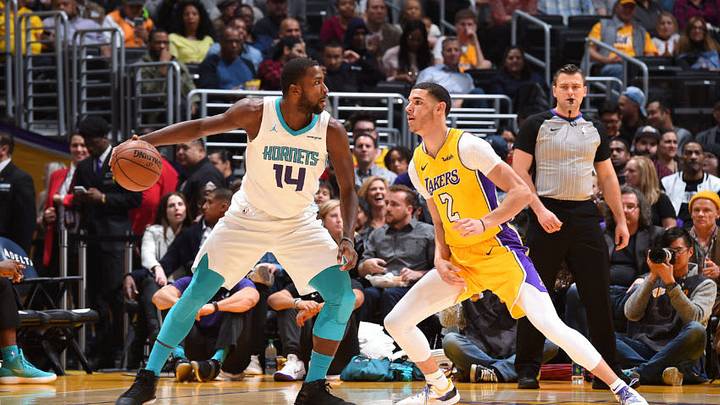
Despite a new coaching staff and an overhauled offensive scheme, the Charlotte Hornets are keeping at least one key facet of the Steve Clifford offense around: The wing post-up.
Wing post-ups were an absolute staple of the Charlotte Hornets offense under Steve Clifford. A large part of the non-Kemba offense involved looking for which of the three wings had a size mismatch, clearing out, and letting them go to work.
And while large amounts of ink were spilled about Dwight Howard’s post-ups, they only accounted for about 60 percent of the total post-ups from the Hornets last year. Thirty-two percent belonged to players that primarily played shooting guard, small forward, or power forward, with the other eight percent scattered between guys like Johnny O’Bryant, Willy Hernangomez, and Michael Carter-Williams.
The results were, unlike Dwight’s, actually not terrible. While Howard averaged a below league average 0.83 points per possession, the wings managed 239 points across 265 points per possession, which is 0.9 points per possession. In the context of general halfcourt offense, that’s below average, but compared to the other post-ups players in the league, that’s above average.
And while new head coach James Borrego appears to have overhauled large parts of the Charlotte offense, that one appears to be here to stay. The most obvious, and only successful one of game one of the preseason was Marvin Williams noticing he had matched up with Jaylen Brown on the right block and immediately turning to post him up. Unfortunately, the NBA does not provide film of preseason games as readily, so there’s no clip available here.
There were also other post-ups in that game — Michael Kidd-Gilchrist backed down Kyrie Irving and missed a turnaround jumper that he makes at a high enough rate for it to be worth him taking. Batum got post position in a weird spot inside the free throw line but didn’t receive the ball quickly enough and it ended up in a turnover.
But regardless, the wing post-up is certainly in the Hornets’ offense to stay, so it’s important to break down a little further how it happened historically.
First, we’re going to primarily focus on the post-ups of Nicolas Batum, Michael Kidd-Gilchrist, and Marvin Williams. These make sense to prioritize because they are the three players who exceeded 30 post-ups from the wing this year.
So first, three post-ups from Batum:
And there’s a bunch of major takeaways from this, which I’m going to go through in somewhat rapid-fire succession here because they’ll extend to the others in a few cases.
All of the plays begin with the correct floor balance. This isn’t a place where they get the ball into the post and then correct the floor balance for the realization that they have a post up possession. Part of initiating the play is that the center is already on the opposite side of the paint, that there is a shooter in the far corner to keep the other help defender from collapsing, and that the entry passer cuts away from the near corner so that his man can’t help.
As a result of beginning with a correct floor balance, all of these plays are quick. While most post-ups are known as grinding, pounding the ball affairs (like those of Dwight Howard often were), these are high tempo shots. The Hornets had pushed a 12-second shot clock in practice, but all of these shots would have fallen within that.
All of them are on a smaller defender. The defenders, respectively, are Dwayne Wade, 6-foot-3, J.R. Smith, 6-foot-5, and Sindarius Thornwell, 6-foot-5. Batum is 6-foot-8 and has a pretty significant release point advantage on those.
All of them resulted in turnaround jumpers. These are jumpers that Batum usually has made throughout his career, but last season they fell at one of the lowest marks of his career. But also, there’s something in the lack of aggression to go to the rim there, when he should be able to mix in a fake or two and get there on a defender that bites.
And most importantly, all of them missed, despite being relatively clear looks. Batum was the least efficient of the three wings last year in spite of matching the volume of the other two combined, scoring .81 points per possession. With almost all Synergy statistics, there tends to be a plague of small sample sizes, and this is no exception. Batum, despite being fairly high volume overall, still only had 83 such possessions. And at that sample size, three or four good rolls can take him from actually worse than Dwight Howard to almost at league average. There’s a reason why these plays have stuck around in the rebuilt offense and the way Batum posts up forms kind of a baseline for what the play normally looks like.
Next, here are three post-ups from Michael Kidd-Gilchrist:
Those differ from Batum’s in a few ways. Primarily, Kidd-Gilchrist, rather than using a finesse game, often just straight overpowers his smaller defender. In the first clip, you see him push Gary Harris about ten feet towards the basket. In the second, you see him just use his first step to turn and blow by the relatively slow-footed Alex Abrines on the baseline. Those are both things Nic Batum can’t do as consistently because he’s not the same caliber of athlete.
But crucially, Kidd-Gilchrist has developed something of a finesse game in the post to keep defenders honest, which is why that third clip is so important, even if it did happen in a broken play. He fakes the pass to force Josh Richardson away and then sinks the fadeaway over Dion Waiters. Over the last two years, his jump shot form has been significantly better when taking shots out of a post up because it limits how much he contorts his body as he’s naturally tempted to do on normal jump shots, and the results are there. He’s been above average out of the post-up, albeit on low volume, both years since his shoulder injury.
Even beyond the difference, though, the crucial elements are still there: The play is quick, it’s targeting a smaller defender, and it’s maintained with proper floor balance so that there’s not an easy help defender, since all of Harris, Abrines, and Waiters are at a size disadvantage on Kidd-Gilchrist.
And finally, there’s Marvin, who doesn’t have the explosiveness of MKG or the consistent turnaround of Batum, but he does have a more diverse series of post moves and the most length of the three. Here are three clips that demonstrate some of his post moves:
That’s three different possessions and three different moves; Some are as simple as that basic turnaround, while some are a slightly higher degree of difficulty moves like the second shot, which needed a couple of pump fakes and a fairly difficult shot to shake Tatum’s defense.
But once again, all three of those main elements for what makes this a working play are there. The plays are a little slower than those from the other two players, but no play ends with more than two-thirds of the shot clock elapsed. Every play targets a smaller defender, from Marcus Smart to Jayson Tatum to Patty Mills. And every play except the last one, against Patty Mills, starts with the floor properly spaced. To no coincidence, that play was the one that Marvin was forced in terms of which moves he could make because of where LaMarcus Aldridge was, and so in spite of being the biggest mismatch, it ended in one of the higher degree of difficulty shots.
As a result, it makes sense that these elements are probably going to stick around sporadically in the new offense. They fit exactly what the Hornets were already doing in the updated schemes, and more than anything, they force defenses to play honestly against players that have nights where they can kind of be cheated off of. And while position changes may complicate exactly how often they occur, since Kidd-Gilchrist and Batum are less likely to get true mismatches at the power and small forwards respectively, the wing post-up is still a valuable tool to have for when those mismatches do occur.
 Add us as a preferred source on Google