
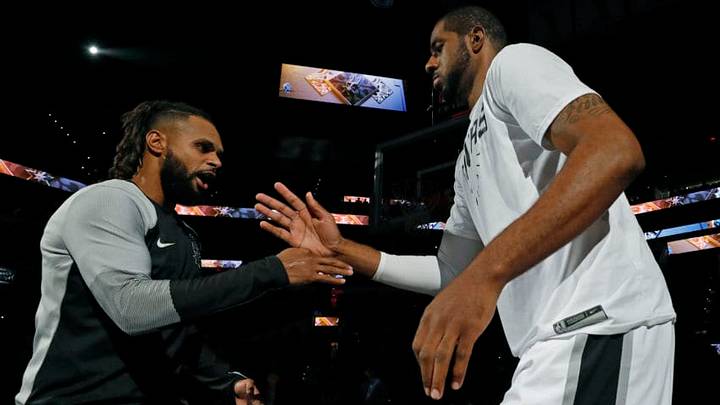
I always thought Rufio was a pretty cool stand in for Peter Pan. The San Antonio Spurs have neither a Pan nor a Rufio. They exist in that moment beyond the Hook screen credits. The old rivalries are done. The fat kid whose action figure was named Thud Butt and whose character was never revealed in the film as having such a horrendous title rules the roost.
LaMarcus Aldridge played some of the best basketball in his 12-year career last season. Some might claim the effort was wasted because Kawhi Leonard only played nine games. But imagine what the Spurs might have been without Aldridge’s 23.1 points per game and 8.5 rebounds. He also finished the season with near career marks in VORP and Win Shares. Sure, the team failed to win 50 games for the first time in forever and lost in the first round of the playoffs but imagine where San Antonio would have finished if not for Aldridge.
With the departures of Tony Parker, Manu Ginobili, and Leonard in the offseason, Aldridge is likely to become a sentimental favorite among Spurs supporters. After all, as is often discussed during the lulls of an NBA game, he could have left in the summer of 2017 for some other franchise, but instead of forcing a trade, he chose to stay. What was often tabbed as Aldridge’s come to Pop moment may have actually been Pop’s come to Aldridge moment, resulting less from the old masthead’s coercive tactics and more from a human understanding that LaMarcus Aldridge is, well, LaMarcus Aldridge and not any other former Spur with Hall of Fame credentials.
While Aldridge exited Portland with questions swirling about his professional jealousies and general surliness and reportedly pined for a Portland reunion only a season or so later, another season in San Antonio has him positioned to become the Grocery Store Joe of south Texas.
This transformation has been slow-going. His addition to the Spurs three years ago did not net a championship in Tim Duncan’s final season and the following year his flatfooted play in the postseason resembled a deranged version of the opening sequence in The Sound of Music. For a moment, picture Manu and Tony in black and white nuns’ habits instead of black and gray basketball uniforms. Then, imagine them singing:
"How do you solve a problem like LaMarcus?How do you catch a pass and slam it down?How do you find the word that means LaMarcus?A whatchamacallit! A whowouldhavethought! Oh no!"
The problem now clearly isn’t LaMarcus, if it ever was, but no one expected him, at age 32, to be bearing such a heavy basketball burden in isolation. If anything, he was supposed to be Kawhi’s burden at this point in time. And yet here he is, in the absence of his supposed running mate, leading a pack of lost boys in torn curtains along the famed River Walk.
As Rob Wolkenbrod observed for FanSided’s Air Alamo a month ago, the San Antonio roster is a bunch of Millennials housed in their parents’ basements.
Pau Gasol is about to start his 18th season. Rudy Gay and Marco Belinelli will be entering their 13th and 12th years. Patty Mills and DeMar DeRozan are both about to notch a decade on the doorframe. Meanwhile, Davis Bertans, Jakob Poeltl, Dejounte Murray, Derrick White, and rookie Lonnie Walker each possess less than three years NBA experience.
The last night in the nursery is in effect, but so too is the rebuild. If someone other than Gregg Popovich were handling the roster, this dynamic could result in political gridlock and kicking the proverbial can down the road. Then again, the Western Conference is a wildfire. It’s fine. Sip from the white coffee mug as the world burns. Think happy thoughts.
Trading Leonard netted DeMar DeRozan. From an objective standpoint, the move is neither terrible nor great. DeRozan is, after all, a talented NBA scorer, if a somewhat anachronistic one. He can light up a scoreboard, but many of his favorite places on the floor overlap with where Aldridge likes to operate, or where Rudy Gay likes to operate, or where Pau Gasol likes to operate, or where Dejounte Murray might operate, or where pretty much any Spur not named Patty Mills is likely to operate.
With all this overlap in shot preference, concern for the San Antonio offense is understandable. However, Aldridge is also used to playing with a guard like Tony Parker, who despite stretching his game to an extent still remained a constant in the lane. Moreover, Gregg Popovich’s teams have been successful over the years in a variety of ways, and a reason for that is his tendency toward not asking players to do what they cannot or are not comfortable in doing. He never asked Avery Johnson to shoot 3-pointers. Instead, the little preacher ran curls along the baseline and spotted up from ten to fifteen feet. Years later, Bruce Bowen ran the same patterns, but he stretched the pathway to beyond the 3-point line and into the geography of a twenty-first century NBA. The more intriguing question may not be whether DeRozan and the offense can be successful in doing what they do best, but whether what they do best can still be successful in today’s NBA.
One could also wonder openly how DeRozan’s timeline — he’s 29 — fits with Dejounte Murray and Lonnie Walker and whether his presence might hamper their development. He may not have the same impact playing twice the number of games against the Western Conference as he has in past seasons. The Western Conference, after all, has a much taller totem pole in terms of established talent than the Eastern Conference. Then again, as is the case with Aldridge, the Spurs are probably better off with a player like DeRozan, even if he is somewhat anachronistic and possibly overpaid, than they would be without him. He may be too old for the San Antonio staff to dramatically change his game, but the San Antonio staff may discover, as it did with Aldridge, that over coaching imported stars may actually be the one true way to snuff them out.
Expectations for the Spurs carry more trepidation than any time in over two decades, maybe even longer. After all, the Tim Duncan era was preceded by the David Robinson era, which was preceded by the George Gervin era. The years have been good, and the years have been many. The lack of legitimate championship hopes could feel like something of a letdown, but to suggest the Gervin and Robinson eras were full of wasted effort is a shallow treatment of human experience. After all, Robinson’s era dovetailed with the Duncan era.
Eventually, all things must go their separate ways. They can go kicking and screaming. They can ramble and stutter. They pause awkwardly in parking lots, not knowing how to say goodbye or when to let go. But, eventually, they do end. The Spurs window is closed, and it will most likely remain so for the foreseeable future. And yet the golden residue remains, and in that twilight, one can still see the hoop and, squinting, make out its shape.
Is that you, Manu? Or just a shadow on the wall? Maybe it’s Dejounte Murray. Perhaps a player to be named later.
 Add us as a preferred source on Google