
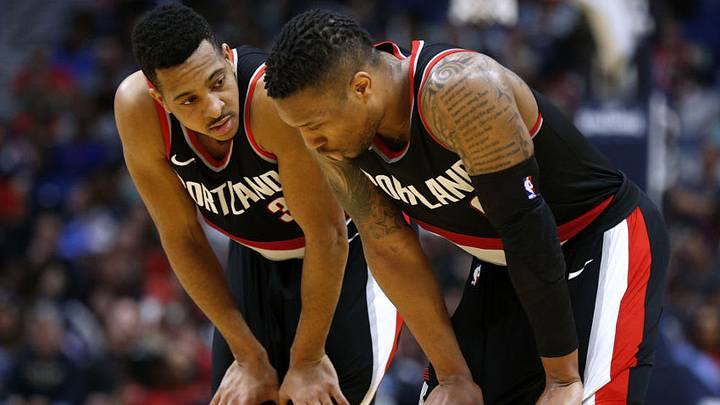
CJ McCollum is the Portland Trail Blazers second-best player. He is probably most famous for hosting a podcast in which other NBA players serve as guests. Correction: he’s probably most famous for conducting a Twitter feud with Kevin Durant, after Durant appeared on his podcast in the offseason. This lukewarm dispute boiled into something more when McCollum issued the now classic tagline of a plea: I’m trying, Jennifer.
And maybe that’s all anyone ever needs to say about basketball or life. We’re all trying. We are ambitious, and we are weak. We dare. We fail. We want credit for the effort. We want credit for the effort because, in the end, we may not have anything else, at least not in the eyes of others. And that’s what desire is about: being seen as substantial in the eyes of others. If we don’t dominate the skyline, can we at least be recognized for our efforts and ideas?
McCollum is a good NBA player, and the good probably needs a positive adverb in front of it. He’s very good. He has averaged no fewer than 21.3 points per game over the last three NBA seasons. He’s clearly trying, hopefully, Jennifer notices. Then again, Jennifer demands rings, and that’s the frame of reference where the very good McCollum and the above average Portland Trail Blazers start to look fairly average.
In the very tough Western Conference, they will most likely not win more than 50 games. Josh Eberley predicts no more than 45 games, which would be fewer than last season. Trying is not necessarily a science.
This past summer, following a brutal playoff sweep to the New Orleans Pelicans, CJ McCollum “received a platelet-rich plasma (PRP) injection” in his knee. An MRI reported no structural damage, but some foundations are difficult to test. Think about it another way. As Eberley observes of the Portland roster: “General manager Neil Olshey has married the Blazers two stud guards to a cast of flawed rotation players.” In others words, McCollum’s knee is the Portland Trail Blazers. Nothing’s truly wrong. But everything’s not right either.
The other stud guard is Damian Lillard. He is their best player. And, because he’s also famous for rapping in whatever spare time a professional athlete possesses, his presence provokes wordplay. The issues are structural. The guards are studs. The role players are a flawed cast. Teams are always building or not building. What does effort achieve in the architecture of people and things?
On the right night, the 6-foot-3 Lillard and the also 6-foot-3 McCollum can look limitless. They inspire in a manner beyond posturing and prompt eye witnesses into believing this must be the league’s best backcourt. Despite their size and quickness, they are cornerstones for some soon to be rising skyscraper, a monolithic structure patent made for cinematic skylines, spider webs, and ambitious bankers. They are striving. On other nights, the steel beams melt, Venom snarls, the bankers plummet — or maybe Anthony Davis is even more unstoppable than a measly pair of guards — but they are still striving. The world is more or less the same, and yet neither.
The Lillard and McCollum pairing is now three seasons old (not counting McCollum’s first two seasons in the league when his minutes and opportunities were limited). The Portland playoff streak of five seasons rests largely on their shoulders. Finding them on a steel beam in May eating their lunches is largely shtick by now; the iconic moment, whether lived or posed, is now whittled down to a postcard or mounted on a dorm room wall, growing more ubiquitous as a souvenir t-shirt but also smaller as the era draws to a close. The two stud guards are Fred Armisen and Carrie Brownstein, and they are ruining hidden neighborhoods everywhere with their big ideas and aspirational blueprints. They are trying.
Portland is not a tall city. The highest building measures approximately 540 feet. Several buildings in either New York or Chicago are almost twice that size. The city is attractive in the way it is not a city, but also in how it holds onto the notion it could be more. Impressive bridges span the Willamette, and creativity is a buzzword. But more wouldn’t be Portland, at least not the Portland that was. Such is the way of Lewis and Clark and Lillard and McCollum.
The two can speak to the wonder of the greater Northwest and promise they won’t sell out. They can turn loyalty into a mantra, preach against constructing super teams, and tattoo the world with old-fashioned values and mystic truths, but none of that can erase how Jrue Holiday looked just as good, if not better, last spring. The very good studs were exposed.
Lillard and McCollum have already survived one rebuild. When both first arrived in Portland, they mingled their talents with the likes of LaMarcus Aldridge, Nicholas Batum, and Wesley Matthews. Those players are all in other cities now. But the new building project is still something of a Jenga tower, and Lillard especially appears cast in a disaster movie reboot. He’s not quite a Brando or Newman or DeNiro. He’s a bit more Steve McQueen. In the right scene, he’s stellar. With the right script and talent, perhaps even iconic. But the Blazers aren’t The Magnificent Seven or The Great Escape. You can’t make a film with just one long scene shot in solitary confinement. Or maybe you can.
Venom opened over the weekend, and while I have not seen it, the reviews are not good (at least I don’t think “A true turd in the wind” is intended as praise). Tom Hardy plays the lead role Eddie Brock, and the idea behind most Venom narratives is that the alien symbiote of a spider suit traps its human host. The two become one. But the two cannot survive. Think Kawhi Leonard his last year in San Antonio, or Jimmy Butler the last few weeks in talks with Minnesota. The analogy, though, isn’t quite right when it comes to either Lillard or McCollum in Portland. After all, they’re trying damn it.
But Tom Hardy often plays a trapped protagonist. Before climbing into a cockpit for Christopher Nolan, he starred in the 2013 film Locke, where his character spends the entire film driving in his car and making long distance phone calls. He’s driving to a hospital where a woman with whom he had a one night stand is about to give birth to a child. He doesn’t really have to go, but he drives through the night out of a peculiar sense of moral duty. His calls to his wife and son reveal him to be something of a good family man, and, if the film can have it both ways, he is also incredibly flawed. This crack in his character looms as a treacherous metaphor for not only his life but also his career.
The day the child is to be born is also the day he is to oversee the concrete pour for his new building. He is an engineer. He is an architect. The crack in his moral foundation disrupts the laying of a literal foundation. One mistake threatens another; the universe is set up like cataclysmic dominoes.
Lillard and McCollum are not Locke. They aren’t even Tom Hardy. After all, Lillard’s hobby of rapping demands more authenticity than acting. And yet at the core of so many great performances is the overlay of the actor and the character — that load-bearing crux. Lillard and McCollum, but especially Lillard, live and breathe Portland, but one wonders when “I’m trying” becomes an hour and a half drive away from all that seemed to matter, when the effort to do and be everything good in a city warps the hero into his own anti-matter. The nature of sports is this: be yourself, but always be better than you are.
How can a team accomplish both?
 Add us as a preferred source on Google