
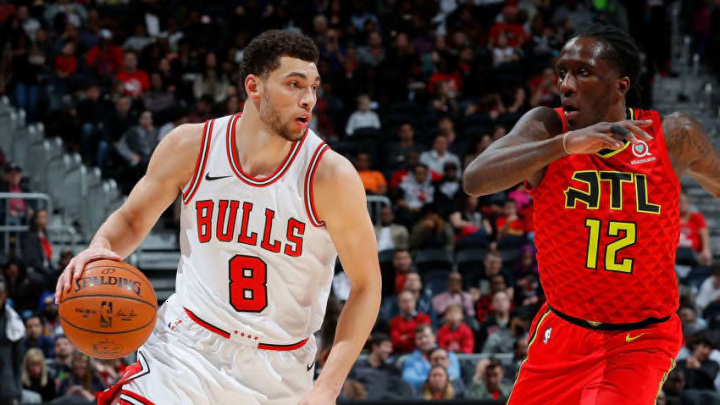
The story of the 2017-18 Chicago Bulls could be summed up simply with just a couple of words: youth-led reset. After sneaking into the playoffs and giving the top-seeded Boston Celtics a run for their money in the first round the year prior, the Bulls decided to part ways with the vast majority of their veterans and usher in a new era by surrounding head coach Fred Hoiberg with a tidal wave of youth, akin to what he was used to working with during his tenure at Iowa State.
Goodbye Dwyane Wade, Rajon Rondo, Taj Gibson, and Jimmy Butler. Hello Zach LaVine, Kris Dunn, and Lauri Markkanen.
To say last season was a rocky one for the new-look Bulls would be a bit of an understatement, though that was always to be expected, at least to some extent. Chicago started 3-20 before Nikola Mirotic returned to the starting lineup after being involved in an early season fight with teammate Bobby Portis and was subsequently shipped to the New Orleans Pelicans because the team actually started winning games; Dunn saw the stock in his upside rise after a promising first 30 games before injuries and everyone realizing he’s already 24 years old caused it to plummet back down to Earth; LaVine’s jumper looked rusty after returning to game action in mid-January following ACL reconstruction, though his signature athleticism remained. About the only player who lived up to the hype with any modicum of consistency was rookie Lauri Markkanen, who may actually be some iteration of Dirk Nowitzki.
In all, it was an eventful, if not ultimately somewhat disappointing, phase one of Operation Rebuild the Bulls.
But if 2017-18 was phase one of the Bulls’ rebuild, then 2018-19 will be — get this — phase two. During the offseason, Chicago doubled-down on their acquisition of LaVine, cementing him as a franchise cornerstone when they decided to match a four-year, $78 million offer placed by the Sacramento Kings. The Bulls took a (somewhat expensive, potentially flexibility limiting) flier on oft-injured Chicago native Jabari Parker, who was brought in to provide further interest in the team as well as more fire-power on offense (and likely relatively little on defense, because, you know, that doesn’t get one paid). With the seventh pick in the draft, they selected versatile big man Wendell Carter Jr. who very well could be the Allen wrench that helps set the proverbial screws of the Bulls’ rebuild in place.
All of the above-mentioned moves fall somewhere along the spectrum of “Well, I maybe wouldn’t have done that but I guess they didn’t have much of a choice” to “This could look really, really good in a year or two”. With how young the roster figures to be during the upcoming season — centers Robin Lopez (10) and Omer Asik (8) are the only players on the roster who have been in the league for longer than five years — there isn’t, or at least shouldn’t, be a ton of pressure on the Bulls to win, at least not right away. Rather, how and to what extent the young Bulls improve, both offensively and defensively, over the course of 82 games will define the success — or failure — of their 2018-19 campaign.
As is the case with most young teams, the Bulls weren’t particularly good on either side of the ball last season. Their 101.3 offensive rating and 109.1 defensive rating each ranked 28th in the league, according to NBA.com/stats, with only the lowly Phoenix Suns and Sacramento Kings having a more popgun offense and Suns and Cleveland Cavaliers a defense more resembling Swiss cheese.
But as demonstrably bad as those numbers are, they were even worse when the three-man lineup of Dunn, LaVine, and Markkanen shared the floor. According to NBAwowy.com, during the mere 255 minutes in which the three cornerstones shared the floor last season, the Bulls possessed an utterly atrocious offensive rating of 98.5 and defensive rating of 120 (the numbers from NBA.com are 97.5 and 119.2, if you were wondering). That’s such an incomprehensible level of bad that they almost have nowhere to go but up. If the Bulls want to grow beyond their production last season, Dunn, LaVine, and Markkanen simply have to play better together.
One way in which this may be easily accomplished, at least on offense, is by simply swapping the usage rate of LaVine and Markkanen within the offense. Markkanen’s usage rate last season was a mere 22.1 percent — placing him 138th in the league, sandwiched between CJ Miles and Wayne Selden among those who played greater than 15 minutes — compared to LaVine’s 29.6 percent (23rd), Bobby Portis’ 26.0 percent (56th), and Dunn’s 24.7 percent (76th) according to NBA.com/stats. The Bulls will likely need to utilize the seven-foot Fin more frequently should they want a more effective offense, which should be of the utmost importance.
LaVine has functioned most optimally, during his brief NBA career, as the microwave scoring third option, posting an effective field goal percentage of 54.4 during his final year in Minnesota. During that season his usage rate was 21.8 percent and never rose above 23.5 percent during his tenure in the great white north. LaVine’s usage will likely drop naturally due to the additions of Parker and Carter Jr. as well as the fact that the Bulls won’t be trying to get him back up to NBA speed, but keeping his usage rate around 22-24 percent may be in Chicago’s best interests.
Speaking of Carter Jr., how the Bulls incorporate him into their rotation will be interesting to watch. As of this writing, it seems likely, at least logically, that Carter Jr. will begin the season coming off the bench. Robin Lopez has started every game he has appeared in since 2011-12 and will likely get the nod once again on opening day. But with Lopez on an expiring contract and after being held out for a number of games down the stretch last season, it would make sense for Chicago to move the center at some point before year’s end. Carter Jr. will almost undoubtedly be the first to slot into the starting lineup should he be traded or go down with an injury.
But that begs the question: how good can we expect the rookie from Duke to be right away? This is the age-old question when it comes to rookies who figure to feature prominently within their team’s rotation. Although it was only five games, Carter Jr. showed a ton of promise during Summer League (I know, I know) and figures, at least theoretically, to be a near perfect fit next to Markkanen in the long term due to his versatility on both sides of the ball. If he can provide anything near what he did in Las Vegas, Bulls fans will, and should, be giddy with excitement.
(I feel as though I should quickly say something about the Bulls’ other rookie Chandler Hutchison, who has yet to be mentioned to this point. Hutchison had a fairly underwhelming debut during Summer League, but the Bulls have been high on him since the pre-draft process. I’m not exactly sure what to expect from the Boise State product coming out of the gates, but with his competition for playing time at the wing being Denzel Valentine, Antonius Cleveland, Antonio Blakeney, and a few others, it seems likely that he’ll get a run at some point.)
The upcoming Chicago Bulls’ season figures to be exciting, though likely frustrating at times as young teams are wont to produce. But at the end of the day, it doesn’t matter how many games the Bulls win, all that matters is that they continue to grow, develop, and age. Should they do that, the future on the banks of Lake Michigan will be looking bright once again. If they don’t, well, it’ll be yet another cold winter in Illinois.
 Add us as a preferred source on Google