
While the dust has more or less settled on an eventful MLB offseason, the arrival of spring training does not mean GMs stop picking up the phone. Several teams still have holes to fill and depth charts to tweak.
ESPN's David Schoenfield helpfully pitched seven hypothetical trades, ranging from high-profile blockbusters to simple cap sheet balancing acts. They include major potential upgrades for the Boston Red Sox, Houston Astros and Atlanta Braves, among others. Let's grade 'em all:
Red Sox trade Wilyer Abreu to Mets

On the surface, this is a fairly even trade, addressing positions of need for both teams. Boston has question marks at third and second base; the Mets could use a proven right fielder next to Juan Soto in left and Luis Robert Jr. in center.
Both players were comparable in terms of impact and production last season, and both are under club control through 2029:
Name | fWAR | OPS | wRC+ |
|---|---|---|---|
Wilyer Abreu | 2.4 | .786 | 110 |
Brett Baty | 2.3 | .748 | 111 |
That said, there are a few potential hangups. For one, the Mets could use Baty at third base if Bo Bichette's position change does not stick, forcing him to DH. Same for potentially replacing Soto in left, should his defense falter. Bichette is also a potential free agent next winter, which could reopen a need at the hot corner.
From Boston's perspective, Abreu is probably their second-most valuable outfielder. While the logjam is an issue worth addressing, Abreu is a Gold Glove-caliber defender out in right — in addition to his burgeoning offensive talent. The Red Sox should probably try to trade Jarren Duran first, or simply cut Masataka Yoshida and be done with the hand-wringing over DH.
Abreu also has a career .791 OPS, compared to a career .666 OPS for Baty. The latter's breakout last season was promising, but it's relatively fresh and untested, whereas Abreu has a few productive MLB seasons under his belt. That, as well as the superior defensive profile, probably leaves Boston inclined to keep Abreu.
It's also worth noting that Boston wants a spot for Marcelo Mayer this season, with Kristian Campbell and top prospect Franklian Arias due for MLB reps sooner than later. Newcomer Caleb Durbin was also just brought in, presumably to play third base, after finishing third in NL Rookie of the Year voting last season. So, there's not enough pressure on Craig Breslow and the Boston front office to pull the trigger.
Mets grade: B
Red Sox grade: C-
Astros trade Isaac Paredes to Pirates

Pittsburgh has made substantial additions this winter, acquiring Brandon Lowe, Ryan O'Hearn, Marcell Ozuna and Jhostynxon García, all for relatively little. Top prospect Konnor Griffin, a 19-year-old phenom drawing comparisons to Bobby Witt Jr. and Hanley Ramírez, could also join the mix.
Still, there's a hole at third base, where utility bat Jared Triolo currently profiles as the everyday option. Houston, meanwhile, has too many quality infielders. The Carlos Correa trade means Isaac Paredes, a 2025 All-Star, will either ride the bench or force an awkward defensive alignment (move Jose Altuve to left field at your own risk). He comes with a couple years of club control and an affordable contract, which should allow Houston to recoup value despite faltering leverage.
Hunter Barco, Pittsburgh's No. 4 prospect, is a solid lefty on the verge of his MLB debut. Houston's rotation is a real mystery box right now, so a depth option with upside is a significant value add. Plus Triolo profiles as a far more realistic fifth infielder, able to plug a few different holes based on need — with a solid walk rate and plus base-running skills, to boot.
This trade makes sense for both sides. If anything, Houston might be able to aim a little higher, but two potential contributors for a mid-tier "star" you don't have space for certainly qualifies as an acceptable bargain.
Pirates grade: B+
Astros grade: B-
Astros trade Christian Walker to Padres

San Diego would also receive cash in this exchange, as Houston is effectively dumping a two-year, $40 million sunk cost.
This is an alternative to the aforementioned Isaac Paredes trade — a move to free up first base for Paredes and rid Houston of its worst infield regular from last season. The Astros signed Walker to a three-year, $60 million contract initially, expecting to acquire a Gold Glove first baseman with a perennial .800-plus OPS. Instead, Walker's strikeout rate spiked and he finished with a sub-.800 OPS (and sub-100 OPS+) for the first time since 2021.
Walker's production began to tick up over the back half of the season, and there's reason to believe the 34-year-old can still produce quality results at first base. That is a position of need for the Padres, who've been hamstrung a bit financially this winter. Any leftover financial risk aside, acquiring Walker in exchange for a Minor League reliever, ranked sixth in a weak Padres farm system, is a reasonable gamble.
For Houston, it's chance to move off (some) of Walker's money while adding an MLB-ready bullpen arm in Bradgley Rodriguez, whose elite fastball can touch triple digits. San Diego's bullpen is a strength, so it can afford this sacrifice — even if years of quality relief work from Rodriguez in Houston might sour this trade for the Padres in hindsight. Only time will tell.
Astros grade: B
Padres grade: C+
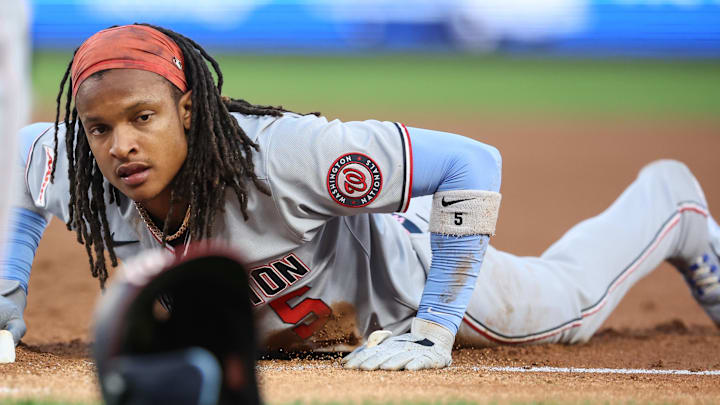
Nationals trade CJ Abrams to Braves

CJ Abrams name has popped up here and there all winter as the Nationals attempt to deconstruct this roster under new GM Paul Toboni. Washington is slow-playing this thing in a competitive division, which means cashing out on Abrams with three years left on his deal, at close to max value, becomes an appealing option.
For Atlanta, this is a chance to put a fork in shortstop what-ifs for the foreseeable future. Abrams is not without his flaws, but he's such a smooth and explosive athlete. He's also just 25, coming off of a season in which he tallied 19 home runs and 31 stolen bases, with a .748 OPS and 111 OPS+. He can be over-aggressive at the plate, and the defense at shortstop is abysmal right now, despite all his tools. But in terms of upside and undiluted talent, Abrams would represent a huge upgrade to this Braves infield.
On paper, Atlanta is very much in contention. Injuries are already threatening to derail a third straight season, but if the Braves can upgrade their weakest position and hold their lineup together with enough bandaids and super glue, something special could happen this season. Abrams is a worthwhile swing for the fences.
Now... how worthwhile exactly? That's a fair question. The Nats receive Atlanta's No. 1 and No. 7 prospects in Caminiti and Fuentes, with Alvarez a former top prospect himself, who has since graduated from prospect status. Caminiti is a few years away. Fuentes made his MLB debut this past season out of desperation, but he's still 20. Alvarez has tried and failed to break through in the Majors, but he is still 22. All three offer considerable long-term upside as Washington embarks on this rebuild.
Given the Nationals' explicit patience during this rebuild, Washington fans probably end up feeling better about this trade than Braves fans — even if it's a significant day-one upgrade for Atlanta, with World Series dreams still within reach.
Nationals grade: B+
Braves grade: B
Nationals trade CJ Abrams to Red Sox

If the Nationals don't want to send Abrams to a division rival, Boston could express interest in the 25-year-old as a second baseman. The Red Sox presumably plan to slot Caleb Durbin at third and Marcelo Mayer at second this year, but the immediate upgrade of Abrams — with the potential for Mayer, Campbell and others to develop patiently on the back burner — ain't half-bad conceptually, especially with Boston so clearly aiming for the World Series.
Washington probably gets more bang for its buck with the Braves trade, and given their long-term focus, the Nats shouldn't sacrifice value just to put Abrams in the American League. That said, Connelly Early is very easy to believe in. He tore through the Minors last season and excelled in his first four starts with Boston: 2.33 ERA and 1.09 WHIP, with 29 strikeouts in 19.1 innings. He could very credibly take the mound on Opening Day for Washington.
If the Nats believe wholeheartly in Early as a foundational ace, and want him on the bump next season, that could push Boston over the top, compared to longer-term projects like Caminiti and Fuentes from the Atlanta deal. Juan Valera is Boston's No. 11 prospect — a 19-year-old righty praised for his work ethic. David Hamilton would be a utility glove in DC, with the potential to start in Abrams' place.
All that said, the Red Sox' outfield logjam is increasingly distracting us from their infield logjam. Mayer and Campbell are MLB-ready pieces, with Franklin Arias, Boston's No. 1 prospect, not far behind. Caleb Durbin and Trevor Story are clear-cut MLB starters. Willson Contreras has first base on lock, with Triston Casas behind him. Boston has the pitching surplus to roll the dice on a talented player like Abrams, but he's another lefty who doesn't really address their core issues. So Boston might bow out of these negotiations at a certain point.
Nationals grade: B+
Red Sox grade: C+
Cardinals trade JoJo Romero to Blue Jays

This is a fun concept, with Toronto reinforcing its bullpen and the Cardinals acquiring four years of control over a quality, do-it-all contributor in Davis Schneider. The Blue Jays are clearly hellbent on getting back to the World Series after such a heartbreaking loss. Schneider helps, but their wealth of positional depth renders him somewhat expendable. Romero would immediately take on a high-leverage role, presumably as the chief setup man to Jeff Hoffman.
Romero was one of the rare bright spots for St. Louis in 2025, putting up a 2.07 ERA and 1.25 WHIP across 61.0 innings in relief. He picked up eight saves, pitching effectively to contact with a groundball rate (57.1) in the 95th percentile. Romero had been good for a couple years since joining the Cardinals, but last season saw him occasionally approaching great.
For St. Louis, Schneider is one heck of a return — probably better than a lot of folks realize. He only appeared in 82 games off the bench last season, splitting time between second base and left field, but he finished with a .797 OPS and 119 OPS+. He was especially dominant against left-handed pitching (.915). Like the majority of Toronto's lineup, Schneider is very disciplined at the plate. He works long counts, with a comical 15.9 percent walk rate, and he can generate some real power on occasion.
At 27, and under club control through 2029, Schneider probably starts a lot of games in left field for St. Louis in the years to come. As productive as Romero was last season, the Cardinals are in no position to contend. Turning the final year of his contract into a long-term, impact player like Schneider is a huge win.
Cardinals grade: A
Blue Jays grade: B
Astros trade Jake Meyers to Angels

The Angels are caught without a real centerfielder at the moment, which is made more difficult by the fact that either Mike Trout or Jorge Soler will be taking the field regularly in one of the corners. Jake Meyers is an instant fix — one of the rangiest outfield gloves in MLB, coming off of a career-best .292 season at the plate with a .727 OPS and 103 OPS+.
Josh Lowe arrived in Anaheim about a month ago, but the Angels swiftly reroute him to Houston in this scenario. That would bump Jo Adell back to right field and allow L.A. to keep Trout in the DH spot, which is a must to avoid the untenable injury risk (God forbid if the Angels attempt to put Trout in center).
Houston wants lefty bats, and Lowe can hold down either corner spot in the outfield. He was much less productive than Meyers last season, with a .650 OPS and 81 OPS+. He's also much less valuable in the field. That said, he was respectable against righties (.727 OPS) in 2025, and he's two years removed from a 20-30 season for Tampa Bay, in which he posted an .835 OPS and 128 OPS+. There's hope that a change of scenery, joining an established winner like Houston, can help Lowe regain top form. He also comes with an extra year of club control compared to Meyers.
Given the upside, and Houston's need to solidify the back half of the lineup with a bit more pop, this feels like a reasonable gamble. The Angels are getting a much higher floor with Meyers, whose defense alone should make him indispensable, but Houston has Cam Smith and other prospects capable of taking over in center.
Angels grade: B
Astros grade: B
 Add us as a preferred source on Google