
Key Points
Bullet point summary by AI
- The Chicago White Sox face renewed tension with Frank Thomas.
- Legal action has been taken regarding the unauthorized use of a legendary player's identity on recent merchandise.
- This feud underscores crucial lessons for MLB teams about maintaining long-term relationships with their icons.
As things currently stand, the National Baseball Hall of Fame might want to begin working on a new plaque for Frank Thomas, one lacking the Chicago White Sox logo on his cap.
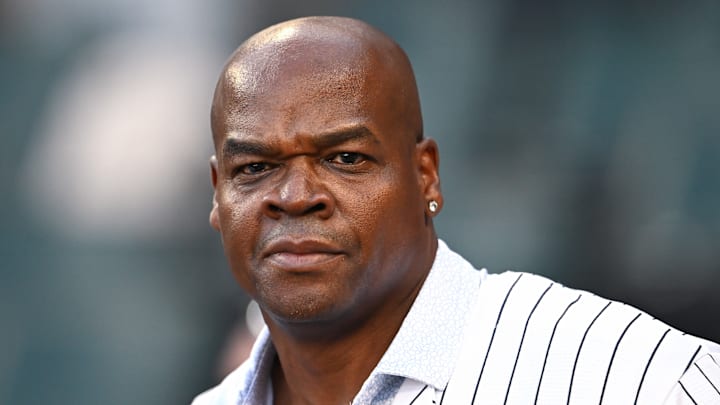
Thomas, a 2014 Hall of Fame enshrinee, announced on Tuesday that he is suing the White Sox, Nike and Fanatics. The longtime White Sox slugger is seeking payment in excess of $50,000 over an alleged unauthorized use of his name, image and likeness on White Sox uniforms, specifically the City Connect 2.0 jerseys that went on sale last year.
“The complaint we filed alleges violations of the Illinois Right to Publicity Act,” Thomas’ attorney, William T. Gibbs, told ESPN. “Companies may not profit from anyone’s identity without their permission. We believe our filing speaks for itself.” A case management hearing is scheduled for May 21, but the damage to Thomas’ on-and-off relationship with the White Sox might be beyond what a settlement can fix.
Frank Thomas and the White Sox have a complicated history
When Thomas agreed to go into the Hall of Fame with a White Sox hat on his plaque, he did so after years of discontent between the two sides. A 1989 first-round pick from Auburn, Thomas hit .307 with 448 home runs, 1,465 RBIs and a .995 OPS in 16 seasons with the White Sox. The two-time American League MVP still remains the franchise’s all-time home run leader, and he trails only Luke Appling and Ed Walsh in bWAR.
However, the problems began in 2002, when the White Sox and then-general manager Ken Williams cut Thomas’ base salary to $250,000, citing a “diminished skills clause.” The organization also deferred over $10.1 million over 10 years without interest. Thomas later agreed to a restructured contract that guaranteed him $22.5 million and could keep him in Chicago through 2006.

Thomas remained in Chicago through the 2005 season, though injuries cost him most of his final two seasons. As a result, he did not play during the 2005 postseason, which culminated in the White Sox’s first title since 1917. Thomas later sued two White Sox doctors, alleging they misdiagnosed a foot injury. That lawsuit was settled in 2011.
The White Sox bought Thomas out in November 2005, and he finished his career with the then-Oakland Athletics and Toronto Blue Jays. He seemingly made peace with the White Sox in 2010, signing a one-year contract with the club that February. The White Sox retired his No. 35 on Frank Thomas Day later that year.
Why this feud still matters for the White Sox today
All seemed fine for years, though speculation began mounting about new issues last summer, when Thomas did not attend the 20-year reunion of the 2005 championship team. Thomas all but confirmed his frustrations with the White Sox in February, when he ripped the organization on social media for leaving him off a Black History Month graphic.
“I Guess the black player who made you rich over there and holds all your records is forgettable!” Thomas wrote. “Don’t worry I’m taking Receipts!” At no point did the White Sox publicly issue an apology or share a standalone post about Thomas.
The Frank Thomas-White Sox feud is a harsh lesson for other professional sports teams

Thomas isn’t the first player to clash with their longtime team, and he certainly won’t be the last. Yogi Berra stayed away from the Yankees for nearly 15 years while feuding with then-owner George Steinbrenner, famously returning in July 1999, shortly before David Cone threw a perfect game. Steve Smith Sr. has publicly called out the Panthers for years, dating back to his release after the 2013 season.
What makes the Thomas case stand out is that the two sides reconciled and seemingly maintained a peaceful relationship for well over a decade. Plenty of White Sox fans probably forgot all about the feud years ago, and for good reason. In fact, the White Sox even unveiled a statue of Thomas outside Guaranteed Rate Field in 2011.
Now, things are as bad as they’ve been since Thomas left the club following the 2005 season. Thomas reportedly has not been at Guaranteed Rate Field since throwing out the first pitch at an August 2024 game, and the aforementioned absence from last year’s reunion was especially telling. It remains unclear whether Thomas voluntarily chose not to attend, or if the team did not invite him.
The entire saga is sobering, partly because it never needed to be this way. Thomas was already among the greatest players in franchise history when the White Sox invoked that “diminished skills” clause. Omitting Thomas from any type of team-wide Black History Month graphic would have been absurd even without the prior history between both parties.
Some breakups are just part of the business, like Thomas leaving Chicago in 2005 or the Colts moving on from Peyton Manning. But when the wounds are self-inflicted and avoidable, it’s a bad look for everyone. Unless cooler heads prevail, this latest chapter between Thomas and the White Sox is destined to end poorly.
More MLB news and analysis:
- The 10 MLB storylines that could change everything in 2026
- The MLB decision-makers under the most pressure heading into 2026
- 9 MLB rising stars who could be first-time All-Stars in 2026
- MLB best bets for 2026 season win totals: Which teams should you buy or sell?
 Add us as a preferred source on Google