
The Pittsburgh Pirates, Tampa Bay Rays and Houston Astros engineered an exciting (and unexpected) three-team trade last week. Brandon Lowe, Jake Mangum and Mason Montgomery all packed for Steel City, while Houston acquired controllable pitcher Mike Burrows and Tampa Bay added two ex-Astros top prospects.
Three-team deals aren't terribly common in MLB, but when needs align, it's a great way to address multiple needs at once. If we were to see another blockbuster trade of that variety this winter, it might look a little something like this.
Hypothetical 3-team trade sends CJ Abrams to Royals, MacKenzie Gore to Orioles
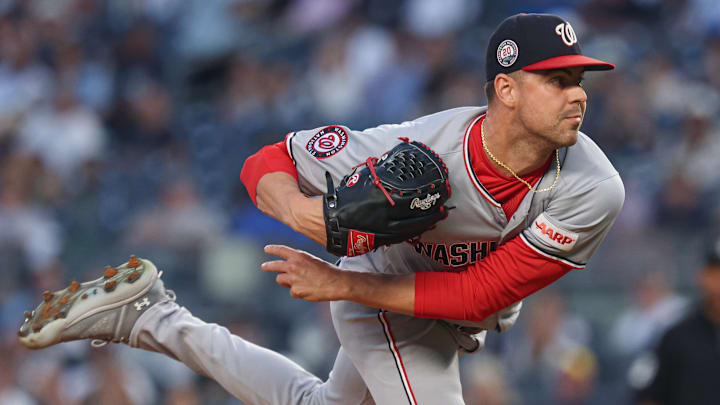
This is at least a rough — but believable — format. The Washington Nationals are expected to dangle both MacKenzie Gore and CJ Abrams, as both their windows of team control are waning. If the Nats can kill two birds with a single stone, what's there stopping new team president Paul Toboni from inducing radical change?
The Baltimore Orioles address a well-documented need and acquire a frontline ace with two years left on his deal. The Kansas City Royals add a bat with pop, hoping to migrate Abrams to either second base or centerfield to better maximize his defensive tools.
Why the Nationals say yes

The Nats are preparing for a rebuild. The core pieces are exceptional — James Wood, Dylan Crews, Daylen Lile — but this team is at a substantial disadvantage in the NL East. MacKenzie Gore, under contract through 2027, and CJ Abrams, under contract through 2028, are both at relative peaks in terms of trade value. Neither is under control long enough to contend in DC, but both have enough time left on their deals to pique the interest of (historically) cheaper contenders.
Baltimore and Kansas City aren't really in the rental market. Giving up two stars, Washington can expect a healthy return.
Coby Mayo and Heston Kjerstad are both buried on a deep Orioles roster. Mayo was a net positive player in his first full season (0.2 fWAR), posting a .687 OPS and 93 OPS+. Kjerstad hit a wall in 2025 (.566 OPS, 58 OPS+), but he's only 26 — and a year removed from a 116 OPS+ stretch with a .394 on-base percentage across 114 plate appearances.
The O's might need to dip deeper into their treasure trove of assets to get a Gore trade across the finish line, but this is a strong baseline for the Nats. Mayo can start at either corner infield spot from Opening Day on, while Kjerstad is a potential third outfield staple next to Wood and Crews.
On the Royals front, Kendry Chourio and Luinder Avila are both future rotation pieces to develop in lieu of Gore. Avila is further along — he posted a 1.29 ERA out of the bullpen in Kansas City last season — but Chourio is a higher-ranked prospect, performing well in Single-A as a teenager. His off-speed offerings pop and he gets solid swing-and-miss results on his mid-90s fastball.
Why the Royals say yes

Kansas City needs more pop in its lineup. The Matt Strahm trade serves as proof the front office is willing to take on money, but outside of Bobby Witt Jr., Vinnie Pasquantino and Maikel García, the Royals were short on consistent offensive production last season. Abrams, 25, can supply 20ish home runs and 30-plus stolen bases, giving Kansas City a ton of plus base-running value.
Abrams' offensive profile is complicated — middling hard contact rate, worrisome strikeout numbers — but he finished last season with a .748 OPS and 111 OPS+. He's still on the upswing, too. He'd immediately join the top half of Kansas City's lineup, with the upside to develop into a foundational piece.
The defense is a problem, as Abrams was responsible for -11 outs above average (OAA) last season. But the Royals don't need Abrams at short, where Witt produces roughly a dozen highlights every game. Kansas City can either move Abrams to a lower-leverage position at second base, or attempt to weaponize his speed in centerfield, a la Oneil Cruz in Pittsburgh.
Either way, Abrams' youth, contract and offensive value make this trade well worth it for a Royals team with a deep pitching pipeline.
Why the Orioles say yes

Baltimore's rationale here is the simplest. MacKenzie Gore might be the best available pitcher not named Tarik Skubal, whose availability is far less concrete. It's only a two-year investment out of the gate, but Baltimore's willingness to spend $155 million on Pete Alonso increases the optimism in a potential extension for Gore. The O's already made a valiant effort to re-sign Corbin Burnes a year ago.
The lefty immediately takes the No. 1 spot in Baltimore's rotation, giving the O's a tantalizing blend of upside and immediate impact. He's one of the best strikeout pitchers in MLB as is. Last season was rough and tumble overall — 4.17 ERA in 159.2 innings — but Gore's curveball is a grade-A weapon, and there's enough life on his fastball to expect consistent All-Star results if his command improves.
Baltimore has one of the deepest positional prospect pipelines in MLB. Both Coby Mayo and Heston Kjerstad are on the roster fringe at this point. Alonso is a lock at first base, Taylor Ward will soak up at-bats in left field. Even if it takes a bit more for the O's to get this deal done, it's well worth it. Alonso was the first step toward contention in a loaded AL East. Gore announces them as a full-fledged championship threat.
 Add us as a preferred source on Google