
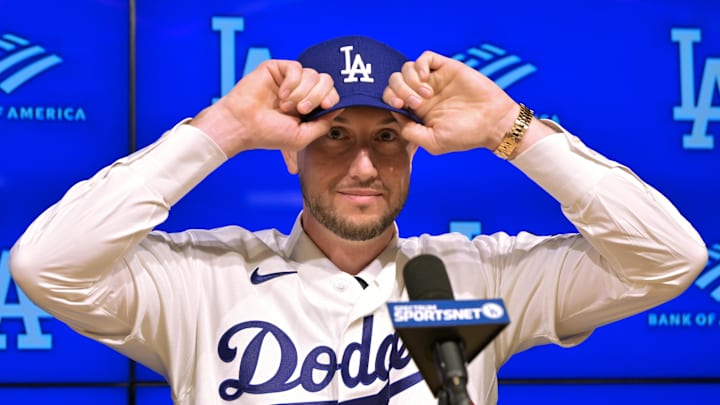
This MLB offseason delivered plenty of excitement, from blockbuster trades to totally unexpected swerves in free agency. Of all the big-money deals handed out, how many players signed with the "expected" team? Alex Bregman left Boston. Kyle Tucker broke the Blue Jays' hearts and Bo Bichette ghosted the Phillies. Framber Valdez went to Detroit. Pete Alonso went to Baltimore. It was a true free-for-all.
In the end, 14 new contracts reached or exceeded $20 million in annual value (with Zac Gallen potentially joining the list, whenever he signs). Those will be the deals we rank based on expected value and risk — upside versus downside, median versus mean.
14. Ha-seong Kim, Atlanta Braves

Contract details: one year, $20 million
Ha-seong Kim appeared in 24 games for Atlanta late last season, essentially as an audition. His numbers weren't great over that stretch — .253/.316/.368 splits with three home runs in 87 at-bats — but Kim's defense is elite and he has the benefit of precedent.
When healthy, Kim is a contact-forward hitter with elite speed whose value practically triples on defense. A one-year contract felt risk-averse in the moment, but now Kim is slated to miss four-to-five months after suffering a non-baseball injury in Korea. That means Atlanta will have a tough time returning value on this investment, even if Kim returns at full strength midseason and plays the best baseball of his career.
13. Jorge Polanco, New York Mets

Contract details: two years, $40 million
Jorge Polanco finished last season with an .821 OPS and a career-best 134 OPS+, proving essential to Seattle's ALCS run. New York poached him on a two-year deal at 32 years old, which should mean the Mets can cut bait before the eventual decline.
It's one of the most reasonable deals signed all winter, really, but there's a catch. It felt like a desperation move for the Mets, introducing more unknown variables. A planned move to first base introduces new defensive responsibilites to an already-weak defender. Polanco should get plenty of DH reps, but the glove in a major question mark. If the bat slips even a little bit, this could become a really drag on the Mets' finances.
12. Ranger Suárez, Boston Red Sox

Contract details: five years, $130 million (mutual option for sixth year)
Boston inked Ranger Suárez to a five-year deal after whiffing on Alex Bregman. It strengthens the deepest pitching staff in the American League, but it's fair to wonder if this was the best use of resources. Suárez has an impeccable postseason résumé and he was sensational for the majority of his injury-shortened 2025 campaign, so the early returns should be solid. But what about the lifespan of the contract?
Suárez is on the wrong side of 30, with declining velocity and a reliance on precision command and groundball contact. He operates with more poise and precision than just about anyone else, but history tells us that pitchers with Suárez's limitations hit a rather dramatic wall eventually. If Suárez hits said wall while blocking Connelly Early, Payton Tolle and other talented lefties in Boston's pipeline, this deal will sour expeditiously.
11. Merrill Kelly, Arizona Diamondbacks

Contract details: two years, $40 million (vesting option for third year)
Arizona desperately needed help in the rotation and reuniting with Merrill Kelly, mere months after recouping assets at the trade deadline, qualifies as a win. There is obvious risk with paying him good money into his age-39 (and potentially age-40) season, though. Kelly's impact flatlined after his deadline move to the Rangers — 4.23 ERA across 55.1 innings, with a career-worst strikeout rate.
Kelly profiles as a solid No. 2 starter behind Corbin Burnes for now, but there's a decent chance he reaches the edge of the proverbial cliff well before this contract expires. Arizona knows Kelly and he knows the D'Backs, so this was a comfortable arrangement for both sides. Plus, two years means this won't linger if it's a mistake. Arizona paid an uncomfortable premium, though.
10. Edwin Díaz, Los Angeles Dodgers

Contract details: three years, $69 million (conditional club option for fourth year)
The Dodgers have seemingly endless resources and paid top-shelf price for the best closer in baseball. It addresses their biggest weakness and solidifies a back-to-back champions core. Los Angeles cares less about tax penalties than any other team and acts accordingly, which is admirable.
Edwin Díaz put up a 1.63 ERA with 98 strikeouts in 66.1 innings last season. He was a machine. He has also seen his ERA balloon over 3.40 in two of his last four seasons, with the 2023 campaign lost to injury. Like all relievers, Díaz will experience volatility month to month and year to year. His contract is ascending in nature, which means L.A. will pay Díaz $26 million in his age-34 season. The Dodgers are above catastrophe at this point, but this contract is questionable in a vacuum.
9. Pete Alonso, Baltimore Orioles

Contract details: five years, $155 million
On the surface, Pete Alonso is a 31-year-old first baseman with poor defensive metrics and a high-strikeout diet, which makes this an exceptionally risky signing for Baltimore — especially when factoring in the O's typical aversion to long-term commitments. If this contract goes wrong, it could prevent Baltimore from spending on areas of need in the future.
That said, the O's needed to put up or shut up. So much was made of new ownership's alleged deep pockets and ability to build Baltimore into a real, annual contender. If the front office hadn't made a splash like this, the Orioles would feel like a second-rate organization in the AL East (again). Alonso is one of the greatest power bats of his generation and his arrival provided a necessary signal to fans: we mean business.
8. Dylan Cease, Toronto Blue Jays

Contract details: seven years, $210 million
Dylan Cease was the first major domino to fall in free agency. Toronto made a statement of intent, adding to a pitching staff that very nearly won the World Series. Cease is a real live wire on the mound. When he has his best stuff, few can dominate a game more thoroughly. When the command falters, however, Cease is liable to get knocked around.
Paying Cease $28 million in his age-36 season is not without downside risk. But Toronto has money to burn and this roster was already built to contend beforehand. He could very well end up as Toronto's top ace for the majority of this deal. Cease has durability on his side, and the peaks are well worth a few potential lulls. Toronto is paying for a strikeout machine in the prime of his career. It deserves a tip of the cap.
7. Framber Valdez, Detroit Tigers

Contract details: three years, $115 million (opt out after second year)
Detroit will spend $70 million between Tarik Skubal and Framber Valdez next season. While the logic behind not trading Skubal is up for debate, the Tigers remain all-in on competing for a World Series. The AL Central favors them heavily and A.J. Hinch gets the most out of his teams, almost without fail.
Too often, Detroit opts out of financial risk altogether. So this is a nice change of pace. Valdez is an elite groundball pitcher; the Tigers will put an excellent defense behind him, in a pitcher-friendly park, which should maximize Valdez's impact. He's a bit older than other free agent pitchers in his tax bracket, but Valdez has a sub-4.00 ERA for six years running. He's a workhorse, Steady Eddie, and a boon for Detroit's 2027 rotation when Skubal inevitably bolts in free agency.
6. Cody Bellinger, New York Yankees

Contract details: five years, $162.5 million (opt-outs after two years and three years)
Cody Bellinger won his staring contest with the Yankees, who simply could not afford to miss out after Kyle Tucker and other pieces left the board. Bellinger's underlying metrics are imperfect, but he's one of his generation's most accomplished players. His skill set is also invaluable to New York — an elite corner outfield glove with 30-home run, 15-stolen base upside every season.
Bellinger will serve as Aaron Judge's chief protector in the Yankees' lineup. He's one of their most versatile and consistent pieces. The opt-outs allow Bellinger to test the market again if he performs at the level he's capable of, which takes leverage away from New York. But it's worth it under the circumstances.
5. Alex Bregman, Chicago Cubs

Contract details: five years, $175 million
Chicago made an unexpected pivot to Alex Bregman with Kyle Tucker all but guaranteed to sign elsewhere. Bregman is not the same caliber of offensive centerpiece, but he fleshes out a deep Cubs lineup. Chicago has arguably the best infield group in MLB, with elite defenders across the board and an impressive blend of contact and power tools.
Is $175 million too much for Bregman as he ages into his mid-30s? Quite possibly, but this was an important win-now statement for the Cubs. Chicago has spent far too long in Milwaukee's shadow. This offseason was proof that Jed Hoyer and the front office are serious about building a World Series-caliber roster. Besides L.A., you'd be hard-pressed to find a better all-around roster in the National League right now.
4. Michael King, San Diego Padres

Contract details: three years, $75 million (opt out after first year)
The San Diego Padres managed to re-sign Michael King to a unique three-year steal, which is heavily backloaded. He will only make $9 million in 2026, with the ability to opt out. If he opts in, King's salary jumps to $32 million in 2027 and $34 million in 2028. That does hand King a bit of leverage, but it also keeps the short-term financial hit to a minimum, which was essential for a team embroiled in an ownership dispute.
King has proven remarkably consistent since making the full-time switch to starter in San Diego. He's the frontline ace for a perennial contender and, at 31, it's not like San Diego is investing beyond his prime. Even if King struggles and opts in, the contract is appropriately short. If he plays well and opts out, it should present San Diego with an opportunity to work out a longer contract with a lower AAV. This risk-reward management here is great, made even better by the essential nature of re-signing King to an otherwise compromised rotation.
3. Kyle Schwarber, Philadelphia Phillies

Contract details: five years, $150 million
Kyle Schwarber will make $18 million in 2026 and $33 million annually for four years after that. Philadelphia arranged this contract to limit the brunt of the financial impact until after significant money comes off the books in 2027. That is smart business. There was really no way for Philly to replace Schwarber this offseason either, so convincing him to re-sign in the face of competitive offers from regional rivals, such as Baltimore and Pittsburgh, was a huge win.
This contract is not without risk. Schwarber is a permanent DH in his mid-30s, which limits positional flexibility and puts all the Phillies' eggs in one basket: Schwarber's power. If the bat declines, there is no other way to extract value or mitigate downside. That said, the NL MVP runner-up earned this deal, and there's no reason to think his power will wane in the next few years. The Phillies are all-in on the present and this was a fully necessary risk.
2. Bo Bichette, New York Mets

Contract details: three years, $126 million (opt outs after one year and two years)
New York came in hot at the 11th hour to sign Bo Bichette after whiffing on Kyle Tucker, giving him $42 million annually to get the job done. His contract structure is similar to Kings, with a muted $15.3 million price tag in 2026 before it jumps to $55.3 million in 2027 — if he opts in. The Mets surely hope Bichette plays well and decides to negotiate a longer-term, lower-AAV deal in the offseason.
Given the strength of Bichette's hit tool and his relative youth at 27, the risk here is sufficiently mitigated. If he struggles in a new ballpark and sticks around for a $55.3 million price tag, that will obviously hurt. He will also be learning a completely new position at third base, compromising the Mets' corner defense. But, at the end of the day, New York has the deepest pockets in baseball and a need to keep up in the NL arms race. Bichette helps them in a huge way, offering elite protection behind Juan Soto in the lineup. Even if it's a one-year pitstop, the Mets ought to feel good about this contract in the end.
1. Kyle Tucker, Los Angeles Dodgers

Contract details: four years, $260 million (opt out after two years)
The Dodgers did it again, signing the best free agent to a comically large contract in order to supplement what is unambiguously the best team in MLB. If there was a weak spot in L.A.'s lineup last season, it was left field. Tucker is a mighty fine solution. His salary next season is only $1 million, with a $54 million signing bonus. It becomes $55 million in year two, with the ability to opt in for $60 million annually in 2028 and 2029, if he so chooses.
Tucker's injury history is worth pointing out, but he's one of the most talented all-around performers in baseball at full strength. Only 29, this deal should allow him to cash a few giant checks before testing the free agent market again in 2028, hopefully to get the 10-year deal he wanted at the beginning of the offseason. Los Angeles has endless money and cares not about the occasional misallocation of resources, so unless Tucker absolutely bombs and sticks around for four years, this deal should prove extremely favorable.
 Add us as a preferred source on Google