
Key Points
Bullet point summary by AI
- The World Baseball Classic kicked off with high hopes and international competition, but quickly faced scrutiny over officiating standards.
- A home plate umpire's inconsistent calls during a key match underscored the absence of an automated strike/ball system that could provide fairness and accuracy.
- This glaring oversight has reignited debates about modernizing the tournament's rules to match professional leagues and ensure consistent, high-quality gameplay.
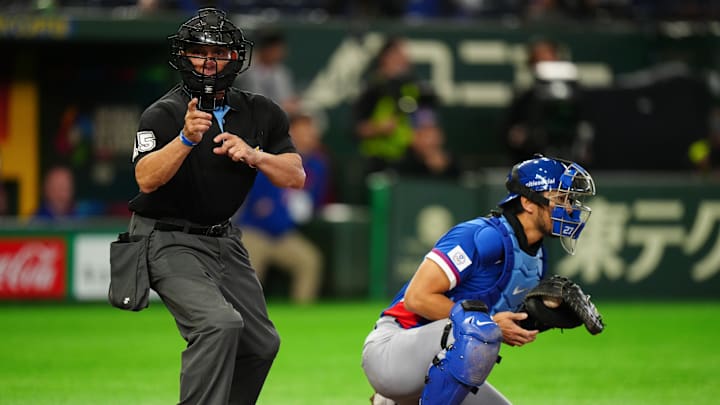
The World Baseball Classic is a tournament that baseball fans all over the world have looked forward to for three years, and it finally got underway on Wednesday night. While it was a lot of fun watching Travis Bazzana hitting a home run in Australia's 3-0 win over Chinese Taipei, it was hard to enjoy that moment when one of the worst umpiring performances I've ever seen went down throughout the contest.
Home plate umpire Omar Peralta struggled mightily when it came to calling balls and strikes, and his inability to do so at a competent level highlights the tournament's biggest defect - there is no ABS system.
Baseball fans can't help but miss ABS after abysmal home plate umpiring performance
I actually went back and counted every single pitch from the Taiwan vs. Australia WBC game. Home plate umpire Omar Peralta's strike zone was an absolute joke. Here is the breakdown of the blown calls:
— Carlos Linares (@linares_ca_93) March 5, 2026
Strikes called as Balls (Batter benefits):
• Taiwan pitchers throwing: 6
•… https://t.co/FgulF3qLKf
There's really nothing to say other than this was a horrendous display of umpiring. Not only did Peralta miss 23 calls behind the plate, but 17 of them favored Australia. I'm not going to say Australia won because of the umpire, but getting the bulk of favorable calls certainly helped. The ABS system would've helped here.
ABS doesn't take home plate umpires out of the game - they still call every pitch a ball or strike - but it allows pitchers, hitters and catchers to challenge a call made by an umpire, raising the possibility of a strike or ball being overturned. Chinese Taipei would have challenged a slew of calls, including the one above, and gotten them overturned.
Nobody expects home plate umpires to be perfect - the job is a very hard one to do well - but this is why the ABS system was introduced. The whole point of it is so performances like these don't happen, and if they do, there are ways to make up for it. Some missed calls are bound to slip through the cracks, but 23 of them? That's unacceptable for a tournament like this.
MLB fans want ABS added to the WBC, and for obvious reasons, but why isn't it already in the tournament if MLB is adding it to its regular season? The answer has to do with the non-MLB stadiums playing host in the tournament.
Why ABS isn't in the World Baseball Classic
ABS has been installed in stadiums like Daikin Park in Houston and LoanDepot Park in Miami, which will host WBC games, but it has not been used by most of the countries participating in the WBC, and is not installed in the Tokyo Dome, where Wednesday's game was played. Obviously, ABS can't be added if only some teams can use it.
Since most of the countries participating haven't used ABS and don't understand it, WBC officials never even considered adding it in this year's tournament, per The Athletic's ($) Jayson Stark. Whether it'll be added in future iterations of the tournament remains to be seen.
How WBC rules differ from MLB

ABS isn't the only way the WBC differs from MLB when it comes to rules. While the WBC will have a pitch clock in this year's tournament for the first time, there are many ways it differs.
For example, extreme defensive shifts are allowed in the WBC, but not in MLB. This means that if a team wants three infield defenders on the right side, it can do that. There is also a mercy rule that'll be put into place if a team is leading by 15 or more runs after five innings or 10 or more runs after seven.
Perhaps the most interesting rule difference is the fact that the WBC has a defined pitch count that must be adhered to, and they differ for each stage of the tournament.
- Pool play: 65 pitches
- Quarterfinals: 80 pitches
- Semifinals and championship: 90 pitches
A pitcher may exceed these figures if he's in the middle of an at-bat, but must be pulled once that at-bat is over. This puts added pressure on the bullpen to get some key late-inning outs.
More WBC news and analysis:
 Add us as a preferred source on Google