
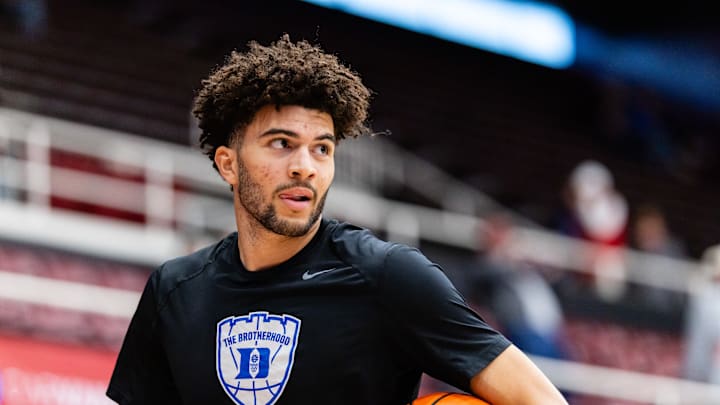
Duke became a titan of college basketball recruitment under Mike Krzyzewski, with their profile only rising under Jon Scheyer. The latest superstar freshman to grace the Durham campus is Cameron Boozer, son of former NBA All-Star (and former Duke legend) Carlos Boozer. At just 18, Boozer is hoping to follow in the footsteps of 2025 top pick Cooper Flagg.
The Blue Devils program is always a prominent fixture in the NBA Draft conversation, and that shows no signs of slowing down; Boozer currently ranks No. 1 in FanSided's latest 2026 NBA Draft big board. In preparation for the latest crop, let's canvass the last 10 drafts to determine the best prospects out of Duke — and how their NBA journey either did or didn't live up to the college hype.
10. Khaman Maluach (No. 10 pick, 2025 NBA Draft)

The Suns are taking an understandably patient approach with Khaman Maluach, who was always more of a long-term project. It's hard to blend into the background at 7-foot-1, 250 pounds, but too often Maluach was an afterthought for college basketball fans tuning into Duke to watch Flagg (and, to a lesser extent, Kon Knueppel). But Maluach has a chance to carve out his own path in Phoenix.
Maluach arrived at Duke with only a few years of genuine basketball experience to his name. The South Sudan native was discovered at a Luol Deng camp in Uganda, where he grew up. Shortly thereafter, he joined the NBA Academy Africa. Maluach was raw but nonetheless impactful for a dominant Blue Devils team, converting on 72.1 percent of his field goal attempts and averaging 3.7 blocks per 100 possessions.
An efficient finisher, with impressively functional athleticism in a superhuman frame, Maluach cemented his status as a top-10 prospect throughout his lone season in Durham. He became an automatic rim finisher. He was an intimidating shot-blocker on defense, and his growth as a processor and decision-maker, on both sides of the ball, defied convention.
It will take some time for Phoenix's investment to pay dividends, but Maluach possesses the size, agility and touch (76 percent on free throws at Duke!) to emerge as a bonafide two-way star down the road.
9. Wendell Carter Jr. (No. 7 pick, 2018 NBA Draft)

Wendell Carter Jr.'s NBA career is best described as solid. He never quite took the star leap fans in Chicago and Orlando hoped for, and there have been uncomfortable lulls in production. But he always comes around in the end, doing enough of the small things to command starting minutes at the five spot each and every season.
He was a very modern archetype in 2018, and has only become more attuned to current trends since making the NBA leap. Carter operated in the shadow of Marvin Bagley in a jumbo Duke frontcourt, but his emergence as the better pro shouldn't have come as such a shock. After all, Carter was a 41.3 percent 3-point shooter for the Blue Devils. He averaged 2.1 blocks in 26.9 minutes while frequently toggling onto perimeter assignments. Carter was the backbone of Duke's defense in a way Bagley simply never was, nor could be.
Carter's defensive profile has changed in the NBA. He's not so much a shot-blocker as an enforcer, with Orlando leaning on his unique ability to both leverage his 270-pound frame in the post and elegantly navigate space. He's a slick lateral mover with strong coordination and a high defensive IQ. Even if he's less of a one-man defense in the pros, Carter has made his value felt across multiple iterations of this Magic roster.
The offensive skill set has remained similar, with a naturally increased emphasis on 3s. But Carter was always a sharp short roll passer and a capable post-up hub, the likes of which have only become more valuable in recent years. Carter was a great prospect who has also managed to surprise us in the NBA.
8. RJ Barrett (No. 3 pick, 2019 NBA Draft)

RJ Barrett was definitely overhyped. The old adage applies: Hindsight is 20-20. But Barrett was part of a special Duke team, one of the most talented groups in program history. He was also a lauded recruit coming out of high school, so his name carried a buzz that his Duke tenure (and his NBA career) never quite lived up to.
To his credit, Barrett weathered early bumps in the road and has carved out a nice career for himself — he's not a bust. He was not what New York wanted (or, frankly, needed) with the No. 3 overall pick, but Barrett's battering-ram strength did ultimately translate to the league. It can be tough to gauge how well certain physical advantages map onto to the next level, as the caliber of athletes in the NBA is so elevated compared to college. But Barrett can still plow through defenders and consistently put two feet in the paint with burst and brute force alone, like he did in Durham. When he commits to spot-up 3s and paint touches, cutting out the errant mid-range pull-ups, that is when Barrett is at his best.
The 25-year-old has begun to add a bit more passing to his repertoire in recent years, a skill that too often eluded him at Duke and early in his NBA journey. Barrett is still not an advanced on-ball decision-maker, but he has gradually started turning paint touches into open 3s or swing-swing ball movement, which greases the wheels of Toronto's offense.
All the special tools that made Barrett so electric on offense have never really carried over to the defensive end. On paper, he should be a premium stopper, built for a range of matchups. In reality, the off-ball defense is simply too detrimental to offset his value on-ball. Even in those iso matchups, Barrett tends to find himself out of position and a step behind against quicker players. Still, he was an awesome player at Duke. That 2018-19 squad will be remembered for a long time.
7. Kon Knueppel (No. 4 pick, 2025 NBA Draft)

Kon Knueppel never received his due credit at Duke since Flagg stole all the headlines, but there's a nonzero chance he can steal Rookie of the Year honors for a bit of good-natured revenge. In reality, Knueppel did exactly what he needed to do for the Blue Devils: He's the ultimate offensive connector, with an extraordinary blend of skill and feel.
The common knock on Knueppel was that he lacked the athleticism to become a star in the NBA. And while there may ultimately be some truth to that statement, Knueppel has put up historic shooting numbers as a rookie. At the very least, he should be a high-level starter whose malleability and IQ allows him to fit into any group. When Duke needed him to step up sans Flagg, Knueppel did. The same thing happened when LaMelo Ball missed time in Charlotte earlier this season. Knueppel can scale up or down as needed; he does not require copious touches, but when needed, there's a higher gear the Wisconsin native can reach.
Knueppel hit 40.6 percent of his 3s at Duke on hearty volume. He was also an efficient two-foot finisher at the rim, able to beat closeouts, leverage his strength on drives and find creative ways to finish among the trees despite limited vertical pop. That finishing has ported over nicely to the NBA. Knueppel can dribble, drive, pass and shoot from just about anywhere. He's not a shooting specialist, despite more skeptical claims of that nature.
He will never be a lockdown defender, but Knueppel has an NBA frame and he knows where he's meant to be on the floor at all times. It all comes back to that baseline feel: It's so often an overlooked attribute, but when you think the game like Knueppel — when you can map out the court and formulate your decisions in real time, on both ends — the quibbles about slow-twitch athleticism start to fall away.
6. Jayson Tatum (No. 3 pick, 2017 NBA Draft)

Jayson Tatum was extremely fun at Duke. He did all the standard Wing Scorer things, taking clear inspiration from Kobe Bryant and other NBA greats. When the Celtics moved off of the No. 1 pick to select him at No. 3, however, the decision was met with understandable skepticism. Tatum did not stack up with Markelle Fultz or Lonzo Ball in a vacuum.
This is another example of hindsight in full effect: My read on Tatum in 2017 was wildly off-base. We all learn. We all grow. The Fultz thing is what it is — there was no predicting a chronic shoulder injury or the complete dismantling of his confidence — but Tatum's size, athleticism and shot-making were all on full display in college. He wasn't the most efficient scorer, but 19-year-olds rarely are. What I (and others) missed were all the requisite traits necessary to evolve into a superstar bucket-getter.
Tatum's movement skills are utterly singular. The list of 6-foot-8 wings with his pliability and dexterity is virtually nonexistent. He combines those special traits with impeccable footwork, something we saw the genesis of at Duke but that he has improved and fine-tuned since arriving on the NBA stage. Tatum just systematically dismantles his defenders, able to mix speeds, change directions on a dime and create space for his pull-ups with a wide base and textbook fundamentals.
There were some red flags on Tatum as a prospect. We didn't just imagine those. He had a negative assist-to-turnover ratio at Duke. He fell a hair below average from 3-point range, and just how effectively he could expand from the mid-range to the NBA 3-point line was a valid question. Tatum also relied on a bunch of tough shots, which is so often a negative indicator. But he is just so damn good at making them now. Plus, Tatum has worked diligently to expand his footprint as a passer. He gets to the rim more consistently now. He's awesome, point blank. The best player on a title team. Boston hoodwinked us all.
5. Paolo Banchero (No. 1 pick, 2022 NBA Draft)

Paolo Banchero was a tricky evaluation at Duke, in no small part due to the contrast in style and strengths compared his peers atop the 2022 draft class. Banchero never felt like the surefire No. 1 pick. In fact, until moments before Orlando called it in, the popular assumption was that Jabari Smith Jr. was on his way to Disneyland. (Meanwhile, Chet Holmgren was No. 1 on my board — a stance I'll double down on.)
Banchero was a deeply flawed prospect, and many of those flaws have reared their ugly head this season. The superstar leap appears fully within Banchero's grasp, but he has struggled to put it all together. So much of it comes down to process and decision-making. Tools-wise, the man is comically blessed: Banchero's strength at 6-foot-9, paired with mobility and real touch out to the 3-point line, gave him a huge leg up on college opponents. It also puts him in an exclusive club at the NBA level.
If Banchero were just more willing to use those tools. That's really all it is. Banchero should be bullying smaller defenders on every possession. He's too strong for most wings, even in the NBA. Bigs can't handle his quickness on drives. And yet, Banchero remains an inefficient jump shooter — but an extremely willing jump shooter all the same. He loves a contested pull-up. Even when isolated with a matchup advantage and a clear path to the rim, Banchero will often settle for a low-quality shot.
Orlando is only marginally better offensively with Banchero on the floor (he's still their chief advantage-creator) and dramatically worse on defense. His tools should, on paper, translate to the defensive end, too. But Banchero exerts so much effort offensively, often in the wrong places, and tends to dial it back on defense, much to the Magic's detriment. He's still a sick player. Often a winning player. But Banchero has become an object of frustration, as there's potential for so much more.
4. Marvin Bagley III (No. 2 pick, 2018 NBA Draft)

Marvin Bagley's precipitous fall from grace is not entirely his fault. He could not control Sacramento's decision to select him ahead of Luka Dončić — a decision that felt incredibly stupid in the moment and has only looked worse with age. Bagley was put into an impossible position narratively. It didn't help that really none of what made him such a dominant force at Duke translated to the pros.
This is a prime example of what makes the NBA Draft such an unpredictable exercise, though. There are infinite factors contributing to a player's success. It's not just how good a player is in school. And Bagley was, to be clear, incredible at Duke: a proper wrecking ball, with a ton of traits that, on paper, favored success at the next level.
College athletes simply could not compete with Bagley on the glass. He's one of the great rebounding prospects of his generation. More than pulverizing strength and a wide base, Bagley had an incredible second jump. He got off the floor with such ease. There are not many 6-foot-11, 230-pound dudes who can levitate on a dime like Bagley. He overpowered folks in Durham. It was mesmerizing to watch.
Bagley was still a great rebounder in the NBA, to his credit. But the rest of his skill set fell a bit flat. He wasn't a good enough shooter early in his career. The defensive warts, which were very much apparent at Duke, only got worse in Sacramento. It certainly didn't help that Bagley got stuck in the worst organization in American professional sports. He did not have the infrastructure and stability necessary to establish a positive developmental arc. There's a chance Bagley's career looks much different if he ends up in Phoenix or Atlanta or Dallas. We can never know for sure, but this feels like a classic case of a team failing the prospect, just as much (if not more so) as the prospect failing the team.
3. Cameron Boozer (--, 2026 NBA Draft)

For now, Cam Boozer checks in at No. 3 on this list. That it's even up for debate is a credit to Boozer, who is the clear-cut best player in college basketball right now. He's 18 years old, and will still be 18 on draft night. Boozer's intersection of youth, IQ and physical maturity puts him in rarefied air. There just are not many guys this far ahead of the curve who bust in the NBA.
The criticisms of Boozer are plentiful, largely due to the magnitude of his competition. Kansas' Darryn Peterson is the betting favorite to go No. 1 overall, despite Boozer's superior résumé. BYU's AJ Dybantsa also sparks plenty of No. 1 chatter. Boozer sits at the top of a draft class with historic potential, and thus he's under the microscope. The main points of concern for skeptics: defensive limitations and a lack of high-end athleticism.
It's fair to question Boozer's defensive outlook in the NBA. In fact, that's probably why he's third on this list. Boozer isn't the zippiest lateral mover, which leaves him at a disadvantage in help situations and presents challenges when he's put on an island against quicker guards or wings. The offensive questions are much less existential. He struggled a bit at the rim early in the season, but quickly made the adjustment to college athletes. His strength, touch, footwork and general tempo lead one to believe he can make similar adjustments at the next level.
Boozer can pummel smaller defenders in the post. It's easy to buy the jumper. He's an incredible processor, and delivers nuts-o passes on the regular. He has dominated every level of competition to an absurd degree and figures to do the same in the NBA. Even with some of the defensive concerns, he's just so smart. He has active hands and picks up a lot of steals. The floor is high. Boozer checks all the boxes of a multi-time All-Star.
2. Cooper Flagg (No. 1 pick, 2025 NBA Draft)

Cooper Flagg arrived at Duke as a 17-year-old and rather quickly emerged as the most dominant force in college basketball. Not unlike Boozer, there were a few early hiccups as he made the adjustment to the speed and athleticism of college hoops. Once it clicked for Flagg mentally, however, it was curtains for everyone else. Duke fell short of the national championship last season, but that team will go down in history as one of the best non-champions ever.
Flagg was practically built in a lab to satisfy current NBA trends. At 6-foot-9, he's a legitimate three-level scorer. Though not quite as surgical in that department, the Kawhi comps were not unearned. Flagg has a massive frame and he understands how to weaponize it. His scalability was the real attraction for NBA scouts, though: Flagg can run point (as Dallas forced him to early in the season, for better and for worse), but he is equally, actually more comfortable off-ball, setting screens, spotting up, attacking downhill and firing sharp connective passes.
A man of many strengths, Flagg is also a hellacious defender. He swoops out of nowhere for weak-side blocks. He has the lateral agility to smother guards on the perimeter. And he's so damn intense. Often these guys who are ranked No. 1 in their recruiting class for years are able to coast on talent. Not Flagg. He's better than everyone, and he wants to assert that fact as frequently as possible.
While Boozer actually has a more refined offensive profile at this stage, Flagg's perimeter skill, versatility and primarily his defense give him the edge — for now. Boozer still has half a season left, not to mention a full NBA career. Boozer might not match Flagg as the No. 1 overall pick, but as potential back-to-back Wooden Award winners at the same school, both at 18, expect Boozer and Flagg to be narratively linked for the remainder of their careers.
1. Zion Williamson (No. 1 pick, 2019 NBA Draft)

It's difficult to overstate how special Boozer and Flagg are, which makes it doubly impressive that Zion Williamson remains the clear pick at No. 1 on this list. Zion's NBA career has gone sideways for reasons we needn't harp on. We can critique his conditioning, his so-called "commitment to winning," but in reality, Williamson has been dealt an incredibly unlucky hand injury-wise. Part of it, no doubt, is that a human body is not meant to move like Zion's does.
At 6-foot-7 and 285 pounds, Zion is the most explosive leaper to come along in quite some time. He's a true one of one athlete — built like a tank, with the quickness and ball control to run point and the vertical pop to elevate from several steps outside the paint and glide to the rim with angelic grace.
Zion was an absolute monster at Duke. Truly, there has not been a more unstoppable individual force since then. He's the greatest freshman of all time. College defenders could not find an answer. Zion lived at the rim. He feasted in transition. There wasn't a bad matchup, nor many off nights. Even without a jump shot or a consistent defensive footprint, Williamson obliterated the competition and stood head-and-shoulders above the crowd on a team that featured two other top recruits and future top-10 picks in R.J. Barrett and Cam Reddish.
DId it all work in the NBA? Well, yes: Zion was a borderline top-10 player at his early peak, on the precipice of an even greater leap. But injuries have sidetracked his career to the point of no return. At least it feels that way. In terms of basketball what-ifs, few engage the imagination like this one. Zion will go down as the MVP who never was.
 Add us as a preferred source on Google