
Key Points
Bullet point summary by AI
- The 2026 NFL Draft class features a standout quarterback prospect from Indiana whose college performance raises concerns about his ability to avoid pressure at the next level.
- Multiple hybrid defenders from Ohio State and Miami are generating buzz, but their positional fit and long-term viability remain major questions for NFL teams.
- This deep draft class includes prospects with significant red flags ranging from injury concerns to positional limitations that could impact their rookie contract value.
With less than three weeks to go until the 2026 NFL Draft, this class has been sliced and diced seven ways to Sunday, and a consensus is forming near the top — starting with QB1 Fernando Mendoza and a fleet of intriguing defenders from Arvell Reese to Sonny Styles to Rueben Bain Jr.
With so much talent available, and so much time to kill from mid-February to late April, it's easy to convince yourself that the best players in this class are destined for stardom. But recent history has taught us that the reality of life in the NFL is much messier — and that even very good prospects have ways they can fail at the highest level. So let's dive into just what those ways might be by breaking down one red flag for everyone in the top 25 of Pro Football Network's consensus big board.
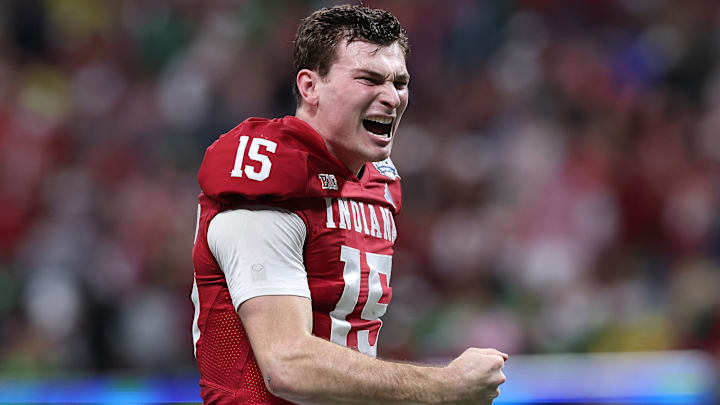
1. QB Fernando Mendoza, Indiana
Red flag: Taking too many sacks
Mendoza isn't just going No. overall by default. He checks a whole lot of boxes for a future franchise QB, from his size to his arm to his poise under pressure and his willingness to push the ball downfield. But there is one thing about his statistical profile in college that stands out: Both his sack rate and his pressure-to-sack rate were middling at Indiana, suggesting that he has a penchant to hold on to the ball a beat too long while hunting for a big play. That tends to be a sticky trait in the pros, and could come back to haunt him behind a Raiders line that still very much needs improvement.

2. LB/EDGE Arvell Reese, Ohio State
Red flag: Which position does he play?
You could tell me that Reese will wind up as a Pro Bowl-caliber linebacker or a Pro Bowl-caliber pass rusher and I'd believe you; that's how talented he is, and he's just scratching the surface at age 20. But while Ohio State deployed him all over the field last year, it remains to be seen where he'll be most successful at the NFL level — and while his skills are undeniable, it'll require some defensive creativity in order to get enough out of him to justify the No. 2 overall pick.
After all, we've seen some similar hybrid prospects crash and burn in the past by getting caught in between. If you think Reese is ticketed for the edge, great. If you have someone like Brian Flores that can fully unleash him as a chess piece, even better. If you want him as a middle linebacker ... is that worth the price?
3. RB Jeremiyah Love, Notre Dame
Red flag: Can he hit enough singles?
Love's big-play ability is beyond question; just flip on any Notre Dame game from last year and you'll see just how devastating he is once he hits the second level. In today's NFL, with two-high defenses keeping the lid on the passing game, the ability to generate home runs on the ground is worth its weight in gold.
You do still need to keep on schedule, though, and Love might not be as complete a prospect in that department as his reputation (or his reported draft stock) would suggest. He can be a bit impatient at times; his Irish counterpart in 2025, Jadarian Price, probably has the better vision and patience of the two. And he doesn't quite have the same make-you-miss element in close quarters that he does in the open field. We're picking nits here, because Love sure looks like a star, but it's just one more reason why a rebuilding team like the Titans or Giants shouldn't reach for him in the top five.

4. S Caleb Downs, Ohio State
Red flag: Size and athleticism
There isn't much that Downs hasn't seen across three years of starting at both Alabama and Ohio State, and when you watch him lurk at the first or second level in college, it's not hard to picture him blossoming into the next version of Kyle Hamilton or Nick Emmanwori — players whose ability to toggle between big nickels and small linebackers makes them unicorns for defensive coordinators.
But both Hamilton and Emmanwori are much bigger, freakier athletes than Downs is at just 6-foot and 206 pounds. He's rarely fooled and is a heat-seeking missile once the ball is snapped, but there are enough questions about his ability to hang with the fastest receivers and the biggest tight ends that you wonder whether teams will view him as worthy of a top-five pick. This is just a question of ceiling and positional value, though, because the floor is as high as anybody's.
5. LB Sonny Styles, Ohio State
Red flag: One year of elite production
Look, your guess is as good as mine here. He proved at the Combine that he's the complete package physically, and his tape at Ohio State in 2025 was truly breathtaking at times — Styles is a menace downhill against the run who's also comfortable in coverage as a converted safety. But he's also only got one year of elite performance, and if you're spending a top-10 pick (at minimum) on an off-ball linebacker, you'd like to be as sure as possible. My money is on Styles being a star, but it's worth noting that he's still progressing in terms of diagnosing what he sees.

6. EDGE Rueben Bain Jr., Miami
Red flag: [deep sigh] Arm length
Personally, I don't buy this as the issue it's been made out to be; if it were, we would've seen it pop up on occasion against the bigger tackles he faced in college. Instead, Bain Jr. laid waste to basically everybody in his path, excelling against elite competition like Notre Dame, Texas A&M and Ohio State. Yes, the arms are historically short, but he has the smarts and the freakish power, burst and flexibility to make it work, getting his shoulder into opposing tackles on a regular basis. But I will concede that history is not on his side here, and that might understandably spook some teams in the top five.
7. EDGE David Bailey, Texas Tech
Red flag: Run defense
Bailey is a blistering athlete, a true terror coming off the edge and easily the best speed rusher in this class. The question is whether he'll be good enough to compensate for his deficiencies elsewhere, because that speed comes at a cost — specifically run defense, where Bailey is light in the pants and could be a real liability at the NFL level. There's a blueprint to make this wide-nine profile work; just look at Broncos star Nik Bonitto, for example. But the bar is very high if you want to be impactful enough as a pass rusher to stay on the field despite getting moved around at the point of attack. Sacking the quarterback is everything, but it's not the only thing.

8. WR Carnell Tate, Ohio State
Red flag: Frame
The operative word with Tate is smooth — smooth in his routes, smooth at the catch point, smooth in just about all of his movements. And I'm not even really worried about his mediocre 40 time; he sure played fast at Ohio State, and a 4.3 is hardly a prerequisite for success.
I am slightly worried about his overall level of physicality, though: He doesn't have the ideal build to be a true alpha WR, and he got bodied by big cornerbacks occasionally in college. Combine that with his lack of game-changing speed, and it's fair to question the ceiling here, even if he'll be a good player for a long time.
9. CB Mansoor Delane, LSU
Red flag: Could struggle a bit in man coverage
This really comes down to what kind of defense you want to run. Delane is a blast to watch in zone coverage, one of the smartest players on the field in any given game who's more than capable of reading and reacting and making plays on the ball. And it's not that he's bad in man coverage, either; really, it's hard to find a glaring weakness in his game.
But Delane isn't the most physically imposing nor the most athletic corner around. Every cornerback is going to get got on occasion with how good NFL receivers are — that's just the reality of the position — but he might have a harder time handling the true Xs at the next level. If you can scheme him around that, though, you'll have a heck of a player.

10. OT Spencer Fano, Utah
Red flag: Is he a guard?
Fano isn't as big as you'd like a franchise tackle to be, noticeably lean on television, and the one blemish on his Combine report card were his short arms at 32 1/8 inches. All of which has ramped up speculation that his best home in the NFL might be inside, where his relative lack of functional strength would be less exposed against pass rushers and his spectacular athleticism and movement ability would really shine as a puller. That might not be the most thrilling pick in the top half of the first round, but hey: Put him in an offense like Mike McDaniels', and you'll be in business.
11. OT Francis Mauigoa, Miami
Red flag: ... is he also a guard?
Unlike Fano, Mauigoa has the requisite size to stick at tackle; he just might not have the requisite high-end athleticism to consistently win in pass protection. The technique is impeccable, which you'd expect from a former blue-chip recruit who spent three years the Mario Cristobal Offensive Line Factory in Miami. It just remains to be seen whether he can move his feet well enough to stay outside. He can often get caught leaning, without his feet underneath him, and that's a death sentence in the NFL.

12. WR Jordyn Tyson, Arizona State
Red flag: Injury history
To be clear: This is not meant to question Tyson's toughness, which has become an increasingly popular topic as draft weekend approaches. He was consistently willing to challenge for balls over the middle of the field at both Colorado and Arizona State, and he willed the Sun Devils to their best win of the 2025 season over Texas Tech despite injuries to both hamstrings.
But, well, that's sort of the problem. Soft-tissue injuries have followed Tyson in recent years, the sorts of issues that make you wonder whether he'll simply have a hard time staying on the field at the next level. If he can, he has a chance to be an awesome player, with the body and the skill to be a true WR1. But there's one very big if.
13. G Olaivavega Ioane, Penn State
Red flag: Lack of quickness
Ioane is a true mauler on the inside; when he gets his hands on you, you can more or less say good night. But he's a very big man at 6-foot-4, 320 pounds, and that's after he cut weight ahead of his final year at Penn State. At times, that lack of athleticism and quickness can cost him, especially against more penetrating interior pass rushers. You shouldn't ask him to pull or move very much at the NFL level, and he could struggle on occasion in pass protection. If you run a power run game, though — looking at you, Baltimore — it's hard to ask for much more.

14. WR Makai Lemon, USC
Red flag: Is he strictly a slot receiver?
This is less a criticism of Lemon as a player and more a question of positional value. The former USC star is fearless over the middle, with great hands and route-running ability. He's also 5-foot-11, and while he lined up everywhere in college, it's very much an open question whether he can do the same at the next level or whether he'll be relegated to the slot full time. Slot receivers are increasingly valuable, and there's a world where he blossoms into the next Amon-Ra St. Brown and makes a top-15 pick look eminently justifiable. But it does put a bit of a cap on his ceiling.
15. TE Kenyon Sadiq, Oregon
Red flag: Can he be an in-line tight end?
It's awfully easy to get sucked in by Sadiq, a true physical marvel who looks like an enormous wide receiver with how smoothly he runs just about every kind of route. Line him up against a linebacker or a slot corner, and he'll be a true matchup nightmare in the vein of someone like Trey McBride.
Of course, he's also not quite as big as McBride, and we've seen these sorts of chess pieces fail to get off the launch pad at the NFL level because they're caught in between: not athletic enough to function as a full-time receiver, but also not big enough to hold up as an in-line blocker. Sadiq is hardly a pushover in that latter department — at the very least, he tries — but he is a bit undersized, and that could make him an awkward fit.

16. CB Jermod McCoy, Tennessee
Red flag: Health
Really, it's just the health. McCoy was spectacular for Tennessee in 2024, so good that he'd be pretty comfortably the best corner in this draft class had he played a full season in 2025. Unfortunately, he didn't play any of 2025 after suffering a torn ACL last January, and he didn't work out for scouts until the Vols' Pro Day last month. Granted, he knocked it out of the park there — 4.38 40, 38-inch vertical, 10-foot 7-inch broad jump — but we just won't know for sure until we actually see him in a competitive environment again. If he's right, though, he can be a true CB1 on the outside.
17. S Dillon Thieneman, Oregon
Red flag: Coverage skills
Thieneman blew the lid off the Combine, running a sub-4.4 40 that got everybody's attention. And if you keep him in the middle of the field and let him use his smarts to disrupt plays in the box and in coverage, you'll have a very good player on your hands for a long time. If there's a concern here, it's in man coverage; he's not the most sudden or quick-twitch athlete, which can show up as a problem against really good receivers and tight ends. Beyond that, though, he checks every box you'd want as a complete safety.

18. CB Avieon Terrell, Clemson
Red flag: Size (of lack thereof)
Terrell is, indeed, small, measuring a 5-foot-11 and just 186 pounds at the Combine. And that limitation does show up on the field at times, especially in contested-catch situations against alpha receivers on the outside. But he's an incredibly smooth and athletic mover, and he's as tough-nosed as you'd expect from AJ Terrell's little brother. The size might cap his ceiling, but you can be confident that Terrell is almost always going to be around the ball and play above his size in the run game.
19. EDGE Keldric Faulk, Auburn
Red flag: Pass-rush juice
I don't have much of any doubt about Faulk's ability to contribute as a solid all-around defender and a true menace against the run. But I do doubt his burst coming off the edge, and his ability to really get after the quarterback as a result. He's smart, he's tough, he just turned 21 and he has the build to be a 4-3 defensive end. In the NFL, though, physical tools carry the day, and if he can't get upfield quickly enough to beat most tackles, it might not ever fully come together.

20. WR Omar Cooper Jr., Indiana
Red flag: How low is the ceiling?
Unlike Lemon above, I do think Cooper Jr. is just big enough to handle some reps on the outside, which he did with Indiana last season. He's a bear to bring down with the ball in his hands, and his toughness and hands make him a trusted efficiency option as well as a legitimate red-zone threat — just ask Penn State. Again, the question is one of ceiling: Cooper Jr. doesn't have ideal size or speed, and he's not as shifty as he needs to be to become a true star in the slot. I'm confident he'll be good, but I have a hard time believing he'll be great; Yahoo's Nate Tice threw out Khalil Shakir as a comp, and that feels about right as a trusted YAC guy who will help you move the chains.
21. OT Monroe Freeling, Georgia
Red flag: Lack of experience
This time last year, Freeling had yet to prove himself as a starter in the SEC; now, he's being talked about as a potential top-15 pick. It's been a meteoric rise, and it's not hard to see why given how fluidly he moves and how projectable his 6-foot-7 frame looks. He's a pure upside pick, one you can get awfully excited about.
Of course, that upside comes with risk; if it didn't, he'd be a slam dunk for the top 10. Freeling has exactly one year of full-time starting experience, and while he was excellent for Georgia in 2025, he still requires some projection when it comes to his strength and technique. Do you trust your coaching staff to get the most out of him?

22. EDGE Akheem Mesidor, Miami
Red flag: Age and injuries
There's no question that Mesidor knows how to rush the passer, capping off his college career with 12.5 sacks at Miami last season while showcasing an impressive variety of moves. But he is a little bit on the small side for the position at 6-foot-3 and 259 pounds, leading to questions about whether he'll be a three-down player or more of a rotational guy.
Really, though, the biggest concern is his age: Mesidor turned 25 earlier this month, meaning he might already be maxed out — and he'll already be pushing 30 by the time he's up for a second contract. Add to that a checkered injury history — including a foot injury — that cost him significant time in 2023, and it complicates the picture for a guy who should be ready to step on an NFL field and contribute day one.
23. DT Peter Woods, Clemson
Red flag: What the heck happened last year?
This time last year, Woods felt like a shoo-in for the top 10 in the 2026 draft. But while Clemson underwhelmed last season, so too did the Tigers' star defensive tackle, who saw his production dip across the board and who felt strangely invisible at times. It's hard to know exactly what went wrong; he remains a special athlete for his size, and it's easy to dream on his potential as an interior disruptor. But it would've been nice to see that player more consistently, and as is, there are real questions about his motor and his run defense.

24. S Emmanuel McNeil-Warren, Toledo
Red flag: Lack of versatility
This one is pretty simple: Keep McNeil-Warren as close to the line of scrimmage as possible, and you'll be in great shape. He's physically imposing at 6-foot-3 and over 200 pounds, and he's a menace playing downhill against the run and in the short passing game. He can get exposed a bit if left on the back end, as he doesn't have the sort of long speed you want from a deep safety. But this sort of hybrid player is becoming more and more en vogue in the league, and McNeil-Warren fits the bill.
25. OT Kadyn Proctor, Alabama
Red flag: Weight questions
Proctor is a mountain of a man at 6-foot-7 and 352 pounds, numbers that jump off the page even by NFL standards. That size and strength comes at a cost, though: He has trouble bending, like most big linemen, and he can often get beat by defenders with superior foot speed and quickness. That has naturally raised questions about whether his future lies at right tackle or at guard, and he'll have to prove those questions wrong as he develops. It's easy to fall in love with Proctor when you watch him move people around, though.
 Add us as a preferred source on Google