
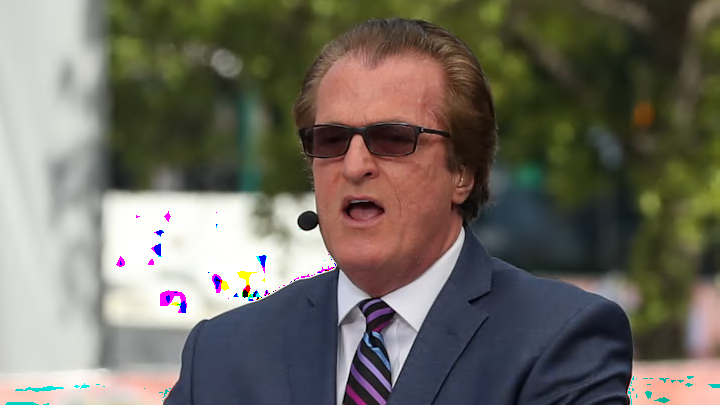
Predicting what'll go down in the NFL Draft is a seemingly impossible task, as the first round of Thursday's festivities would confirm, but predicting what'll happen is supposed to be where ESPN's draft savant Mel Kiper shines. It's safe to say he did not shine in hindsight.
While Kiper was right that the Las Vegas Raiders would select Fernando Mendoza and that the New York Jets would take David Bailey over Arvell Reese, his mock draft went off the rails from there. To be honest, we can't fully blame him, though, because while he made several mistakes in his final mock draft that appear laughable now, we made the same ones.
Mistake 1: Believing a running back wouldn’t go top three (Jeremiyah Love)

- Mel Kiper's pick: Jeremiyah Love at No. 4
- Reality: Love went No. 3
This one doesn't seem so egregious, but the difference between No. 4 and No. 3 is stark. Kiper, and many others, assumed Jeremiyah Love would be the Tennessee Titans' pick as they hope to see a year-two leap from Cam Ward. Tennessee might've taken him, but never got the chance, since the Arizona Cardinals snagged him No. 3 overall.
This one was genuinely shocking for a couple of reasons. First, the Cardinals appeared fairly set at the running back position with Tyler Allgeier and James Connor in the mix, and seemingly had several other holes to address with the No. 3 overall pick. Second, and most importantly, how often do we see a running back go in the top three? Even recent generational running back prospects like Ashton Jeanty and Bijan Robinson failed to crack the top five, let alone the top three.
Ultimately, the Cardinals decided that Love was too talented to pass on and broke the seemingly unbreakable rule of not reaching for a running back. It's a pick that not many people are fond of now, but that can change.
Mistake 2: Underestimating QB desperation (Ty Simpson)

- Mel Kiper's pick: Ty Simpson at No. 30
- Reality: Simpson went No. 13
Quarterback is the most valuable position in all of sports, so when teams see one that they like, they'll do whatever it takes to select one. Mendoza is not the best player in this year's class, but he went No. 1 overall because he's the best player by far at the most valuable position by far. Kiper seemingly underestimated how desperate teams are to land potential franchise quarterbacks by predicting Ty Simpson wouldn't get selected until the No. 30 overall pick.
The Los Angeles Rams selected Simpson No. 13 overall. The destination wasn't surprising, as Matthew Stafford is nearing retirement and the Rams didn't have an internal successor, but the Rams, a team in Super Bowl contention, using its first-round pick on a player who, in a perfect world, will not play a meaningful snap in 2026, instead of selecting a player who can help them win a Super Bowl was unexpected. Even Sean McVay didn't seem so thrilled.
Ultimately, the value of a player that the Rams clearly think is a franchise quarterback was too high to pass on. I can't blame Kiper for assuming a team in a Super Bowl window wouldn't use a top 15 pick on a quarterback who likely won't see the field in an important game in 2026, and it's fair to question whether he is even a future franchise quarterback, but that doesn't mean he (and most others) wasn't very wrong.
Mistake 3: Trusting medical concerns to scare teams off (Caleb Banks)

- Mel Kiper's pick: Jordyn Tyson at No. 9, Caleb Banks at No. 62
- Reality: Tyson went No. 8, Banks went No. 18
There are other factors NFL teams need to consider when making a draft pick beyond talent and fit, like durability. It's hard to justify teams using high picks on players who are already hurt or who teams expect to miss substantial time over the years. Well, two players with clear medical red flags went higher than Kiper expected.
Jordyn Tyson has dealt with a slew of injuries over the past couple of years, missing a third of his college game due to various ailments. This is why Kiper had him slated to go No. 9 overall to the Kansas City Chiefs. Instead, Tyson went No. 8 to the New Orleans Saints.
There admittedly wasn't much variance there, but can we talk about Caleb Banks? Kiper thought that Banks' repeated foot injuries would cause him to slide to No. 62 overall, the back end of the second round, to the Denver Broncos. Instead, Banks went No. 18 overall to the Minnesota Vikings, a 44-pick difference.
This does feel like a major reach from Minnesota's perspective, as selecting a 327-pound defensive tackle who missed most of the year with a foot injury and isn't expected to be ready for football activities until June, is a clear risk. With that being said, Banks, when healthy, is a clear first-round talent, so the odds of him slipping all the way to the end of the second round were probably slim.
FanSided's Mike Luciano had Banks going No. 49 overall (to the same Vikings team, might I add), and that probably made more sense.
Mistake 4: Selling short measurables over tape (Rueben Bain Jr.)

- Mel Kiper's pick: Rueben Bain Jr. at No. 8
- Reality: Bain went No. 15
From a talent perspective, Rueben Bain Jr. is as good a player as any in this year's class. One major red flag emerged at the combine, though: He has incredibly short arms. Bain's arms are among the shortest for an edge rusher prospect in recent memory, and that caused many to adjust their mock drafts accordingly. Kiper had Bain going No. 8 overall, citing those arms in his explanation for the pick.
Ultimately, the short arms wound up being a huge deal, as Bain fell to No. 15 overall, right in the Tampa Bay Buccaneers' laps. This has the potential to be the biggest steal in the entire draft. There's a reason FanSided's Cody Williams gave the Bucs an A+ for this selection.
At the end of the day, short arms only mean so much. That can make life harder for an edge rusher, but Bain dominated in spite of his arm length. Why shouldn't anyone believe he can be impactful at the professional level?
More NFL Draft news and analysis:
 Add us as a preferred source on Google